


Insights / AI / Edge AI
When IoT Starts Thinking: The Rise of Cognitive IoT
What cognitive IoT is, how it differs from rule-based IoT, how its layers form a closed loop, where it is used and what makes it hard to deliver.


The short answer
Cognitive IoT combines connected devices and sensors with AI, so the system does more than sense and report. It recognises patterns, learns from new data and decides what to do, instead of only following rules a programmer wrote in advance. Architecturally, it adds intelligence to every layer of a classic IoT system: small models on devices, analysis at the edge, training and orchestration in the cloud, and decisions or insights in the application. Those layers form a closed loop from sensors back to actuators and people.
Key takeaways
- Cognitive IoT shifts a system from rule-based automation to learning-based behaviour.
- Intelligence is placed per layer: device, edge, cloud and application each do part of the work.
- Data quality and integration with existing systems decide outcomes more often than model choice.
- Start with a narrow, measurable use case and set realistic expectations for model ramp-up.
From connected things to thinking systems
Connecting devices is no longer the hard part. Many IoT deployments collect more data than anyone acts on, and the value stops at a dashboard. Cognitive IoT is the step from connected things to systems that interpret what they sense and respond, with more autonomy and less manual effort.
That promise comes with real engineering work: deciding where intelligence runs, getting usable data, and keeping an autonomous system safe and explainable. This article covers the concept and architecture. For how we approach it as a product proposition, see why cognitive IoT.
What is cognitive IoT?
- Cognitive IoT
- Connected devices and sensors combined with artificial intelligence so that the system can understand patterns, learn from new information and reason about which action to take, rather than only sensing and sending data.
In a traditional IoT deployment, sensors collect data and send it to the cloud, where pre-programmed rules or simple analytics trigger actions. The system is called smart, but its behaviour is limited to what its programmers explicitly coded. A cognitive system learns from data and adjusts its behaviour without every scenario being written in advance. It might learn to predict a machine's failure from how it behaves, or learn a household's energy patterns and tune the thermostat.
| Aspect | Cognitive IoT | Traditional IoT |
|---|---|---|
| Learning and improvement | Learns from data and improves behaviour over time | Executes predefined rules; behaviour changes only when people update it |
| Response to changing conditions | Adapts by updating models, without redeploying software | Needs new rules or a software release |
| Decision-making | Decides in near real time, often at the edge | Sends data to the cloud and waits for analysis before acting |
| Data and complexity | Uses AI on unstructured and complex data such as video, language and sensor fusion | Relies on simple thresholds and basic analytics |
What autonomy looks like in practice
Ideally a cognitive IoT system runs with minimal human supervision. In controlled environments, four forms of autonomy are already practical:
- Self-healing and self-optimising: the system detects faulty sensors, degraded performance or changed conditions and adjusts configuration or switches to other data sources.
- Autonomous response to anomalies: on detecting an anomaly or threat, it acts instead of only alerting, for example by isolating a compromised device, rotating keys or rerouting traffic.
- Edge autonomy: devices and gateways analyse data and decide locally. A drone inspecting power lines can detect damage, change its route and capture more detail on the spot.
- Context awareness: devices interpret intent, not only commands. A request to prepare a room for a meeting becomes changes to lighting, temperature and presentation equipment.
The architecture of cognitive IoT
Most cognitive IoT systems follow the layered model of classic IoT, with intelligence added throughout:
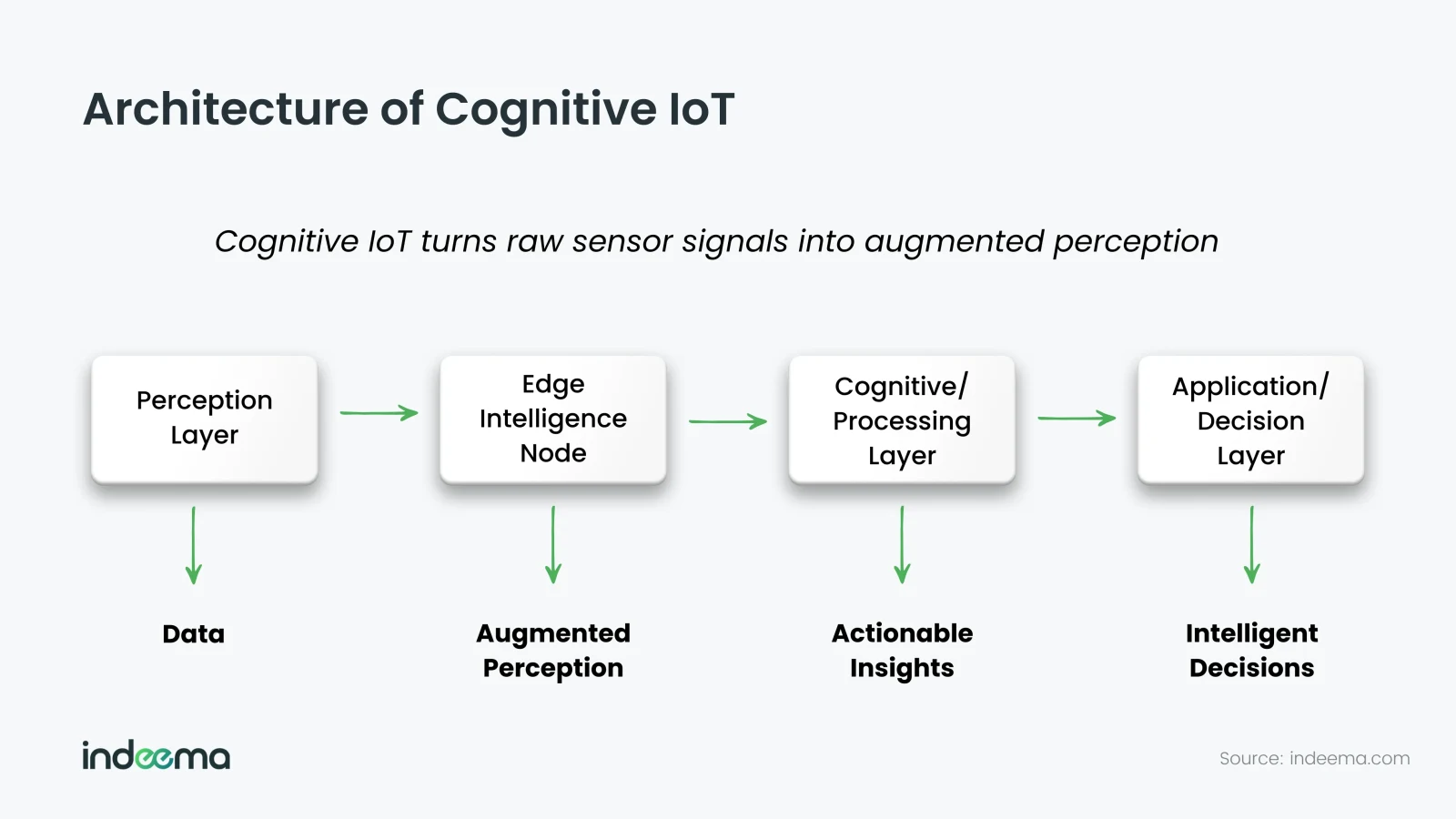
- Perception layer: sensors and actuators that collect data and act on the physical world. Devices may run tiny models on microcontrollers for tasks such as local anomaly detection.
- Edge intelligence layer: gateways, local servers or edge AI appliances on site that aggregate data, run intermediate analytics and turn raw signals into structured information before anything goes to the cloud.
- Cognitive or processing layer: the cloud platform where heavy analytics, model training and central management happen.
- Decision or application layer: turns insights into decisions and automation, and provides dashboards, apps, alerts and APIs for people and other systems.
- SenseDevices collect data and may pre-process it with small on-device models.
- Interpret at the edgeEdge nodes aggregate and analyse data, and can decide locally.
- Learn in the cloudThe cloud trains models on fleet-wide data and orchestrates them.
- DecideThe application layer turns insights into decisions, automation or recommendations.
- ActCommands return to actuators, or alerts go to people.
Results of each action feed back as new data, so models and rules improve over time.
For how to decide which functions belong on the device, at the edge or in the cloud, see edge computing and IoT.
Why cognitive IoT is practical now
- More data from more devices: fleets now produce more data than people can review, which pushes interpretation into the system itself.
- Smaller, more efficient models: TinyML runs compact models on microcontrollers with very little memory, and federated learning lets devices improve a shared model without sending raw data to the cloud.
- AI accelerators: dedicated chips let image, voice and anomaly detection run in a sensor or gateway.
- Better connectivity: where devices still rely on cloud AI, faster mobile networks shorten the round trip for mobile and remote use cases.
- Edge-cloud tooling: cloud providers and industrial vendors offer runtimes and services that distribute work between edge and cloud, which lowers the barrier to entry.
- Regulation and sustainability: stricter reporting on energy, emissions, safety and traceability needs continuous, granular monitoring that AI can help interpret.
Where cognitive IoT is applied
| Application | Signals | What the intelligence adds |
|---|---|---|
| Predictive and prescriptive maintenance | Vibration, temperature, pressure, current | Forecasts when a component will fail and recommends when and how to service it |
| Smart buildings and cities | Occupancy, temperature, air quality, traffic | Adjusts HVAC, lighting and signals dynamically instead of on fixed schedules |
| Energy and utilities | Grid, generation and consumption data | Detects faults, forecasts renewable output and orchestrates storage and charging |
| Industrial automation and robotics | Machine data, vision, positions | Lets robots and vehicles adapt paths and speeds, and tunes process parameters and visual inspection |
| Personalised experiences | Usage patterns from homes, wearables and vehicles | Learns routines and preferences and adapts the device to each user |
In predictive maintenance, for example, a model can learn that a specific vibration pattern precedes a bearing failure, so maintenance is scheduled before the failure instead of after it. We have described turning machine vibration into condition-monitoring views.
Examples from our projects
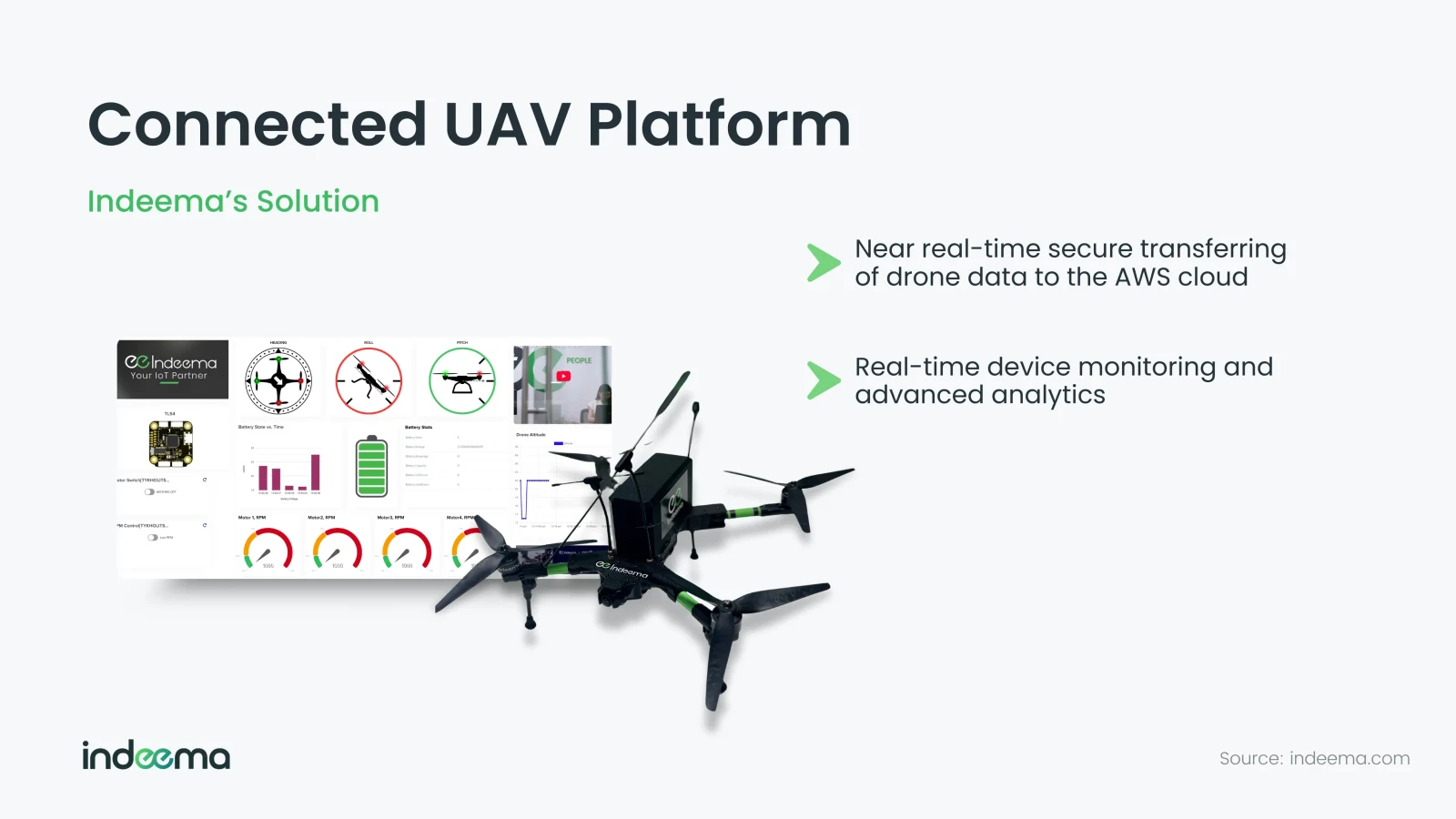
Connected UAV platform. A modular firmware foundation that bridges drones to cloud infrastructure, built with AWS IoT Core, AWS IoT Greengrass, Amazon Kinesis and other AWS services, with secure near real-time transfer of drone data and live device monitoring. The architecture is described in our AWS reference architecture for connected drone operations.
IoMT heart monitoring. A complete monitoring solution with a measurement device, cloud storage, a web portal for doctors and mobile apps for patients.
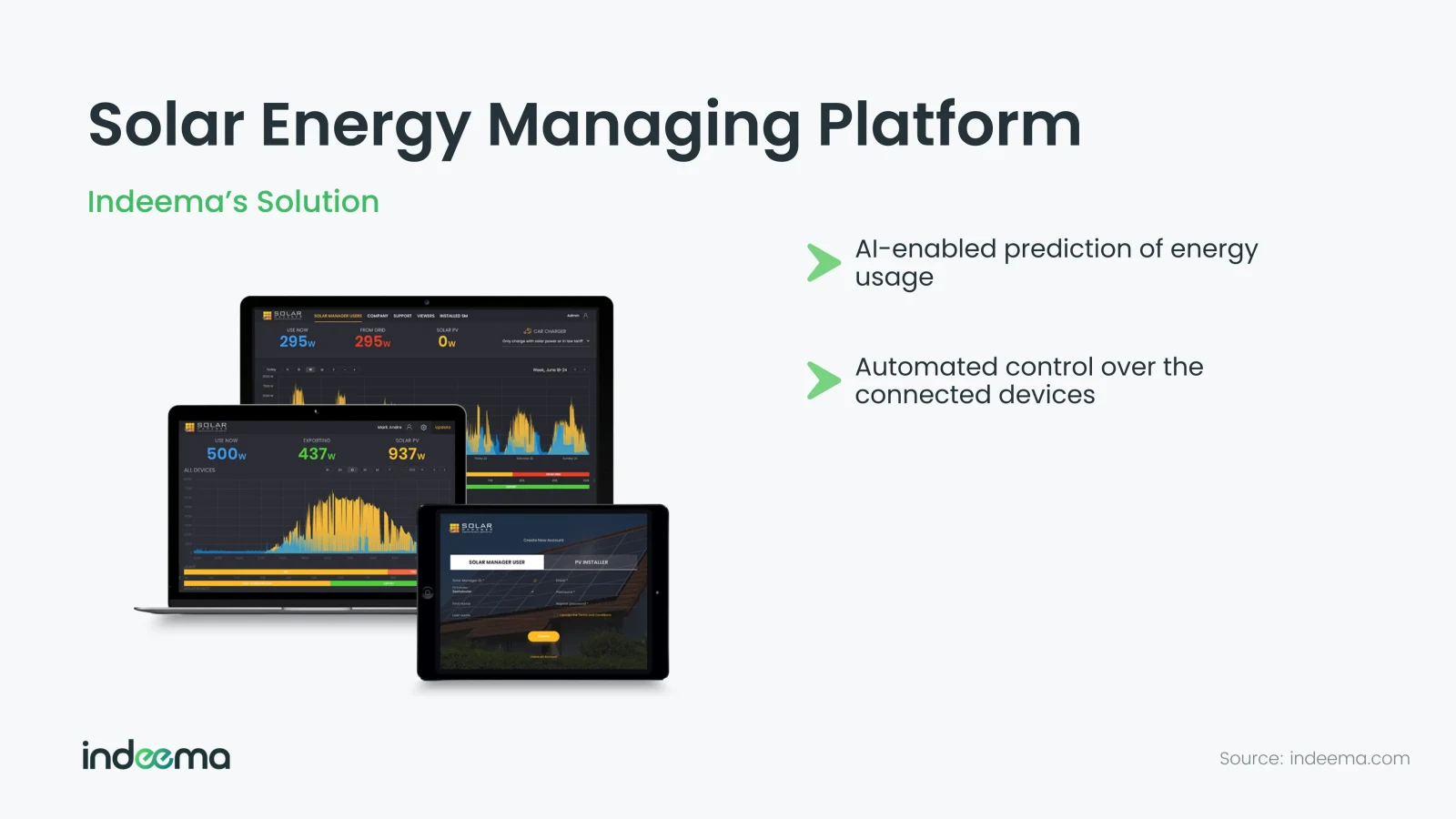
Solar energy management. A cloud-based system for monitoring solar production and consumption and controlling connected devices from one dashboard.
Challenges of implementing cognitive IoT
For organisations adopting it
- Unclear return and stalled pilots: proofs of concept fail to scale when the business case is vague. Start with a narrow task where improvement is easy to measure, such as automating a manual data-logging step.
- Integration with existing systems: OT systems, SCADA, ERPs and data silos rarely fit new sensors and AI platforms cleanly. Gateways that speak older protocols, and even computer vision reading analogue gauges, are common workarounds.
- Data quality and quantity: models are only as good as their data. New deployments may lack history, so plan for calibration, cleaning, pre-trained models or simulated data, and a ramp-up period.
- Security and privacy: every device widens the attack surface, and a system that acts on its own raises the stakes of a compromise. Privacy by design may limit which data can be used.
- Skills and culture: the work needs people who understand OT, IT, data science and the domain, and staff may distrust AI recommendations at first.
For teams building it
- Domain understanding: a predictive model for a factory needs the process and its failure modes; an agriculture system needs agronomy. Data scientists and field engineers have to work closely.
- Model reuse: a model trained on one site's equipment may not transfer to another's. Transfer learning helps, but many projects stay partly custom.
- Interoperability: solutions often have to support Modbus, OPC UA, MQTT, BLE and Zigbee, and run on more than one cloud.
- Security responsibility: device identity, encrypted communication and a secure cloud architecture are required from the start, not added later.
Where cognitive IoT is heading
- More intelligence in everyday devices, as AI chips get cheaper and models smaller.
- Agentic AI, where software agents tune production, order supplies or coordinate loads with less human input, and systems coordinate with each other.
- Language models on top of IoT data, letting engineers query systems in natural language and encoding manuals and procedures into explainable decisions.
- Edge-first designs, where devices act locally and sync with the cloud mainly for learning and coordination.
- Explainability and regulation, with zero-trust security and AI rules favouring systems that are auditable by design.
Engineering trade-offs
Rules vs learned models
- You gain
- Rules are predictable, explainable and need no training data; models handle patterns no one wrote down.
- You pay
- Rules miss new situations; models need data, monitoring for drift and a way to explain decisions.
- Choose it when
- Keep rules for safety limits and known conditions; add models where patterns are too complex or change too often for rules.
Edge inference vs cloud inference
- You gain
- Edge inference responds faster, works offline and keeps raw data local.
- You pay
- It is limited by device compute and power, and models are harder to update across a fleet.
- Choose it when
- Run time-critical or privacy-sensitive inference at the edge; keep training and fleet-wide analysis in the cloud.
Act autonomously vs recommend
- You gain
- Autonomous action removes delay and manual effort.
- You pay
- A wrong autonomous action can be costly or unsafe, and is harder to audit.
- Choose it when
- Automate reversible, low-risk actions; keep a person in the loop for high-impact ones.
Where the intelligence should run
Each placement suits a different kind of decision:
| Device | Response time | Data it sees | Update path | Typical job |
|---|---|---|---|---|
| On-device model (TinyML) | Immediate | One device's raw signals | Firmware or model update over the air | Anomaly detection, wake-word, filtering |
| Edge node or gateway | Fast, local | Several devices on one site | Container or module deployment | Vision, site-level control, data reduction |
| Cloud | Slower, network dependent | Whole fleet and history | Central deployment | Training, fleet analytics, optimisation |
| Application layer | Human pace | Insights, not raw data | Software release | Recommendations, reporting, approvals |
Decision rule: Train centrally, infer as close to the data as the response time requires, and keep high-impact decisions where a person can review them.
Starting a cognitive IoT project
- Pick one decision the system should make or support, and define how improvement will be measured.
- Check that the data exists, is labelled where needed and is good enough; plan calibration and cleaning.
- Decide per decision whether it runs on the device, at the edge or in the cloud.
- Define which actions are automatic and which are recommendations for a person.
- Plan how models are monitored, retrained and rolled back in the field.
- Design device identity and secure communication before connecting anything.
Where we've built this
Our solar energy management work shows the loop at product scale: equipment data flows into a cloud platform, the dashboard shows production, consumption and grid draw together, and connected devices can be controlled from the same place.
Case studyA web service for monitoring and configuring residential solar systemsA connected solar energy management system that monitors production and consumption and controls connected devices from one dashboard, the kind of closed loop this article describes.Was this useful?
Where this shows up in our work
SolutionWhy Cognitive IoT: From Connected Data to DecisionsFor how we turn connected data into decisions inside a product, and when cognitive IoT is worth the investment, see our cognitive IoT approach.Energy assets are where prediction and autonomous response meet hard reliability limits. See Engineering connected products for energy environments.
Apply this to your product