

Expertise / Product engineering
MVP software development services for connected products
Indeema provides minimum viable product development services for software and connected products: MVP consulting, prototyping, proof of concept, development, launch and the path to a full-scale product. When the idea involves a device, the MVP can span hardware, firmware, cloud and the app, with only the risky parts built for real.
Who we are
Minimum viable product development services from an engineering team
Indeema Software is an engineering company with Internet of Things (IoT) expertise, founded in 2010. Our engineers in Lviv, where we run an R&D hub, and in Wrocław work with start-ups and established businesses in Europe and North America on digital transformation and new products in which electronics, embedded software, connectivity, cloud and applications have to work as one system.
That is why our MVP development is not limited to software. A minimum viable product can be a web or mobile application, a connected device with its firmware and app, or a proof of concept that shows a risky technical idea works before anyone commits to the full build.
Why MVP
Why is MVP important?
A well-thought-out MVP is a practical way to estimate your idea’s potential without wasting time and budget. It puts basic functionality and the features that make your product different in front of real users, so you can check whether the product can compete before rolling it out to the market. A working MVP also helps you show investors that the idea is worth bringing to life.
For a connected product, the MVP has a second job: it shows which technical assumptions hold. Can the sensor measure the condition reliably? Does the device stay connected where it is installed? Will users finish setup on their own? Answering those questions with a small system costs far less than changing hardware, firmware and cloud after launch.
Process
Our MVP development process
Six steps, from market research to the first users. For a connected product, the same steps run across the device, the cloud and the app.
Research & Discovery
Before development starts, we research the market to check that the future product meets the target audience’s needs, and look at the competition to see whether the idea can stand out. In parallel, business analysis collects what is needed to select and prioritize the MVP’s features and, for a device, the technical risks to test first.
Idea Validation
Next, we estimate whether the product brings value to people: which problems it solves, how it helps the end user and why people would use it. The assumption the MVP must test, and the result that would confirm or reject it, are written down before MVP software development begins.
Prototyping & UI/UX Design
Once the concept is validated, we create a prototype, an early way to visualize the solution and test ideas before they are fully developed. When your stakeholders approve it, our UI/UX design team designs the interfaces and flows the MVP has to test. For hardware, this stage can include a feasibility prototype on development boards or an existing platform.
Development
Engineers turn the design into a working product: application code and the back end and, for a connected MVP, the firmware, device connectivity and cloud services. Parts the hypothesis does not depend on are simplified, simulated or taken off the shelf.
Testing & Quality Assurance
We test the MVP before it goes live. Testing is often overlooked at this stage, but stable behavior lets early users give feedback on the product and its experience instead of on defects. For devices, tests cover the whole path from the sensor to the app.
MVP Launch
Once the MVP is complete, we collect feedback from the first users, or from the pilot group of devices, and make continuous updates based on it until the evidence is clear enough to decide the next step.
Services
Our custom MVP software development services
A range of custom MVP development services, chosen by where your project is now. Engage us for a single step or from the idea to a full-scale product.
MVP consulting
Help with conceptualizing your idea, deciding the functionality of your MVP and selecting the most suitable technology stack, including which hardware, connectivity and cloud services a connected MVP really needs.
IoT consulting and product discoveryMVP development
End-to-end minimum viable product development, from defining the concept to delivery and support. We build MVPs on an architecture that can later be scaled into a full-fledged product, and record clearly which parts are temporary.
Prototyping
When the goal is to validate the look and flow rather than collect detailed product feedback, a prototype lets users and stakeholders try an interactive visualization of the future solution without spending many resources. For devices, prototypes can also be physical units prepared for testing.
UI/UX design and prototypingProof of concept
A proof of concept shows that your idea can deliver value and that its risky technical part works, such as a drone behavior, a sensing method or a data link, before you invest in the full product.
Hardware developmentMVP improvement
After the first launch, we map out an improvement strategy based on user feedback: enhancing the MVP, reducing its running costs and planning its path to a full product. We also take over MVPs another team built and extend them without a rewrite where that is the sensible choice.
Maintenance and product supportTransforming your MVP into a full-scale product
We guide the move from MVP to full product: prioritizing the customer pain points to solve next, formulating the development roadmap and planning what changes at scale, such as production hardware, certification, device provisioning and operations.
IoT product engineering
Principles
We provide custom MVP services that are
Reliable
We work to reduce the chances of the system going wrong, and agree clear, measurable success criteria with you so the MVP’s results can be assessed objectively.
Cost-effective
Budget goes into what the hypothesis depends on. Everything else is simplified, reused or taken off the shelf, such as an existing hardware platform, development boards or open-source software.
Fast to market
We follow a build-measure-learn approach: make a well-founded assumption, put it into practice with minimal resources, test it, and repeat.
Secure
Device identity, data protection and the update path are designed in from the first build, because they are expensive to retrofit. Time for research and planning goes into risk mitigation.
Carefully planned
Analysis and planning prevent issues that would slow development, and the architecture leaves room for the features the full product will need.
Connected products
Where an MVP fits in a connected product
A connected MVP spans the whole system: device, firmware, connectivity, cloud, data and the interface people use. Not every layer has to be production-grade to test the idea, but some must be right from the first build.
Hardware
What the MVP can simplifyDevelopment boards, an existing hardware platform or off-the-shelf devices instead of custom electronics
What should be right from the first buildSensor choice and placement, when the measurement is what the MVP must prove
Firmware
What the MVP can simplifyOpen-source or reference stacks, fixed settings and manual provisioning
What should be right from the first buildA safe update path and a versioned protocol between device and app
Connectivity
What the MVP can simplifyOne connection method, in the conditions of the pilot site
What should be right from the first buildSecure transport and defined behavior when the link drops
Cloud
What the MVP can simplifyManaged or serverless services and manual back-office steps
What should be right from the first buildDevice identity, certificates and a data model you will not have to migrate
Data and AI
What the MVP can simplifyRules and thresholds instead of trained models, while the MVP collects the data a model would need
What should be right from the first buildData ownership, consent and a record of what each device measured
App and interface
What the MVP can simplifyOne platform, or one cross-platform codebase, and only the flows the hypothesis needs
What should be right from the first buildSetup and the core task, tested with real users
When the product will add intelligence, read AI for IoT systems. For the device side, see hardware development and firmware; for the back end, cloud software development.
Who it is for
We offer MVP as a service for
Start-ups
Founders with an idea and perhaps a rough architecture who need a working MVP or a proof of concept to test the market or show investors. Market analysis and planning come first, so the idea is adapted to the target audience’s needs.
Enterprises
Established businesses testing a new product line or building connected devices for the first time, where enterprise requirements such as security, integration and production provisioning shape the MVP from the start.
Small & medium businesses
Teams that need an MVP delivered with focused scope and investment, or an existing MVP extended with the features users now ask for.
Decisions
MVP decisions to settle before scope is fixed
Within a connected product, the MVP is one stage of a single system, not a standalone deliverable. These are the questions to settle first.
State the hypothesis first
An MVP tests a specific assumption: users will adopt it, a sensor can measure the condition reliably, or a workflow saves time. Write the assumption and the evidence that would confirm or reject it before deciding what to build.
Choose the thinnest slice across the system
A connected MVP spans hardware, firmware, connectivity, cloud and an application. Decide which layers are prototype-grade, which must be production-grade from the start (security, data ownership, update path) and which are simulated.
Separate what is throw-away from what is foundation
Development boards and manual back-office steps are acceptable in a pilot. Data models, device identity and update mechanisms are expensive to change later. Mark each element as disposable or foundational.
Plan the pilot, not only the build
Decide how many devices, which users, for how long and how issues will be captured. Define the success threshold in advance so the pilot ends in a decision.
Know the path beyond the MVP
List what changes for volume production: certification, manufacturing, support and operations. Recording these as open items keeps the MVP honest about what it does not yet prove.
The rest of the stack
- IoT Hardware Development Electronics from feasibility prototype to production boards.
- Embedded & Firmware The device software, its update path and the protocol to the app.
- Cloud & Connected Systems Device identity, data and the services the app talks to.
- Applications & Experience The mobile and web apps people use with the device.
Case studies
MVPs, prototypes and proofs of concept Indeema has engineered
Five projects described on our case pages, from a first proof of concept to extending an existing MVP. Client names and figures are not shown here.
MVP · Firmware · iOS and Android · Web
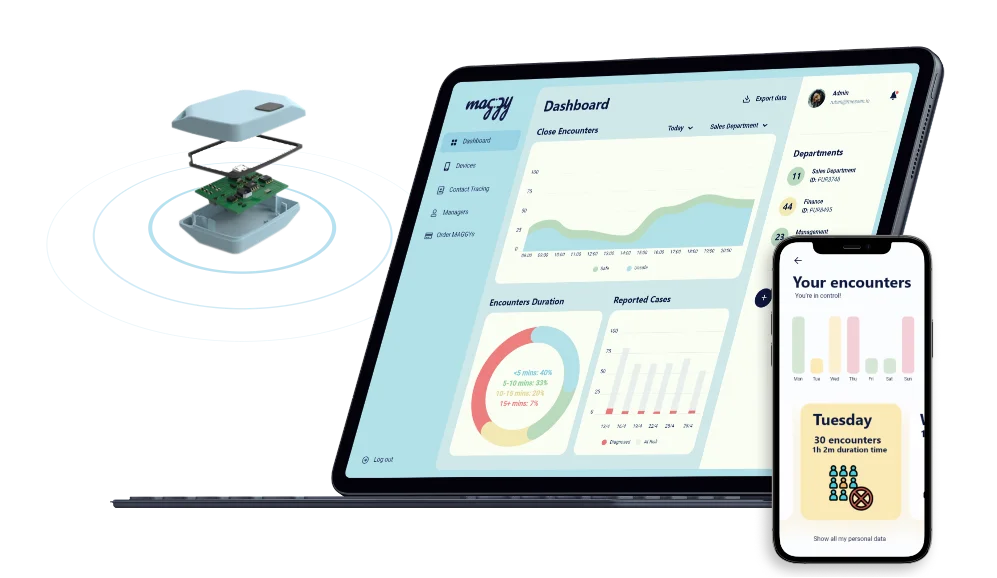
Connected wearable MVP
From only a rough hardware architecture to a working MVP: proximity firmware for a Bluetooth wearable with adjustable sensitivity, iOS and Android apps, a web app with a dashboard of close-contact events and an integration API. A specification phase removed risks first, so the short schedule went into building.
A Bluetooth proximity wearable MVP with mobile apps and a dashboard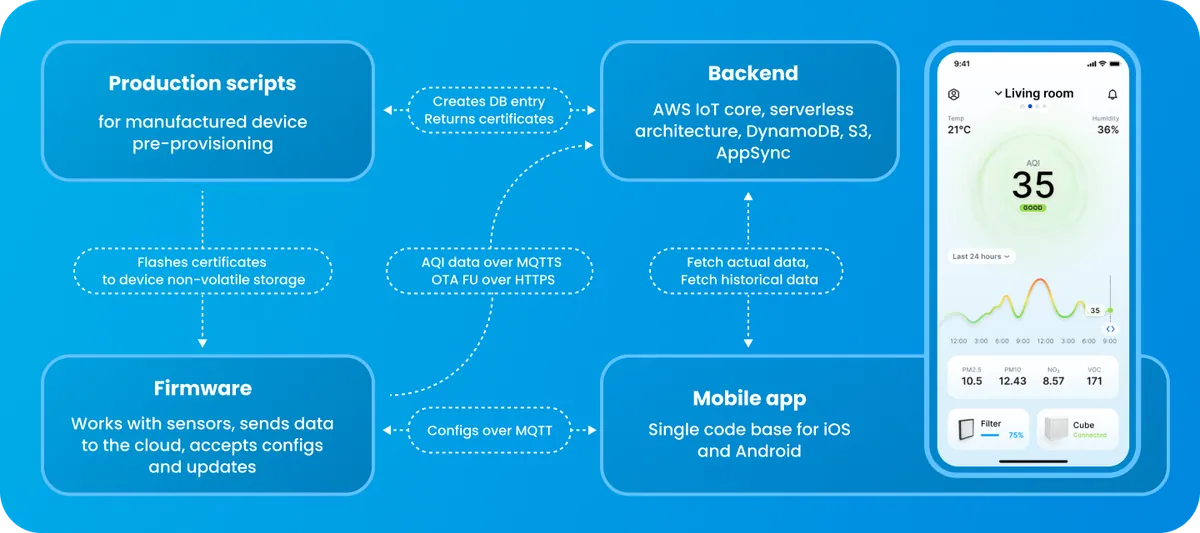
Prototypes · Two device generations · Beta testing
Air monitor across two prototype generations
Sensor selection, ESP-IDF firmware, a serverless AWS back end and a Flutter app, delivered as two prototype generations, a unit inside an air purifier and a desktop unit, prepared for beta testing, with production scripts that provision each manufactured device.
Building an indoor air monitor and companion app across two device generations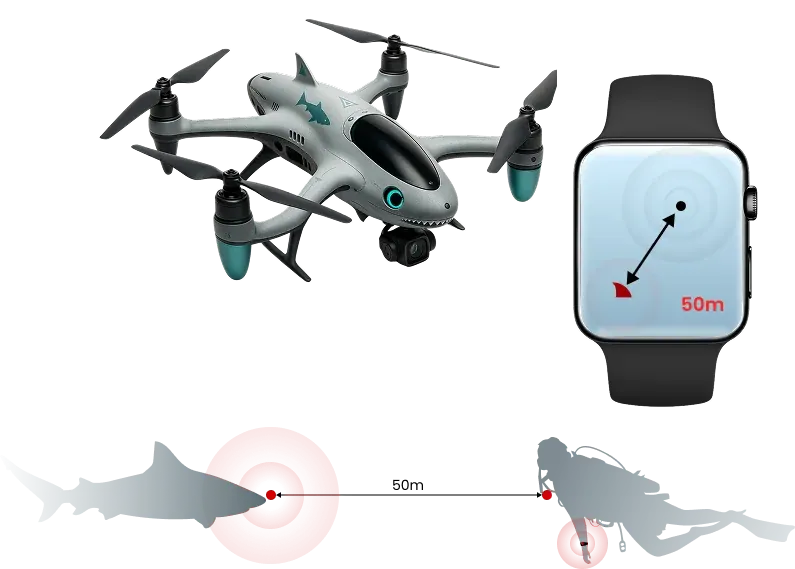
Proof of concept · Existing hardware platform
Companion-drone proof of concept
A proof of concept built on an existing drone platform with open-source flight software instead of custom firmware. It tested follow-me behavior, on-board detection in a controlled scenario and alerts to wristbands and an iOS app, and ended with a plan for the next stages.
Proving a follow-me alert drone concept with wristband and phone alertsSchematic design · PCB design · Board bring-up
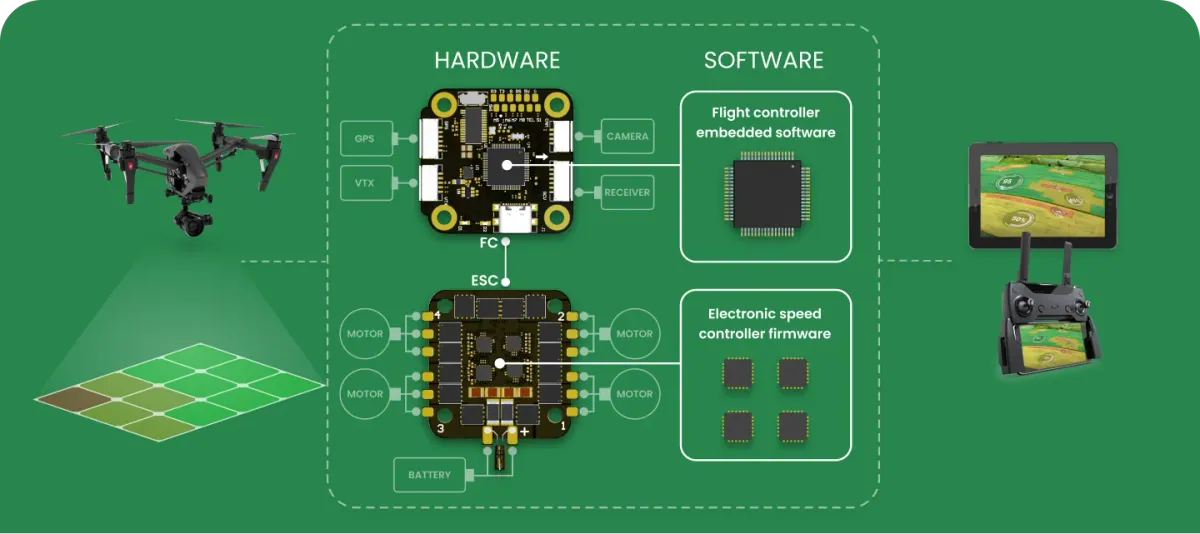
Flight electronics from concept to boards
A drone concept with no requirements or schematics became flight-controller and ESC boards: requirements, prototypes of the non-trivial parts before layout, schematic and PCB design, contract manufacturing and iterative bring-up with open-source firmware.
Flight-controller and ESC electronics for a 7-inch drone flight stack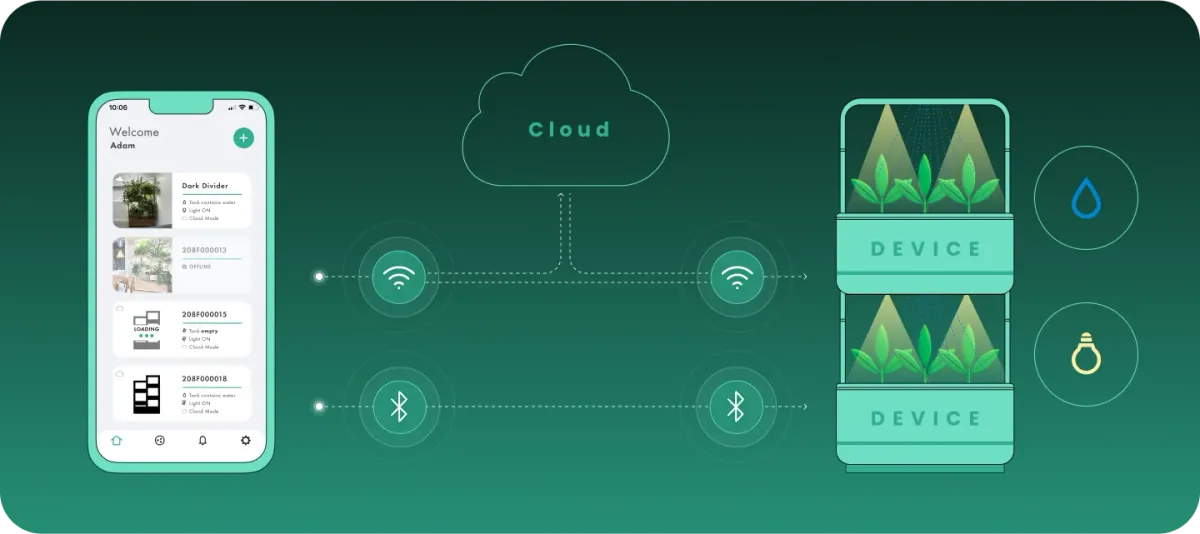
Existing MVP · Flutter · Bluetooth
Extending an MVP device app
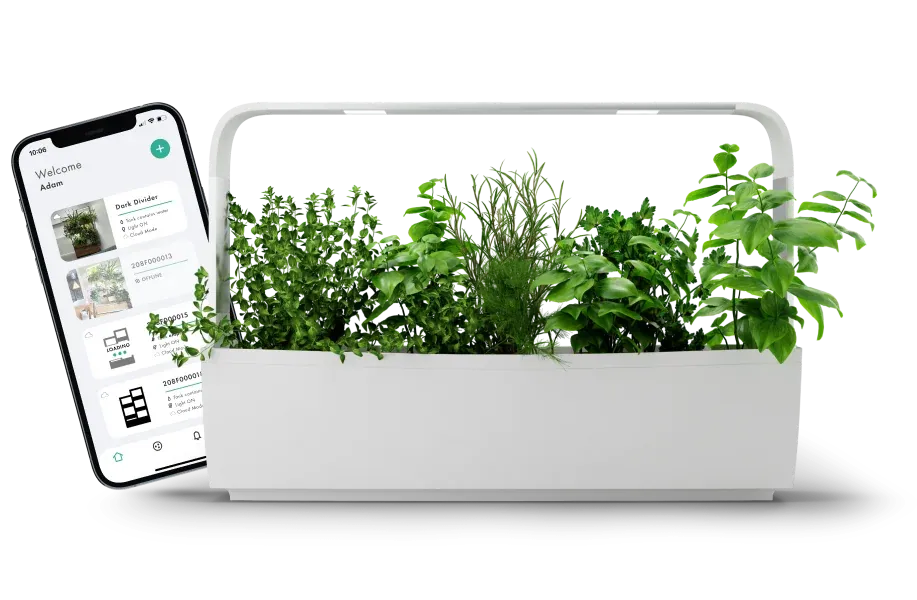
An existing Flutter MVP that controls irrigation and lighting units gained Bluetooth setup and control, firmware updates over Bluetooth and better logs and notifications. A full rewrite was judged unnecessary at MVP stage, so the codebase was extended and a later overhaul planned.
Adding Bluetooth setup and OTA updates to an indoor plant-care control app
Related engineering insights
- Starting an IoT project From the idea to a proof of concept, a prototype and a validated product plan.
- How much does an IoT solution cost? The cost drivers behind hardware, firmware, cloud and apps.
FAQ
MVP development questions
How long does it take to develop MVP software?
It depends on the type of MVP, its complexity, how much research is needed and your budget. A software-only MVP with a few core flows moves faster than a connected MVP that needs hardware, firmware, cloud and an app, and custom electronics take longer than development boards. We give a timeline after discovery, once the hypothesis and scope are fixed.
How to choose a reliable MVP software development company?
Start with the list of services each company offers to see whether it can cover your needs, including hardware and firmware if your product has a device. Then read its case studies to check whether its experience matches your project, and ask how it decides what the MVP will and will not prove.
What is the difference between an MVP and a prototype?
A prototype is a lightweight early version without full features, used to test basic ideas and assumptions behind the product quickly. An MVP is a usable product version with a single core feature or a set of features, suitable for testing with real users in real conditions.
What is the difference between an MVP and a proof of concept?
A proof of concept answers a technical question: can this be done? It may never reach a user. An MVP answers a market question: will people use the product and value it? Connected products often need both, first a proof of concept for the risky technical part, then an MVP for the product.
Can an MVP include hardware and firmware, not only software?
Yes. A connected MVP can include the device, its firmware, connectivity, a cloud back end and the apps. Our case pages include a Bluetooth wearable MVP with firmware, mobile and web apps, and air-monitor prototypes in two device generations. Where possible we start on development boards or existing hardware.
Do you build MVPs for start-ups?
Yes. Several of our case pages describe start-ups that came with an idea and little else: a product concept, a rough hardware architecture or a vision without a specification. We start with discovery and a specification, then build the MVP or proof of concept that tests the idea.
Can you take over and improve an existing MVP?
Yes. We start with a code and architecture review, then decide with you whether to extend, refactor or rebuild. On one project we added Bluetooth control and firmware updates to an existing MVP app instead of rewriting it, and planned the larger overhaul for later.
How much does MVP development cost?
Cost follows scope: the number of flows the MVP must test, whether it needs custom hardware or off-the-shelf devices, the cloud services involved and the platforms the app must support. We estimate after discovery; our article on IoT solution costs explains the main drivers.
Tell us about your project
Start with the assumption your MVP has to prove
A first conversation covers the hypothesis, the riskiest part of the system and what the pilot should show, not a technology pitch.
Bring us
- Your idea and the problem it solves
- What already exists: designs, hardware, code or an earlier MVP
- Who the first users are and how you will reach them
- The decision the MVP should let you make
Related services
- IoT consulting and product discovery When the idea needs shaping before an MVP is scoped.
- UI/UX design When the MVP has to be prototyped and tested with users first.
- IoT product engineering When the MVP becomes a full connected product.
- Maintenance and product support When the launched MVP needs updates and support.