


Solar energy / PV monitoring and AI forecasting
Web service for monitoring, forecasting and managing photovoltaic systemsWeb service, device connectivity, AI forecasting and UX, delivered with LLM-assisted engineering
A web service for monitoring and configuring residential solar systems
Solar Manager was a start-up building a service to monitor and manage photovoltaic (PV) systems. Its product helps users see how much solar energy they produce and consume, and decide where it goes. The service launched in October 2018, and every installation connected to it has been adding to a growing history of production data ever since.
Users needed to see production, consumption, export and import, and to configure how solar energy is distributed across their devices. Installers and support staff needed role-based access and a way to update PV system configurations and device software without site visits. As the data accumulated, the service also needed to look ahead: to estimate how much energy each installation is likely to produce, so that consumption can be planned rather than only observed.
- Product
- Web service for monitoring, forecasting and managing photovoltaic systems
- Buyer
- Solar and energy-management product companies serving homeowners and PV installers
- Engagement
- Web service, device connectivity, AI forecasting and UX, delivered with LLM-assisted engineering
- Indeema scope
- Web service, Device connection, Energy-usage configuration, AI production forecasting, UX/UI design, LLM-assisted engineering
The product need
What had to become possible
Users needed to see production, consumption, export and import, and to configure how solar energy is distributed across their devices. Installers and support staff needed role-based access and a way to update PV system configurations and device software without site visits. As the data accumulated, the service also needed to look ahead: to estimate how much energy each installation is likely to produce, so that consumption can be planned rather than only observed.
Ownership, made clear
Where the work started and what Indeema owned
Starting system
Solar Manager devices
The solution connects the embedded devices installed with each PV system to the Solar Manager service.
Product concept
The start-up defined the service: monitoring PV production and consumption and setting how solar energy is distributed.
Indeema owned
Web service
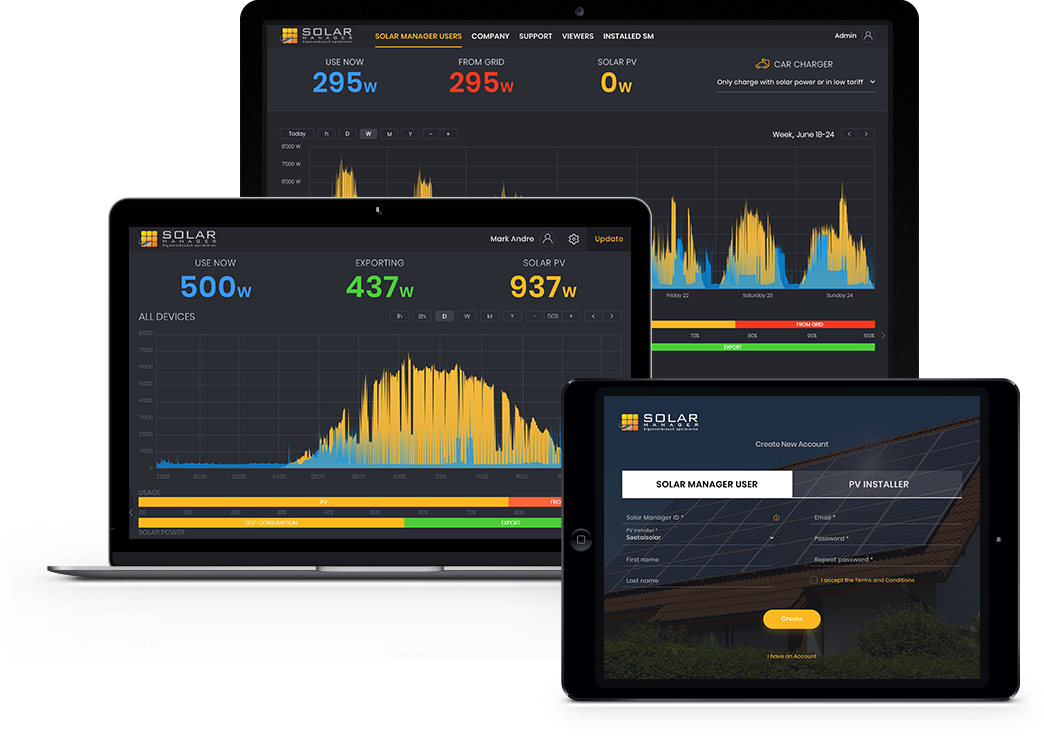
Build the Solar Manager web application with a real-time dashboard for production, consumption, export and import, plus account types with their own settings, permissions and access levels for users, installers and support staff.
Device connection
Provide a simple way to connect the embedded devices to the service and to roll out new device firmware from the user interface.
Energy-usage configuration
Let users set active hours and limits and choose how solar energy is distributed.
AI production forecasting
Collect production analytics over time and combine each installation's history with weather forecasts in an AI model that predicts upcoming PV output.
UX/UI design
Design an interface that groups and highlights the information users need most.
LLM-assisted engineering
Use LLM coding assistants as part of the team's everyday programming workflow, with engineers owning design, review and testing of every change.
Worked with
AWS IoT
Device data travels between the local installation and the cloud through AWS IoT.
Weather forecasts
Weather forecast data feeds the production model alongside each installation's measured history.
Real-time streaming
Socket.io streams live energy data to the dashboard.
Charting
Highcharts renders production, consumption, export and import over time.
Product constraints
What made the engineering difficult
- 01
Connecting devices easily
Device-to-service connection had to be simple for the people installing and using the system.
- 02
Cloud-local communication
Data had to be stored and moved between the local devices and the cloud.
- 03
Forecasting each installation
PV output depends on the installation as much as on the weather, so the forecast had to learn from each site's own production history, not from a generic solar curve.
- 04
Readable energy data
The interface had to stay simple while presenting several energy flows in real time.
- 05
Roles and calculations
The service had to administer users across roles and calculate the relevant energy values.
- 06
Privacy
Energy data had to be encrypted to protect user privacy.
Engineering judgement
Decisions that shaped the product
Treat the data history as a model input
Production analytics collected over time are paired with weather forecasts, so the AI prediction reflects how each installation actually performs.
Stream live values to the browser
Socket.io pushes energy readings to the dashboard so users see current production and consumption.
Model access by role
Account types with their own settings and permissions separate what end users, installers and support staff can see and change.
Update devices from the UI
Firmware rollout to the connected devices is started from the web interface rather than on site.
Put LLMs in the engineering loop
LLM coding assistants speed up implementation, refactoring and test writing, while review and the test suite remain the quality gate.
Product system
How the product moves from signal to user
- 01
PV system and household devices
The installation produces solar energy and consumes or exports it.
- 02
Solar Manager device
Embedded devices at the site are connected to the service and report energy data.
- 03
AWS IoT cloud
Data moves between the local installation and the cloud and is stored for the service.
- 04
AI forecasting
Each installation's production history and weather forecasts feed a model that predicts upcoming PV output.
- 05
Web service
Real-time dashboard, production forecast, energy-distribution settings, roles and device updates.
Delivered product capability
What the product can do
- 01
Real-time energy dashboard
View current and historical production, consumption, export and import.
- 02
AI production forecast
Predict upcoming PV production for each installation from its history and the weather forecast, so consumption can be planned ahead.
- 03
Automatic trend calculation
Calculate energy statistics and trends for each installation.
- 04
Energy distribution settings
Set active hours and limits and choose how solar energy is distributed.
- 05
Roles and permissions
Give user types different access levels for monitoring, support and configuration.
- 06
Device updates through the UI
Push new firmware to connected devices from the web interface.
Product change
What changed for the product team
Solar Manager moved from a product concept to a web service that streams PV production, consumption, export and import in real time and uses AI to forecast what each installation will produce next, based on its accumulated data and weather forecasts. Users set how solar energy is used, and installers and support staff work with role-based access and remote device updates. LLM-assisted development made the delivery team about 20% more efficient.
For a solar or energy-management company, the case shows how a connected device fleet, cloud messaging and a role-based web service become the data foundation for AI: once production history is collected reliably, it can be combined with weather forecasts to predict output, not just report it.
- Users can see PV production, consumption, export and import in real time and set how solar energy is distributed.
- AI forecasts upcoming PV production for each installation from its accumulated data and weather forecasts.
- Installers and support staff work in role-based accounts and can update device firmware from the web interface.
- Since its launch in October 2018, the service has been used by leading photovoltaic wholesalers and installers in Europe.
- Measured efficiency gain from LLM-assisted engineering
- +20 % During the engagement · Measured by Indeema across its engineering work on this project
Technology, in context
JavaScript · React · Redux · RxJS · Socket.io · Highcharts · HammerJS · Moment.js · i18next · Sass · Webpack · ESLint · Jest · Enzyme · Strapi SDK · Node.js · C++ · AWS IoT · Machine learning (time-series forecasting) · Weather forecast data · LLM coding assistants
Indeema Software employs a team of hardworking and organized development experts. Their responsiveness spurred continued engagement. I appreciate their commitment to searching for solutions and making the client happy.
A comparable product problem?
Solar Manager: PV monitoring with AI production forecasting
Bring the product context, the system that already exists and the engineering decision you need to make.