


Insights / Drones & UAV
A Reference Architecture for Connected Drone Operations, Built with AWS
The middle mile between drone and dashboard, and an AWS reference architecture for intermittent links, bandwidth cost, firmware integrity and model drift.

The short answer
Connecting a drone fleet is not a simple data pipe. Between the airframe and the dashboard sits a middle mile that has to survive dropped links, keep commands intact, track each drone's last known state and prove that only signed firmware runs on every aircraft. Our reference architecture handles this on AWS with offline-first edge logic (AWS IoT Greengrass and Device Shadow), filtering at the edge so only actionable data is sent, a signed update chain for firmware and AI models, and a closed retraining loop for the onboard models. It is a white-box design: the OEM owns the code, the cloud account and the data.
Key takeaways
- Treat drone connectivity as a distributed system, not a feature you code in a sprint.
- Design for the link being down: cache on the drone, keep a shadow state in the cloud, reconcile on reconnect.
- Send decisions, not raw streams: detect at the edge and transmit the frame and metadata that matter.
- Firmware and model updates should share one signed channel, and the drone should reject anything unsigned.
- Owning the architecture keeps data sovereignty and integration options with the OEM.

Why connectivity stalls drone roadmaps
Drone OEMs have pushed airframes and flight control a long way. The software ecosystem around them often lags. As data-sovereignty requirements and restrictions on some foreign suppliers push operators towards new vendors, many manufacturers try to build that whole ecosystem themselves.
The pattern is familiar. The team treats connectivity as a commodity, a pipe it can code in a few sprints. Two or three iterations later it realises the "simple feature" is a high-concurrency distributed system, and months go into synchronisation bugs instead of mission features.
The anatomy of drone data flow
Every connected drone operation has three stages, and most failures happen in the one in the middle.
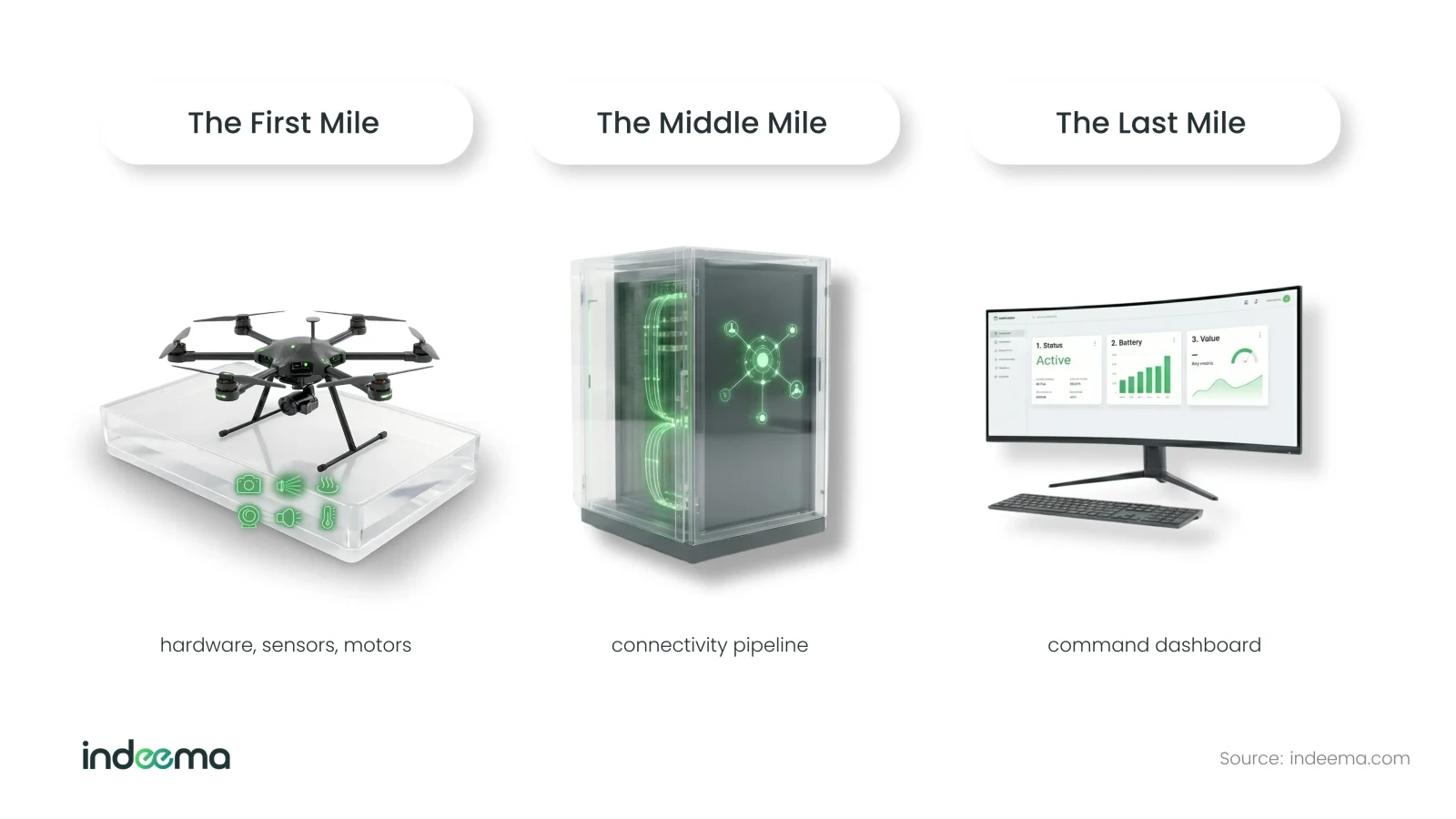
- First mile: the physical edge. Airframe, sensors, motors and the autopilot, where data is generated and commands are carried out.
- Middle mile: infrastructure and logic. Transport, security and state management that connect high-frequency drone data with what operators need.
- Last mile: user value. Command dashboards, mission reports and alerts that drive decisions.
- Middle mile (drone operations)
- The layer between the drone and the operator's applications that moves data, enforces security and keeps the drone's state consistent across unreliable links.
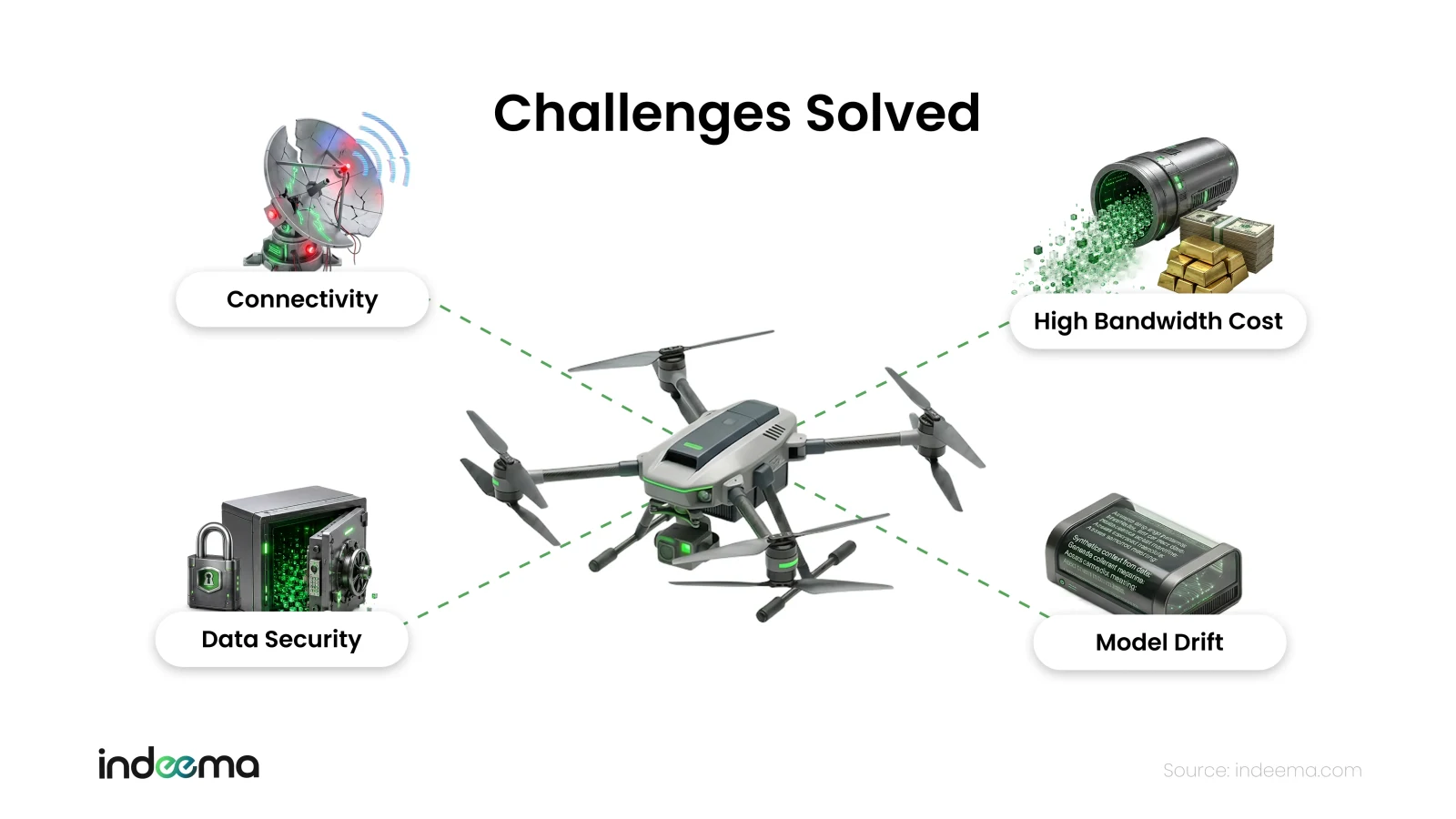
The middle mile is a high-entropy environment: network drops, fluctuating latency and the risk of the edge and cloud disagreeing about state. Three problems dominate it:
- Command integrity: a control message from the dashboard must arrive and run uncorrupted and in order, even over asynchronous links.
- Security and firmware integrity: the drone must ignore unauthorised commands and run only trusted firmware, keeping a chain of trust from cloud to edge.
- State synchronisation: the system must know each drone's last recorded state and catch up correctly when a drone flies into an RF shadow and reappears.
A white-box reference architecture on AWS
Off-the-shelf drone platforms exist, but they usually work as black boxes: the OEM joins their ecosystem, pays their licence and has limited visibility of its own data. We designed the connectivity layer as a white-box reference architecture built natively on AWS instead.
- Data sovereignty: the OEM owns and can see the whole data flow from drone to cloud, deployed in its own or its client's AWS account and VPC.
- Architectural flexibility: the code can be extended for mission-specific computer vision or custom telemetry protocols.
- Cloud-native resilience: scaling, multi-region recovery and security services come from the AWS platform.
- Serverless operation: AWS IoT Core and AWS Lambda remove server management, and the infrastructure scales with the fleet.
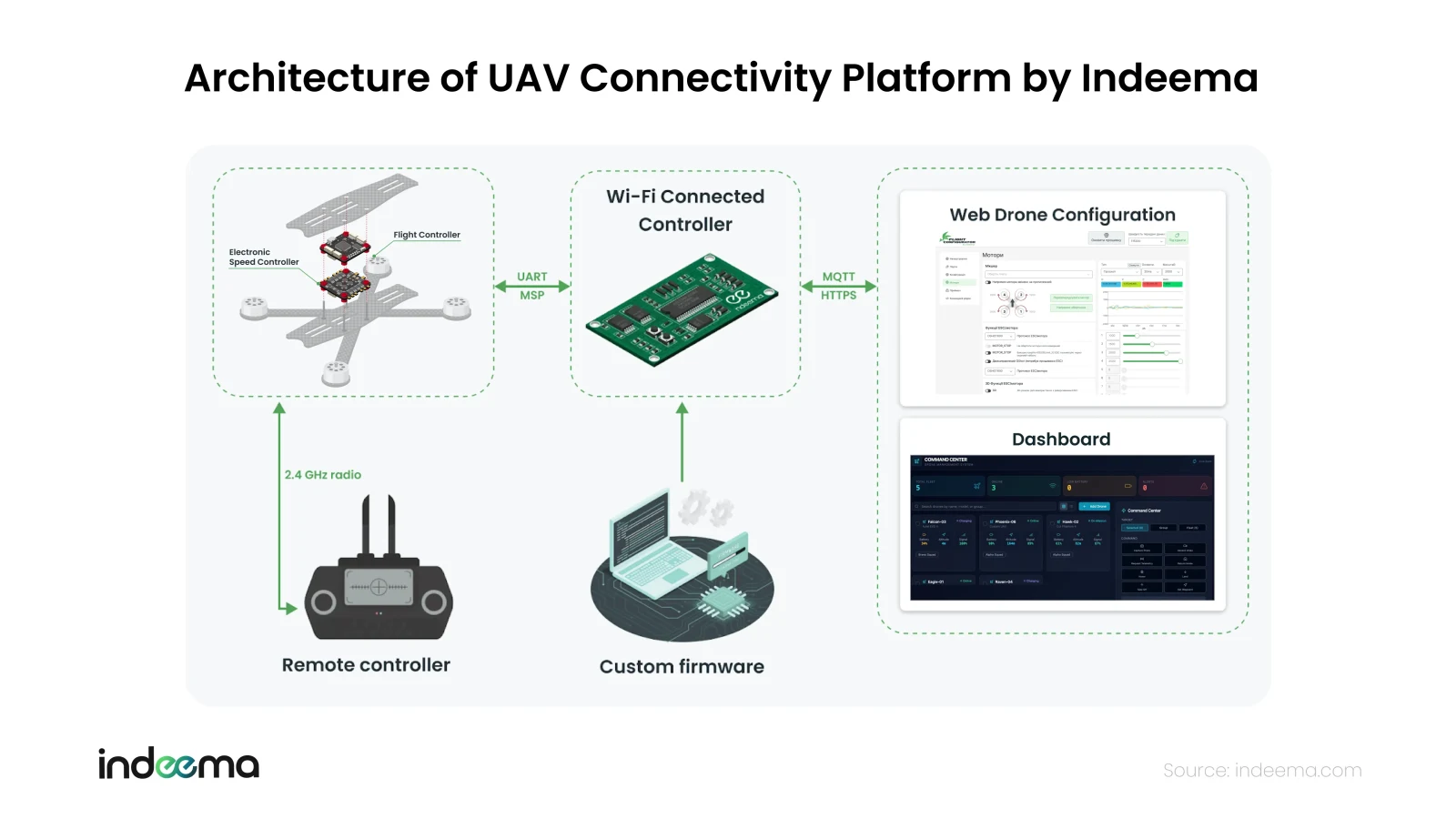
The architecture is hardware-agnostic at the edge. In the platform build shown below, the flight controller and ESC talk to a Wi-Fi connected controller over UART using MSP; the controller runs custom firmware and connects over MQTT and HTTPS to a web configuration tool and a command dashboard, while a 2.4 GHz remote controller keeps direct manual control.
- Detect at the edgeThe companion computer runs detection locally and keeps only actionable events, plus the relevant frame and metadata.
- Cache when offlineAWS IoT Greengrass on the drone acts as a local message broker and buffers telemetry while the link is down.
- Connect with identityThe drone connects to AWS IoT Core over TLS with its own X.509 certificate; unauthenticated devices and commands are rejected.
- Reconcile stateAWS IoT Device Shadow keeps the last known state in the cloud; on reconnection the drone and shadow reconcile automatically.
- Retrain on doubtLow-confidence images go to the cloud, a foundation model on Amazon Bedrock proposes labels, and Amazon SageMaker retrains the model.
- Ship signed updatesFirmware and models are signed with AWS Signer and delivered through AWS IoT Device Management; the drone installs only what carries a valid signature.
Field data feeds retraining, and new models return to the fleet through the same signed channel as firmware.
How the architecture handles four UAV challenges
1. Intermittent links: offline-first logic
Drones often fly in noisy RF environments, through signal shadows and across tower handovers. In a conventional design that means telemetry gaps, lost commands and drones the dashboard can no longer track. Here the drone caches locally, the cloud keeps a shadow of its state, and reconnection triggers reconciliation, so the operator sees a continuous record instead of a gap.
2. Bandwidth cost: filtering at the edge
Streaming raw high-definition sensor data over cellular or satellite links is expensive, and most of it is routine "system normal" traffic. Moving the intelligence to the edge inverts the model: the drone identifies an anomaly locally and transmits only the relevant frame and metadata. That keeps the link free for command traffic.
- High-performance builds: NVIDIA Jetson modules for parallel processing and heavier models.
- Efficiency builds: a Raspberry Pi on its own for lightweight monitoring, or paired with a Hailo-8 AI accelerator for edge inference at low power on long-endurance missions.
3. Data security and drone firmware integrity
OEMs increasingly have to show that their fleets are not compromised and do not route data to servers outside their control. Provisioning X.509 certificates by hand for every aircraft becomes a manufacturing bottleneck, and without a root of trust the firmware is open to unauthorised changes or man-in-the-middle attacks. In this architecture every firmware version is signed in the OEM's AWS environment, and the drone rejects any package whose signature does not match. Device identity and provisioning run through AWS IoT Device Management.
4. Model drift: closed-loop AI updates
Detection and navigation models drift as environments change, and updating hundreds of drones by hand grounds a programme. When the onboard model meets an image it is unsure about, it uploads it; a foundation model labels it, SageMaker retrains, and the new model is pushed over the air as a signed update. No unit has to return to base for the fleet's models to improve.
Because the architecture is built on AWS IoT Core, it can also sit under partner device-management and visualisation layers built on the same services, for OEMs that want an enterprise management tier on top.
Two edge configurations, one architecture
The middle mile should not dictate hardware. We demonstrated the platform at CES with two edge builds on the same software foundation: a Raspberry Pi with a Hailo-8 accelerator for efficiency, and NVIDIA Jetson for heavier workloads. The same reference architecture can then serve use cases from precision agriculture to livestock monitoring.
Engineering trade-offs
White-box architecture vs hosted drone platform
- You gain
- Ownership of data, code and keys, and freedom to integrate and extend.
- You pay
- The OEM or its partner runs and evolves the stack, rather than a vendor.
- Choose it when
- When data sovereignty, compliance or deep enterprise integration are product requirements.
NVIDIA Jetson vs Raspberry Pi with a Hailo-8 accelerator
- You gain
- Jetson gives more headroom and a mature GPU toolchain; the Pi and Hailo-8 build is cheaper and draws less power.
- You pay
- Jetson costs more in power, weight and price; the Pi build limits model size and depends on the accelerator's toolchain.
- Choose it when
- Jetson for heavier autonomy; Pi and Hailo-8 for long-endurance or cost-sensitive missions.
Build the middle mile vs start from a reference architecture
- You gain
- A reference architecture lets the team start from solved structural problems and spend time on mission features.
- You pay
- Its patterns and service choices become your starting assumptions.
- Choose it when
- Start from a reference when the differentiator is the mission, not the transport and state layer.
Where a white-box architecture fits
Three operating profiles where owning the middle mile matters more than the convenience of a hosted platform.
| Device | Main constraint | What the architecture provides | Deployment |
|---|---|---|---|
| Compliance-first drone OEM | Auditable, sovereign data handling for high-security markets | Full ownership of code, data flow and signing keys | The OEM's or its client's private AWS VPC |
| Enterprise system integrator | Drone data has to flow into ERP and asset systems such as SAP, Oracle or IBM Maximo | Open APIs and data schema instead of a walled dashboard | Alongside the client's existing enterprise stack |
| Operator in denied or remote environments | Connectivity that is absent, intermittent or jammed: mines, offshore sites, remote farmland | Edge intelligence and local shadowing that keep the mission useful offline | Edge-heavy, with the cloud used when the link returns |
Decision rule: Use a hosted platform when speed matters more than ownership; adopt or build a white-box middle mile when sovereignty, deep integration or offline operation are requirements.
Before you connect a drone fleet
Decisions to make before the first production aircraft ships:
- Define which state must survive a lost link on the drone, and which lives in the cloud shadow.
- Decide what the drone sends live and what it filters at the edge.
- Plan per-device certificates and automated provisioning at manufacturing.
- Set up firmware and model signing, with keys kept in the OEM's controlled environment.
- Choose the edge compute per mission profile, not once for the whole fleet.
- Map where drone data must land in the operator's existing systems.
Common mistakes
Treating connectivity as a pipe
The team ends up debugging synchronisation and lost commands instead of shipping features.
Instead: Design state, ordering and reconnection behaviour up front.
Streaming everything to the cloud
Link costs rise and command traffic competes with routine telemetry.
Instead: Filter at the edge and send events with context.
Separate update paths for firmware and models
One path ends up unsigned or untested, and the chain of trust breaks.
Instead: Ship both through one signed over-the-air channel.
Where we've built this
Case studyFlight-controller and ESC electronics for a 7-inch drone flight stackCustom flight controller and ESC boards for 7-inch drones: the first-mile hardware a connectivity architecture like this one links to the cloud.Was this useful?
Where this shows up in our work
ExpertiseCloud engineering for the systems behind connected productsDesigning the cloud side of a drone fleet, from device identity and shadow state to signed updates and data pipelines, is cloud engineering we do together with our firmware team.For how this architecture fits into full drone programmes, from flight stack to fleet operations, see UAV and drone systems engineering.
Apply this to your product
Talk through your drone system
Sources
- AWS IoT Greengrass accessed 1 October 2026
- AWS IoT Device Shadow service accessed 1 October 2026