


Expertise / Research & development
Research and development services for hardware and software products
Research and development services from Indeema help you find out what is worth building, and how, before the investment becomes expensive. Hardware and software research, a proof of concept, a prototype and a specification turn an idea or a changed market into a product decision you can act on.
Overview
R&D services before the build
Indeema R&D services help you get ahead in the market, satisfy your end users and spend your budget where it matters. The future of a product is defined not only by software development but also by thorough research: what the market needs, what users will do, and which technology can actually deliver it.
Much of our software R&D sits next to hardware. A connected product combines electronics, firmware, a cloud back end and apps, and the riskiest assumptions often sit between them: whether a chip can handle a video stream, whether a sensor sees the signal that matters, whether a drone can follow a user. Hardware and software research tests those assumptions early, while a change still costs little.
Why Indeema
Why choose Indeema Software
Indeema Software is a research and development company for software and connected products. We treat research as the key stage of development, because it decides what the rest of the work will be.
Open discussion
Assumptions, risks and findings are shared as they appear, including the ones that question the original idea.
Personal approach
Each R&D phase is shaped around your question, your existing product or team, and the decision you need to make next.
Managed workflow and processes
Stages, deliverables and reviews are agreed up front, so research stays a bounded piece of work with a clear output.
Engineers across hardware and software
Researchers come from the disciplines the question needs: electronics, firmware, cloud, apps, data and UX.
Ways we cooperate
Two ways of our cooperation in research & development
In both cases the discovery phase is the foundation of the project: you find out which solution fits your product and get a realistic picture of the results you can expect.
Where you start
A new product idea: You have an idea for a hardware or software product, but not yet the technology choice, the concept or the list of challenges.
An existing product: You have a product or a technology background, but the market has changed and the product needs to change with it.
What is missing
A new product idea: Expertise to choose the most suitable technology, develop the concept and foresee the challenges and details.
An existing product: Evidence for which adjustments are possible, what they cost and how they fit the existing system.
What R&D answers
A new product idea: Is the idea feasible, with which technology and within what budget?
An existing product: Which change is worth making, and can the current hardware and software support it?
What you leave with
A new product idea: A proven concept, a prototype where it is needed, and a specification to build from.
An existing product: A tested direction for the change and documentation for the team that will implement it.
Three aspects
Innovation, quality and technology
Our R&D work looks after three aspects of your product at the same time.
Innovation
What makes the product different, and whether that difference is something users want and the market does not already offer.
Quality
How the product should behave in real conditions, defined early enough to test against, so quality is designed in rather than inspected later.
Technology
Which components, platforms and tools can deliver the concept, and what each choice means for cost, power, performance and maintenance.
Process
Indeema Software research and development services process
To succeed, we follow an established research & development process. Each stage answers a narrower question than the one before.
Investigation
We get to know each other and your project, then start the actual research: our R&D software team talks to stakeholders and to potential or existing end users, and stays in close contact with your team so the possible solution lines up with your business goals. The result is a detailed plan, suggested tools and the related services to reach your goals.
Proof of concept
We form and prove the concept of your future product: whether the idea is feasible and achievable, which technological possibilities exist and what budget it needs. A proof of concept tests the riskiest assumption, not the whole product.
Prototype
Prototyping finds malfunctions and risks of the future product while they cost little to fix. Depending on the question, a prototype can be a working circuit on manufacturer-recommended parts, firmware on a development board or a clickable interface.
Documentation
Hardware and software research, the concept and the prototype lead to a specification: a clear picture of the future product for you, and a plan the development team can follow.
Where the work continues
- IoT Consulting & Product Discovery When the question is product strategy and architecture rather than feasibility.
- MVP Development When the concept is proven and the next step is a product for real users.
- IoT Hardware Development When the prototype becomes electronics, PCB design and manufacturing files.
- IoT Product Engineering Device, cloud, data and applications as one scope.
Investigation
What does the investigation imply?
The investigation phase is crucial. These are the research areas it covers; the mix depends on your product and on what is already known.
Market investigation
Who else serves the need, how the market is moving and where the product could fit.
Competitors analysis
What existing products and solutions do, and do not do, so the concept builds on what is known instead of repeating it.
Defining and estimating business requirements, needs and goals
What the product must achieve for the business, written down so later choices can be traced back to it.
Business processes analysis
How the product will be sold, installed, used and supported, and which of those processes it changes.
Defining target audience
Who the users and buyers are, what they need from the product and in which conditions they will use it.
Technology research and evaluation
Candidate components, platforms and methods, compared against the requirements and tested where the answer is not obvious.
Firmware and embedded engineering
Documentation
What the R&D documentation includes
The specification is crucial for you, to have a clear picture of the future product, and for the development team, to build everything as planned. It includes an overview of the project, all system components, software and technology specifics, the design specification, hardware components, interfaces and user flows, and the related services and tools.
Written requirements come before drawings and code, so every board-level or architecture choice traces back to a stated product need. The same documents later become the basis for estimates, for testing and for the hardware development or software build that follows.
Advantages
Advantages of our R&D software services
Research and development is an essential factor in a product’s success, with benefits for the business and for the team that builds the product.
Comprehensive picture
You see what the project will look like and how it will work after implementation, before the main investment is made.
Better interaction
Applied research and a detailed plan give every team member a shared vision of the project, and the documentation keeps the implementation aligned with your business needs.
Future development
As a product owner, you can plan how to scale the project and stay flexible when the market changes.
Saving time and money
Market and technology research simplifies the work that follows and reduces the time and money spent on rework for everyone involved.
Customer success stories
R&D work in Indeema projects
Four projects whose case pages describe research, proof-of-concept or prototype work.
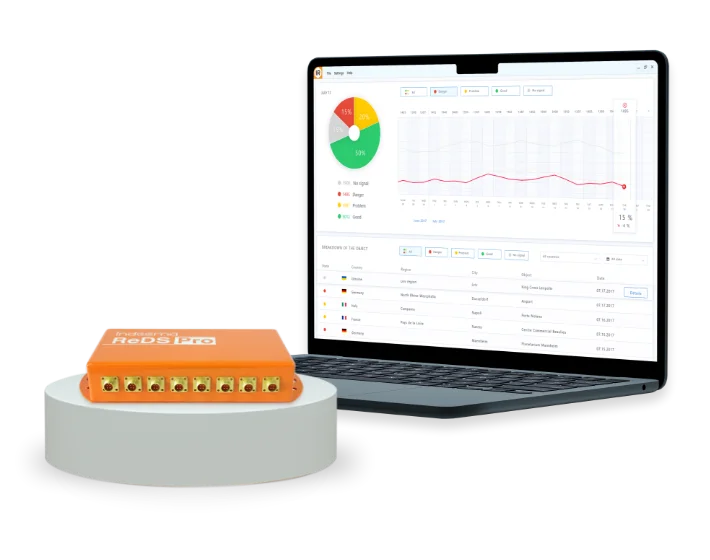
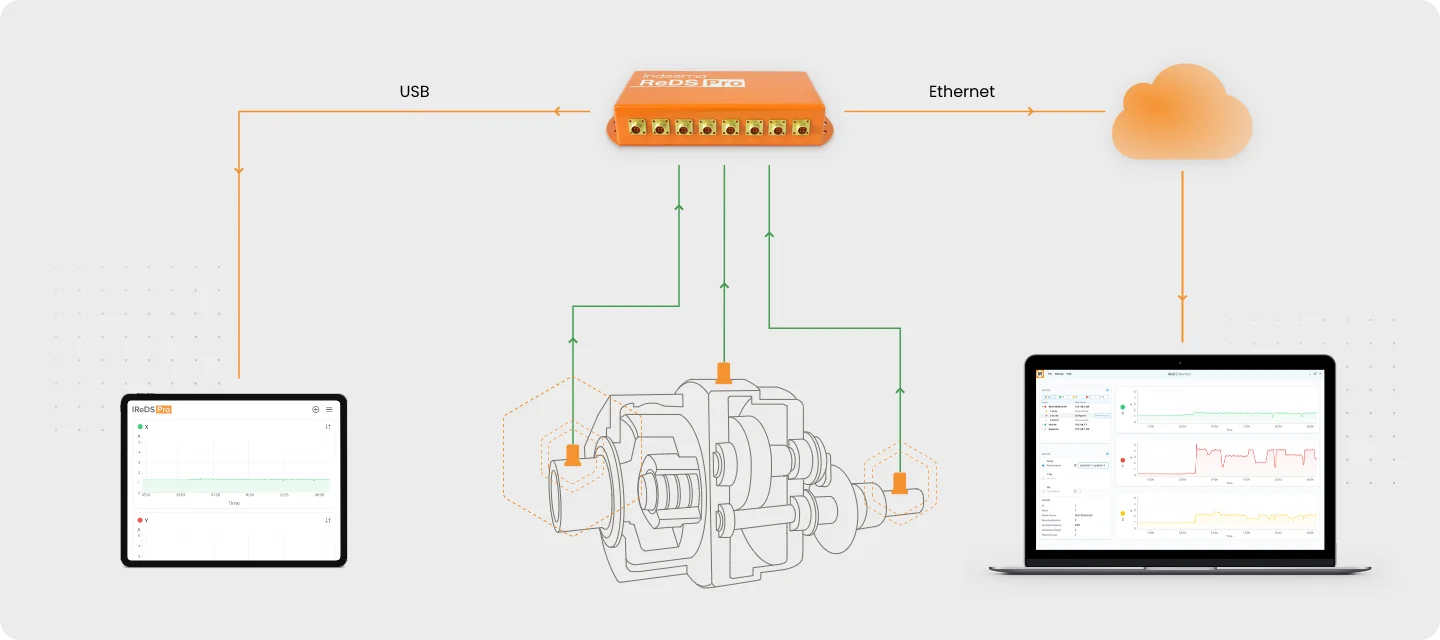
Predictive maintenance · Specification
Predictive maintenance of rotary machinery equipment
Before development, the team analyzed the condition-monitoring solutions on the market and the demand for one, defined operating conditions, critical components and failure modes, then designed the system architecture and documented hardware and software requirements in a specification phase.
Turning machine vibration into condition-monitoring views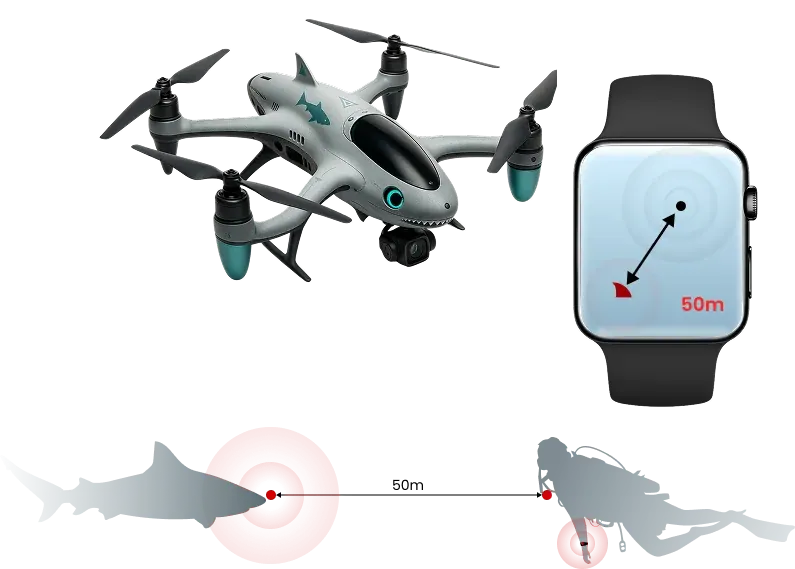
Proof of concept · Discovery
Proof of concept for a companion-drone idea
Discovery workshops, a functional requirements document and a system design took an early-stage idea to a proof of concept on existing drone hardware, with the detection and alert flow tested in a controlled, simulated scenario.
Proving a follow-me alert drone concept with wristband and phone alerts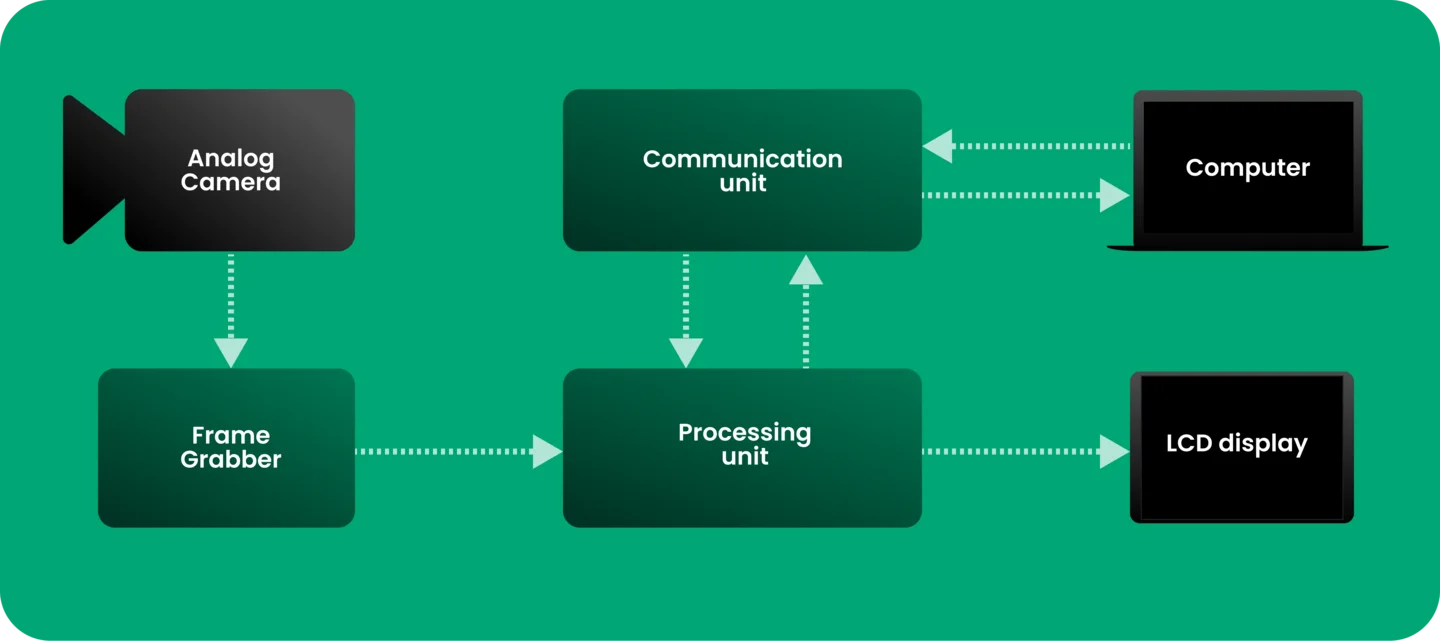
Prototype · Feasibility
Feasibility prototype for an untested chip choice
A short feasibility prototype tested whether the proposed SoC could digitize analog door-camera video, encode it in hardware and stream it over Wi-Fi, before any product design was committed.
Prototyping an ESP32-P4 indoor monitor for analog door-camera video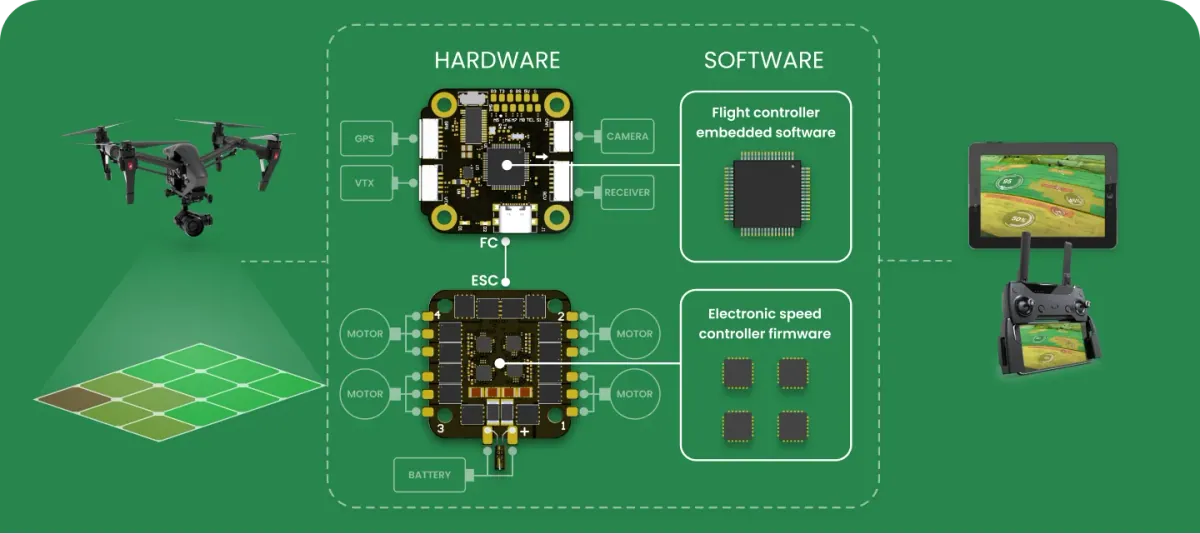
Specification · Bring-up
From concept to a tested flight stack
Requirements and a technical specification came first, risky components were prototyped before the schematic was frozen, and bring-up results fed updated production files for a second board revision.
Flight-controller and ESC electronics for a 7-inch drone flight stack
Related engineering insights
- Vibration diagnostics use case The iReDS condition-monitoring system in more depth.
- Starting an IoT project What to decide before a connected-product project begins.
- The importance of project planning Why the plan made at the start shapes the rest of the project.
FAQ
R&D services questions
What are R&D services?
R&D services are research and development work bought from an engineering company: investigating a market and the technology, proving a concept, building a prototype and documenting the result, so a product decision rests on evidence rather than assumptions.
What is R&D in software development?
In software development, R&D is the work done before the main build to answer what is not yet known: whether an approach is feasible, which technology fits, how the system should be structured. In connected products it usually covers hardware and software research together.
How do you eliminate R&D risks?
Duration and cost are the most common risks in research and development. We reduce them by splitting the work into stages with a defined question and output each, testing the riskiest assumption first, and reviewing the findings with you before the next stage starts.
What are R&D costs?
R&D costs depend on the project: how broad and long the research is, how complex the product and technology are, whether hardware has to be prototyped, and which specialists are involved. We estimate each stage once its question and scope are agreed, using our experience from previous projects.
What is a software R&D team?
A software R&D team consists of researchers and engineers from the disciplines the question needs, for example firmware, electronics, cloud, mobile, data or UX, led by a project manager or business analyst who keeps the work tied to your goals.
How do I know that you will develop exactly what I'm expecting?
First, documentation is one of the stages of our research and development process: it records the specifications we agreed with you after the research and the concept. Second, we divide the work into doable steps and keep you posted at every stage.
What is the difference between a proof of concept and a prototype?
A proof of concept shows that the core idea can work, often with existing hardware or a simplified setup. A prototype is closer to the product: it shows how the product will look, behave or be built, and exposes problems before the main development starts.
Tell us about your project
Start with the question you need answered
A first conversation covers the idea or the change, what is already known and what has to be proven, not a fixed scope.
Bring us
- The idea, or the product and what has changed
- What you already know: users, market, technology
- The assumption that worries you most
- The decision the research should support
Related services
- IoT Consulting & Product Discovery When the decision is about product strategy and architecture.
- MVP Development When the concept is proven and needs to reach real users.
- IoT Hardware Development When the prototype becomes production electronics.
- IoT Product Engineering When research turns into building the whole connected product.