


Building communications / Embedded video prototype
Indoor intercom monitor prototype on ESP32-P4Discovery, firmware and hardware-feasibility prototype
Prototyping an ESP32-P4 indoor monitor for analog door-camera video
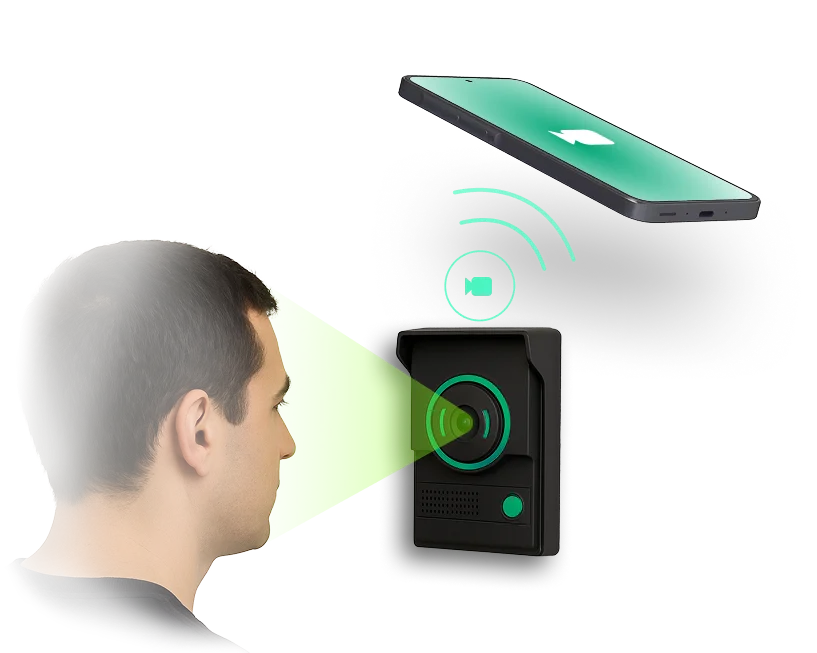
A company that builds in-building communication systems wanted a new indoor monitor that could take analog video from an existing front-door camera and make it viewable on a resident's smartphone, so the system could work with installed door cameras.
The client had a concept, detailed requirements and a preliminary architecture, and had proposed the Espressif ESP32-P4 as the platform, but the choice was not yet validated. It needed a team experienced with Espressif SoCs to prove that the hardware could digitize PAL video, encode it and stream it with low latency.
- Product
- Indoor intercom monitor prototype on ESP32-P4
- Buyer
- Building-communications manufacturers evaluating a new SoC for an indoor monitor
- Engagement
- Discovery, firmware and hardware-feasibility prototype
- Indeema scope
- Discovery, Prototype assembly, Firmware, Development pipeline
The product need
What had to become possible
The client had a concept, detailed requirements and a preliminary architecture, and had proposed the Espressif ESP32-P4 as the platform, but the choice was not yet validated. It needed a team experienced with Espressif SoCs to prove that the hardware could digitize PAL video, encode it and stream it with low latency.
Ownership, made clear
Where the work started and what Indeema owned
Starting system
Concept and requirements
A general concept of the monitor, its core functions and a preliminary architecture document.
Proposed platform
ESP32-P4 suggested as the target SoC, not yet tested for this video path.
What did not exist
No firmware, no video-processing implementation, no streaming component and no mobile-app integration.
Indeema owned
Discovery
Turn the concept into a Functional Requirements Document with the client, then a technical specification covering constraints, implementation strategy and hardware integration.
Prototype assembly
Identify and procure manufacturer-recommended components and assemble a feasibility prototype around the ESP32-P4.
Firmware
Configure the ESP32-P4 for a DSI display, a CSI camera and audio input; digitize PAL video, encode it to H.264 and stream it over Wi-Fi; write a custom audio driver and RTSP component.
Development pipeline
Set up a GitLab repository with a lightweight CI/CD pipeline for automated firmware builds.
Worked with
Analog door camera
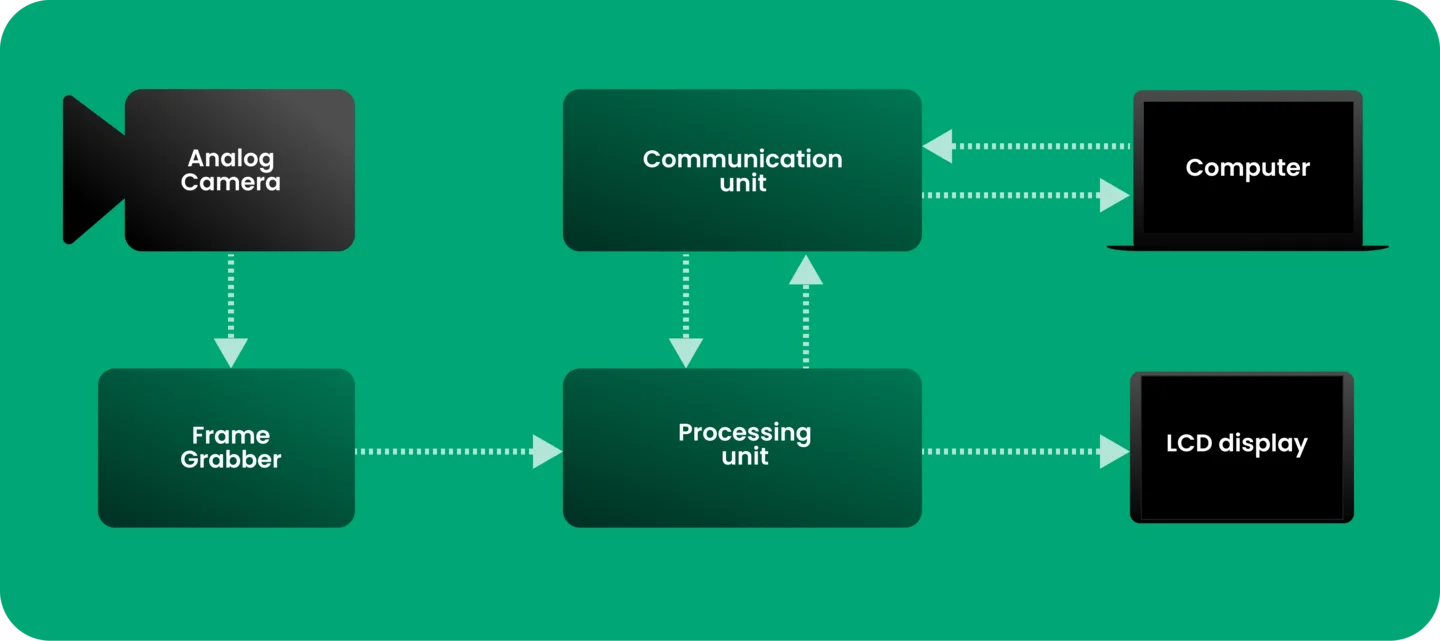
PAL video from the camera is digitized by a TW9992 video decoder.
Local display
The processing unit shows the video stream on an LCD over DSI.
Network client
The H.264 stream is sent over Wi-Fi via RTSP to a computer for evaluation; the smartphone app was the intended next client.
Product constraints
What made the engineering difficult
- 01
A closed streaming component
Espressif's RTSP component was not designed for full multimedia use and its source was not available, which limited integration.
- 02
Colour from an analog source
Colour output from the analog stream differed from the source because of hardware and software discrepancies.
- 03
Latency
Video had to reach the viewer with low delay for an intercom to be usable.
- 04
Unvalidated hardware
The new SoC's video, display and audio capabilities had to be proven before product design could continue.
Engineering judgement
Decisions that shaped the product
Write a custom RTSP component
Instead of relying on the closed component, the team implemented its own RTSP streaming tailored to the system.
Use the hardware H.264 codec
Encoding on the ESP32-P4's built-in codec reduced transmission delay compared with a software path.
Calibrate the analog video path
Colour was fine-tuned and calibrated so the digitized image matched the source.
Prove feasibility first
The prototype used manufacturer-recommended parts and streamed to a PC so latency, performance and image quality could be evaluated before app work.
Delivered product capability
What the product can do
- 01
PAL video digitization
Analog door-camera video captured and digitized on the prototype.
- 02
Display and camera integration
DSI display and CSI camera configured on the ESP32-P4.
- 03
H.264 encoding and RTSP streaming
Hardware-encoded video streamed over Wi-Fi to a computer through a custom RTSP component.
- 04
Audio
Custom audio driver for the prototype's audio input.
- 05
Architecture for next steps
A documented architecture for further development of the monitor.
Product change
What changed for the product team
The client started with an idea and an untested platform choice. It finished with a working prototype that digitizes analog door-camera video, shows it locally, encodes it in hardware and streams it over Wi-Fi, which gave the client evidence on ESP32-P4 for this video path and an architecture to continue from. Smartphone integration and productization were outside this prototype.
For a team evaluating a new SoC for a video product, this case shows how a short feasibility prototype can test the real constraints (analog capture, colour, codec, streaming stack and latency) before committing to product design.
- The prototype digitized analog door-camera video, encoded it to H.264 in hardware and streamed it over Wi-Fi to a computer.
Product evidence
A closer look at the product
Technology, in context
Espressif ESP32-P4 · Espressif ESP32-C6 · TW9992 video decoder · C/C++ · ESP-IDF · ESP-ADF · H.264 · RTSP · MIPI DSI · MIPI CSI · Wi-Fi · GitLab CI/CD
A comparable product problem?
Video intercom prototype
Bring the product context, the system that already exists and the engineering decision you need to make.