


Building equipment / Lift energy and usage monitoring
Connected lift-monitoring device with cloud back end and web portalDevice design, firmware, cloud and web development with ongoing maintenance
A lift energy and trip monitor, from meter interface to web portal
The Lift Consultancy works on lift modernisation, refurbishment, replacement, surveys and portfolio management. It wanted to offer a new service that shows clients how much energy their lifts use, how they are used and when they are out of service, based on data recorded in real time.
A device installed in the lift motor room, next to a three-phase power meter, had to record active and reactive energy, detect when each trip starts and stops and, where wired to the control panel's out-of-service signal, log when the lift is unavailable. The data had to reach the cloud and be presented per lift in a web portal, across lifts with different electrical characteristics.
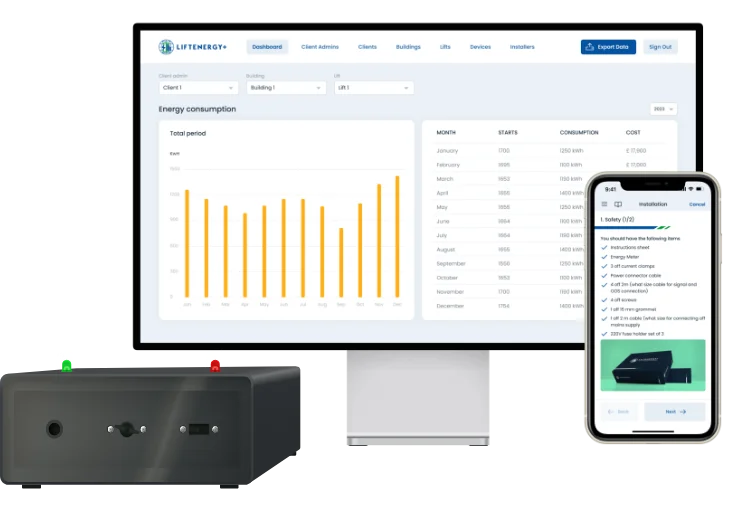
- Product
- Connected lift-monitoring device with cloud back end and web portal
- Buyer
- Equipment consultancies and service companies adding a connected monitoring service
- Engagement
- Device design, firmware, cloud and web development with ongoing maintenance
- Indeema scope
- Proof of concept, Device hardware, Embedded firmware, Cloud and web portal, Maintenance
The product need
What had to become possible
A device installed in the lift motor room, next to a three-phase power meter, had to record active and reactive energy, detect when each trip starts and stops and, where wired to the control panel's out-of-service signal, log when the lift is unavailable. The data had to reach the cloud and be presented per lift in a web portal, across lifts with different electrical characteristics.
Ownership, made clear
Where the work started and what Indeema owned
Starting system
Service concept and requirements
The client brought a defined idea for the service and clear requirements for an IoT system that monitors lifts in buildings.
Lift trip and electrical detail
The team received a breakdown of the events in a lift trip (doors opening and closing, movement, braking) and reviewed the lift's electrical system.
Three-phase energy meter
The device reads energy data from a three-phase power meter installed beside it in the motor room.
Indeema owned
Proof of concept
Build a PoC with a power meter, basic firmware and AWS IoT Core to confirm that lift trips and their duration could be detected from current readings.
Device hardware
Select an integrated module combining a Wi-Fi MCU and an LTE modem, and design the out-of-service signal detection circuitry and the RS-485 interface to the energy meter.
Embedded firmware
Develop a C++ framework on FreeRTOS and ESP-IDF with connectivity, trip detection, out-of-service logging and OTA updates over LTE and Wi-Fi.
Cloud and web portal
Design and build the web portal (Node.js, Strapi, Hapi, Angular) for per-lift energy, trip and inactivity data, hosted on AWS with Docker.
Maintenance
Continue maintaining the system, including OTA firmware updates to installed devices.
Worked with
Energy meter over RS-485
An RS-485 adapter links the MCU's UART to the three-phase energy meter, which communicates over the Modbus protocol.
Lift control panel
Detection circuitry reads the out-of-service signal from the control panel and is designed to work with a range of lift systems.
AWS IoT Core
Devices send data to AWS IoT Core over MQTT with TLS, and over HTTPS.
Product constraints
What made the engineering difficult
- 01
Detect trips on different lifts
Lifts draw different starting currents, so one fixed threshold could not identify trips reliably across lift types.
- 02
Interface with varied equipment
The device had to read a standard energy meter and an out-of-service signal from control panels that differ between lift systems.
- 03
Move data efficiently
Data had to be sent over Wi-Fi or LTE without unnecessary traffic and without losing the detail needed for reporting.
- 04
Manage devices securely
Installed devices needed authenticated, encrypted connections and remote management and updates.
Engineering judgement
Decisions that shaped the product
Validate trip detection first
A proof of concept on a power meter and AWS IoT Core tested trip detection from current readings before the full device was specified.
Adaptive trip thresholds
Threshold-correction algorithms analyse each lift's operating characteristics and adjust the trip-detection thresholds for that lift.
Two connectivity paths
An integrated module combining a Wi-Fi MCU and an LTE modem gives the device alternative connectivity options; OTA updates work over both.
Compress and batch uploads
Data compression and batching reduce the volume transmitted from each device.
Product system
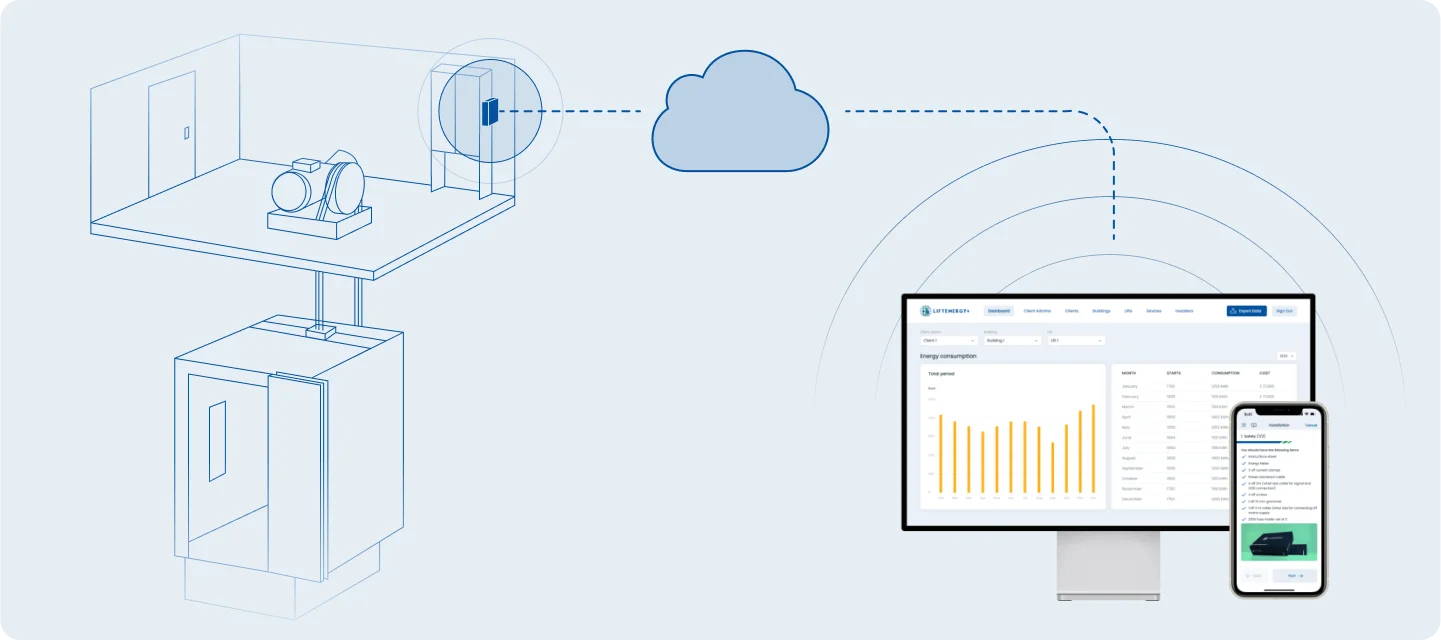
How the product moves from signal to user
- 01
Energy meter and control panel
A three-phase meter measures lift energy; the control panel's out-of-service signal shows availability.
- 02
LiftEnergy+ device
ESP32-based device reads the meter over RS-485, detects trips with adaptive thresholds and logs out-of-service periods.
- 03
Wi-Fi or LTE uplink
Compressed, batched data is sent to AWS IoT Core; OTA firmware updates come back over the same links.
- 04
Cloud back end
Node.js services with Strapi and Hapi store and prepare lift data on AWS.
- 05
Web portal
Angular portal shows energy consumption, trips and inactivity for each lift.
Delivered product capability
What the product can do
- 01
Lift energy recording
Record active and reactive energy consumption for each monitored lift from the three-phase meter.
- 02
Trip detection
Detect when the lift starts and stops and count trips.
- 03
Out-of-service logging
Log periods when the lift is out of service, where the device is connected to the control panel signal.
- 04
Per-lift web portal
Show energy consumption, total trips, inactivity periods and other operating statistics for each lift.
- 05
Remote firmware updates
Update device firmware over the air through LTE or Wi-Fi.
Product change
What changed for the product team
The Lift Consultancy moved from a service concept and requirements to a working monitoring system: a LiftEnergy+ device in the motor room, a cloud connection through AWS IoT Core, and a web portal that reports energy use, trips and out-of-service periods for each lift.
For a company turning equipment expertise into a monitoring service, the case shows the full path from meter and control-panel interfaces, through detection logic that adapts to each installation, to the cloud and reporting views a client sees.
- Lift energy use, trips and out-of-service periods are recorded by the device and reported per lift in a web portal.
- Installed devices can receive firmware updates remotely over LTE or Wi-Fi.
Product evidence
A closer look at the product
Technology, in context
ESP32 · FreeRTOS · ESP-IDF · C/C++ · PlatformIO · KiCad · RS-485 · Modbus · MQTT over TLS · AWS IoT Core · Node.js · Strapi · Hapi · Angular · MongoDB · Redis · Amazon S3 · Docker · GitLab
A comparable product problem?
LiftEnergy+ lift energy and trip monitoring
Bring the product context, the system that already exists and the engineering decision you need to make.