


Smart home / Indoor air monitoring device
Indoor air-quality monitor with companion mobile appR&D, firmware, mechanical layout, cloud and mobile app engineering
Building an indoor air monitor and companion app across two device generations
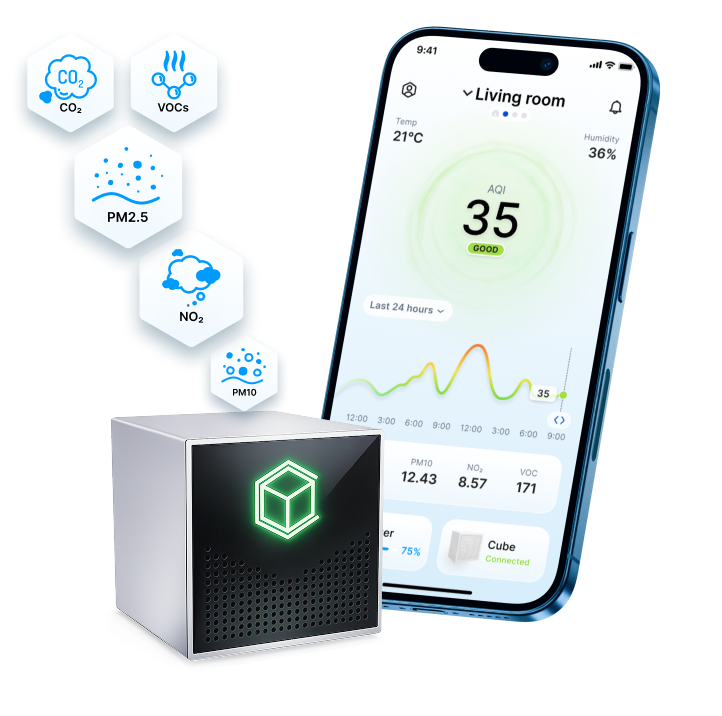
Cube Air is an indoor air monitoring product created for a property developer building premium hotels and condominiums. The developer was also working on an indoor air purifier and was entering device production and connected-system development for the first time.
The developer needed a monitoring system that tracks indoor air conditions, shows residents the current status in a mobile app, and notifies them when the purifier should be switched on. It needed a partner to take the device from sensor selection through firmware, cloud and app.
- Product
- Indoor air-quality monitor with companion mobile app
- Buyer
- Product teams adding connected sensing and an app to a home appliance
- Engagement
- R&D, firmware, mechanical layout, cloud and mobile app engineering
- Indeema scope
- Sensor and processor selection, Air-quality index definition, Device firmware, Desktop device layout, Cloud back end, Mobile app and design
The product need
What had to become possible
The developer needed a monitoring system that tracks indoor air conditions, shows residents the current status in a mobile app, and notifies them when the purifier should be switched on. It needed a partner to take the device from sensor selection through firmware, cloud and app.
Ownership, made clear
Where the work started and what Indeema owned
Starting system
Purifier drawings
The client supplied a drawing and a 3D model of the air purifier that the first monitoring unit had to fit inside.
No device or system experience
The client had no existing monitoring device, firmware, cloud back end or app, and no in-house hardware or connected-system team.
Indeema owned
Sensor and processor selection
Select the air-quality sensors and the main processor during an R&D phase, evaluate them, and determine where the sensor should sit inside the purifier.
Air-quality index definition
Define which measured air parameters contribute to the overall air-quality index the device reports.
Device firmware
Develop ESP-IDF firmware that reads the sensors, processes data on the device, calculates the index, accepts configuration and updates, and sends data to the cloud.
Desktop device layout
Prepare the 3D model of the second-generation desktop device, rework the internal component and PCB placement to fit the client's dimensions, and define the LED indication scheme.
Cloud back end
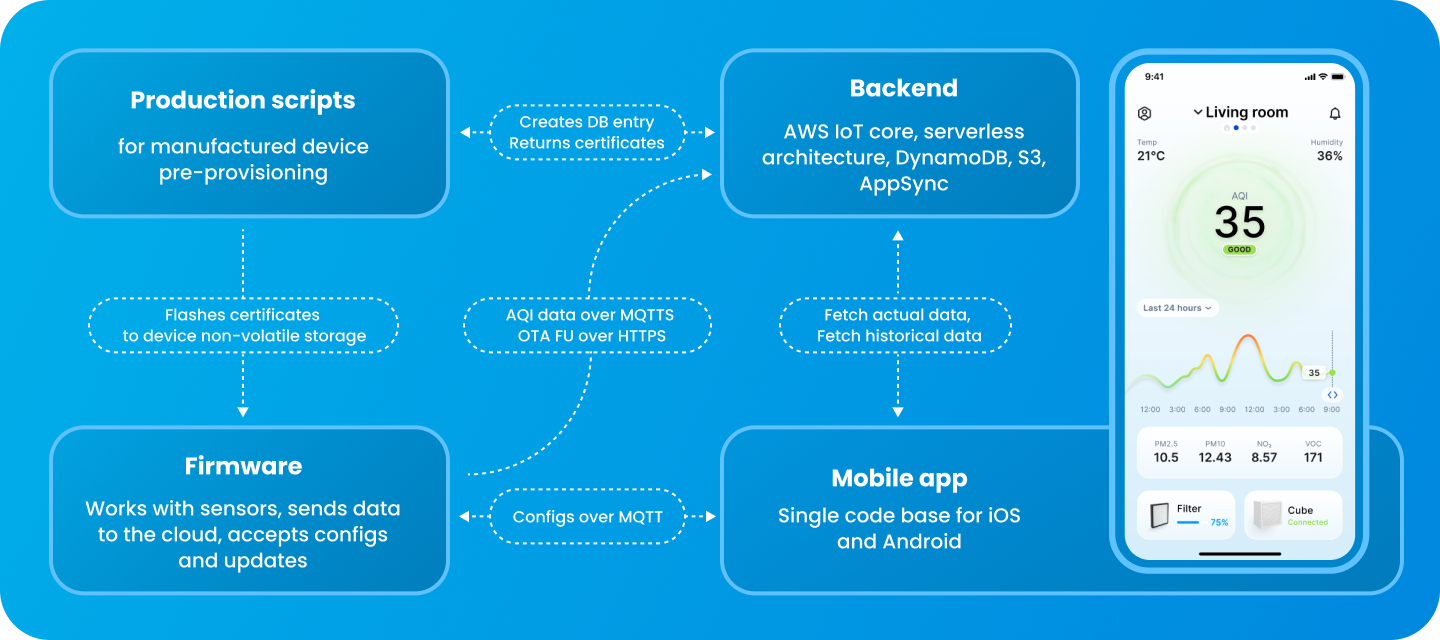
Build a serverless AWS back end with AWS IoT Core, Lambda functions, DynamoDB, S3 and AppSync that connects devices to the app, including production scripts that pre-provision manufactured devices with certificates.
Mobile app and design
Design and build a Flutter app for iOS and Android that shows current and historical readings and sends notifications.
Worked with
Device to cloud
The firmware publishes air-quality data over MQTT with TLS, receives configuration over MQTT and downloads firmware updates over HTTPS.
Cloud to app
The app fetches current and historical readings from the AWS back end through AppSync and GraphQL.
Manufacturing provisioning
Production scripts create a database entry for each manufactured device, obtain its certificates and flash them to the device's non-volatile storage.
Product constraints
What made the engineering difficult
- 01
Place the sensor inside someone else's product
The first-generation unit had to sit inside the client's purifier, so the sensor position and the choice of measured parameters had to be worked out from the purifier drawings and 3D model.
- 02
Fit a smaller, standalone second generation
The second-generation device became a portable desktop unit with the client's specified dimensions, and it still had to hold every internal component plus an added CO2 sensor.
- 03
Readable for non-technical residents
Residents with little technical experience had to understand air status at a glance, on the device and in the app.
- 04
Provision devices for production
Each manufactured unit needed its own cloud identity and certificates before it reached a resident.
Engineering judgement
Decisions that shaped the product
Compute the index on the device
The firmware processes sensor data and calculates the air-quality index locally, so the device's LED indication and the cloud receive the same derived value.
Serverless AWS back end
AWS IoT Core and Lambda functions process incoming device data, store it, and push updated readings to the app without a fleet of always-on servers to manage.
One cross-platform codebase
Flutter gives the client one app codebase for both Android and iOS.
LED status on the device
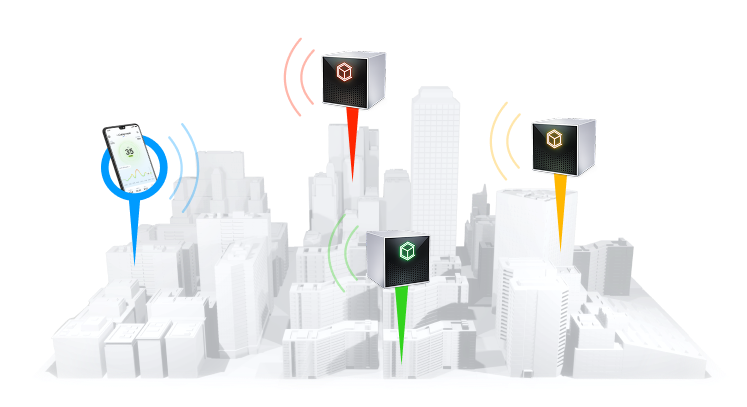
A colour-coded LED scheme lets residents read air status from the device itself without opening the app.
Product system
How the product moves from signal to user
- 01
Sensors
Measure indoor air parameters inside the purifier or in the desktop unit.
- 02
Firmware
Process readings, calculate the index, drive the LED and accept configuration and updates.
- 03
AWS IoT Core
Receive data over MQTT with TLS and serve firmware updates over HTTPS.
- 04
Serverless back end
Lambda, DynamoDB, S3 and AppSync process and store readings.
- 05
Mobile app
Show current and historical air data and notify residents.
Delivered product capability
What the product can do
- 01
Sensor-based air monitoring
Read indoor air parameters, calculate an air-quality index on the device and send readings to the cloud.
- 02
Live and historical app views
Show the current index, temperature, humidity and individual pollutant readings, with a historical chart, in the mobile app.
- 03
Notifications
Notify residents through the app, with additional notifications added for the second-generation CO2 readings.
- 04
Remote configuration and updates
Send configuration to devices and deliver firmware updates over the air.
- 05
Factory pre-provisioning
Register manufactured devices and flash their certificates with production scripts.
- 06
Two device generations
An in-purifier first generation and a portable desktop second generation with a CO2 sensor, both prepared as prototypes for beta testing.
Product change
What changed for the product team
The client moved from purifier drawings and no device experience to two prototype generations of a connected air monitor: a unit built into the purifier and a standalone desktop device, both connected to a serverless cloud back end and a cross-platform app, with production provisioning scripts for manufactured devices.
For an appliance or property business adding sensing to a product, the case shows the full chain in one engagement: sensor choice and placement, on-device processing, mechanical layout under a fixed size, device provisioning and certificates, cloud, and an app built for non-technical users.
- Two device generations prepared as prototypes for beta testing: an in-purifier unit and a portable desktop unit with a CO2 sensor.
- Devices, a serverless AWS back end and an iOS and Android app connected end to end, with remote configuration and firmware updates.
Product evidence
A closer look at the product
Technology, in context
ESP32-C6 · ESP-IDF · C/C++ · Python · C# · AWS IoT Core · AWS Lambda · Amazon DynamoDB · Amazon S3 · AWS AppSync · GraphQL · MQTT · Flutter
A comparable product problem?
Cube Air indoor air monitor
Bring the product context, the system that already exists and the engineering decision you need to make.