


Smart home / Connected ventilation product
Decentralized ventilation unit with heat recuperation, app and cloudR&D, hardware architecture, embedded firmware, UX/UI, mobile and cloud integration
Electronics, firmware and app for a connected ventilation unit
Prana manufactures decentralized ventilation units with heat recuperation, which exchange indoor and outdoor air. For its next generation, Prana Platinum, the electronics, firmware, sensor architecture and user experience all had to be redesigned. Prana already ran a cloud platform on ThingsBoard.
Prana needed a full R&D and development partner for Prana Platinum: hardware architecture and microcontroller selection, embedded firmware, air sensor integration, multi-protocol and smart-home connectivity, a mobile app, and extensions to its existing ThingsBoard cloud.
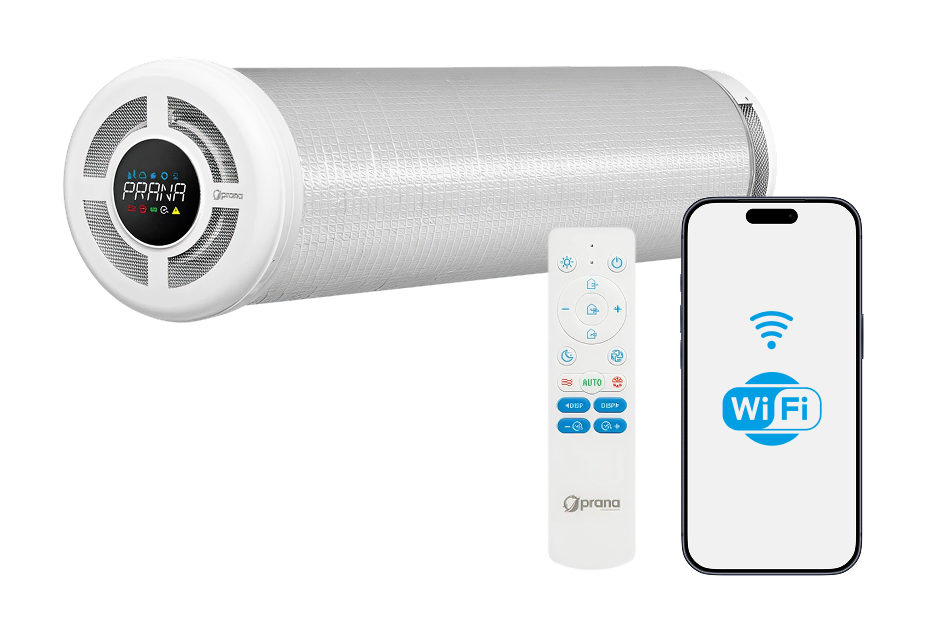
- Product
- Decentralized ventilation unit with heat recuperation, app and cloud
- Buyer
- Appliance manufacturers redesigning a product generation around connectivity
- Engagement
- R&D, hardware architecture, embedded firmware, UX/UI, mobile and cloud integration
- Indeema scope
- Hardware architecture and SoC selection, Split power design, Embedded firmware, Connectivity, UX/UI and mobile app, ThingsBoard extensions
The product need
What had to become possible
Prana needed a full R&D and development partner for Prana Platinum: hardware architecture and microcontroller selection, embedded firmware, air sensor integration, multi-protocol and smart-home connectivity, a mobile app, and extensions to its existing ThingsBoard cloud.
Ownership, made clear
Where the work started and what Indeema owned
Starting system
Existing product line
An established range of decentralized ventilation units on which the new generation would build.
ThingsBoard cloud
A working cloud platform on ThingsBoard, used as the foundation for the new product's cloud features.
Open architecture questions
No microcontroller selected, no defined sensor measurement points, no firmware or power architecture, and no plan yet for smart-home integration.
Indeema owned
Hardware architecture and SoC selection
Review the architecture, evaluate seven SoC families against I/O, connectivity, supply-chain and ecosystem criteria, define power isolation, and specify the sensor measurement architecture across four airflow points.
Split power design
Design a power architecture with dedicated AC/DC supplies for the motors and isolated rails for the MCU and sensors, with per-channel current sensing.
Embedded firmware
Build FreeRTOS/ESP-IDF firmware with separate tasks for motor control, sensor polling, display, connectivity and diagnostics, including dual-motor PWM control and eleven operating modes.
Connectivity
Implement control from four channels at once: the mobile app over Wi-Fi or BLE, an IR remote, Matter smart-home platforms and the physical controls.
UX/UI and mobile app
Design one visual system for the on-device display, iOS and Android app and web interface; the app includes a scenario builder, weekly schedules, an air-quality dashboard, device sharing and group management.
ThingsBoard extensions
Add historical sensor logs, remote scenario management, service-technician error dashboards and consent-based data collection to Prana's ThingsBoard platform.
Worked with
Sensors
Temperature, humidity, CO2, VOC and PM1.0/PM2.5 readings logged to the cloud.
Matter
Matter is one of the unit's control channels alongside the app, IR remote and physical controls.
ThingsBoard
The unit and app use Prana's existing ThingsBoard platform for history, scenarios and service dashboards.
Time sync
SNTP time synchronisation with an on-board RTC fallback keeps schedules running when the connection drops.
Product constraints
What made the engineering difficult
- 01
One SoC for many protocols
The controller had to provide Wi-Fi, BLE and the radios needed for Matter and mesh networking, with enough I/O and a stable supply chain, without adding co-processors.
- 02
Motor noise affecting sensors
Switching noise from the motors could disturb sensor readings.
- 03
Eleven modes that can conflict
Operating modes such as Auto Air Quality, Auto Temperature, Winter, Bypass, Intelligent and Standby, plus user schedules, could overlap.
- 04
Recognising the filter type
The unit had to identify which filter is fitted without barcodes or manual setup.
- 05
Damper and fan timing
The damper had to open in step with fan ramp-up to avoid pressure spikes at start-up.
- 06
Diagnostics without extra sensors
Motor stalls and faults had to be detected without adding dedicated diagnostic sensors.
Engineering judgement
Decisions that shaped the product
ESP32-C6
Chosen for its native support of Wi-Fi 6, BLE 5.3, Matter, Thread and Zigbee, which removes the need for additional connectivity co-processors.
Separate power for motors and electronics
Dedicated motor supplies and isolated MCU and sensor rails keep motor switching noise away from measurements, and per-channel current sensing feeds diagnostics.
Explicit state machine
Operating modes run as a state machine with defined transitions; the app detects schedule conflicts and notifies the user.
Micro-switch filter coding
A micro-switch matrix in the filter shaft lets firmware identify the filter at start-up, load the matching control algorithm and start lifetime tracking.
Diagnostics from existing signals
Static pressure readings while motors are idle, tachometer feedback and current anomalies are combined to detect motor stalls.
Product system
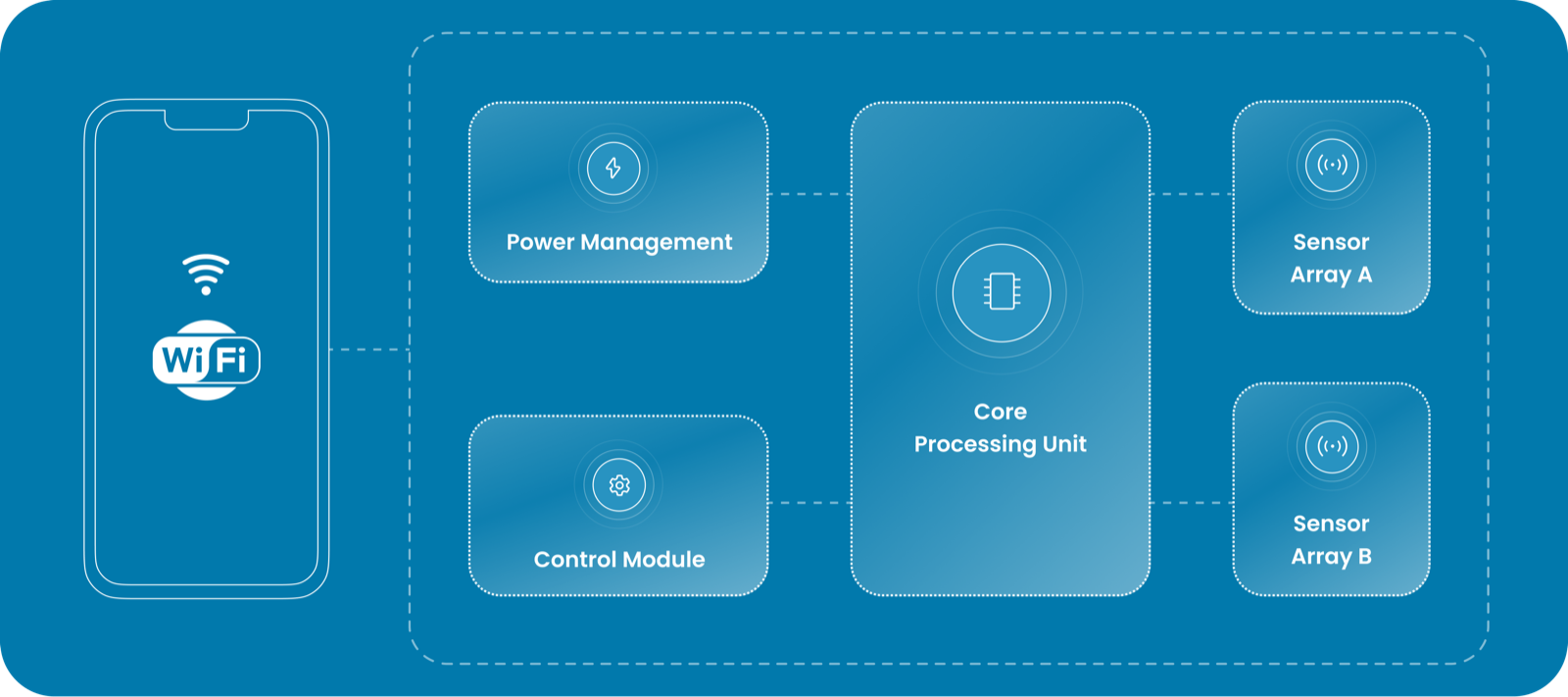
How the product moves from signal to user
- 01
Sensors
Temperature, humidity, CO2, VOC and particulate readings at four airflow points.
- 02
ESP32-C6 firmware
FreeRTOS tasks for motors, sensors, display, connectivity and diagnostics.
- 03
Motors and damper
PWM fan control with tachometer feedback and synchronised damper steps.
- 04
Control channels
App over Wi-Fi or BLE, IR remote, Matter platforms and physical buttons.
- 05
ThingsBoard cloud
Sensor history, remote scenarios and technician error dashboards.
- 06
Mobile app
Scenarios, weekly schedules, air-quality dashboard, sharing and groups.
Delivered product capability
What the product can do
- 01
Dual-motor control
PWM control of two motors with tachometer feedback, current sensing and step-counted damper synchronisation.
- 02
Eleven operating modes
Including automatic air-quality and temperature modes, Winter, Bypass, Intelligent and Standby.
- 03
Four control channels
Mobile app over Wi-Fi or BLE, IR remote, Matter platforms and physical controls.
- 04
Automatic filter identification
Detect the fitted filter type and track its lifetime.
- 05
Self-diagnostics
Detect motor stalls from pressure, tachometer and current data.
- 06
App and display
Scenario builder, weekly scheduling, air-quality dashboard, device sharing and groups, with a matching on-device display.
- 07
Cloud history and service views
Historical sensor logs, remote scenarios and technician error dashboards on ThingsBoard.
Product change
What changed for the product team
Prana Platinum moved from a product concept with open hardware questions to a defined architecture on ESP32-C6 with isolated power, multi-task firmware with eleven modes and self-diagnostics, four control channels including Matter, and an app and ThingsBoard extensions, developed while iterating with Prana on prototype hardware. Indeema continues to support hardware revisions, firmware and sensor-driver updates.
For an appliance maker redesigning a product generation, the case shows how controller selection, power design, motor and sensor firmware, smart-home connectivity and the app can be planned together, and how existing signals can be reused for filter detection and diagnostics.
- A Prana Platinum architecture on ESP32-C6 with isolated motor and electronics power, chosen after evaluating seven SoC families.
- FreeRTOS firmware with dual-motor control, eleven operating modes, filter identification and self-diagnostics.
- Control from the app, IR remote, Matter platforms and physical controls, with ThingsBoard history and service dashboards.
Product evidence
A closer look at the product
Technology, in context
ESP32-C6 · ESP-IDF · FreeRTOS · Wi-Fi 6 · Bluetooth LE 5.3 · Matter · Thread · IR remote · SNTP · ThingsBoard · iOS · Android
A comparable product problem?
Prana Platinum ventilation unit
Bring the product context, the system that already exists and the engineering decision you need to make.