


Insights / IoT / Connected Products
Smart Lift Systems: How Office Building Elevators Get Smarter
What makes a lift smart, which features matter in an office building, and how monitoring can be added to an existing elevator without replacing it.


The short answer
A smart elevator system is a lift that measures its own operation and shares that data. Sensors and a connected controller record trips, door cycles, energy use, faults and out-of-service periods, and send them to a cloud platform. On top of that data come traffic-aware dispatching, remote monitoring and condition-based maintenance, touchless and credential-based access, energy recovery and integration with the building's management, access and fire systems. Most existing lifts do not need replacing to get there: a monitoring device in the machine room is often the first step.
What makes a lift "smart"
Most people only notice an elevator when it stops working. For building owners and facility managers, that is the problem: a conventional lift gives no warning, reports nothing about its energy use and is serviced on a calendar rather than on its condition.
- Smart elevator system
- An elevator whose controller or an added monitoring device records how the lift operates, such as trips, doors, energy, faults and service state, and shares that data with people and other building systems so the lift can be managed on evidence.
"Smart" therefore starts with data, not with features in the cabin. Dispatching, predictive alerts and building integration all depend on the lift first being able to report reliably what it is doing.
The capabilities that define a smart elevator
| Capability | What it does | What it needs | Who benefits |
|---|---|---|---|
| Traffic-aware dispatching | Groups passengers travelling in the same direction to cut waits and stops | Destination input at the landing and a group controller that uses live traffic data | Occupants at peak times |
| Remote monitoring and diagnostics | Reports faults, door problems and out-of-service periods as they happen | Sensors or a connected device, a network link and a monitoring platform | Maintenance teams and building managers |
| Condition-based maintenance | Schedules service when the data shows wear or anomalies, not only by the calendar | Usage and fault history long enough to show a pattern | Owners and service contractors |
| Touchless and credential-based access | Calls lifts from a phone, QR code, NFC or access card, and limits floors by user | Integration with the access-control system | Occupants, visitors and security teams |
| Energy measurement and recovery | Shows each lift's consumption; regenerative drives feed braking energy back to the building | Metering, and a regenerative drive where the lift supports one | Owners and sustainability reporting |
Not every building needs all five. A mid-rise office with predictable traffic may gain most from monitoring and energy data; a busy tower gains most from dispatching.
Safety and the passenger experience
The basic promise of a lift is to move people safely and comfortably. Connected systems extend that promise in four ways, each with an engineering condition attached.
| Feature | What it adds | Engineering condition |
|---|---|---|
| Cabin monitoring | Detects a fall, a trapped passenger or an emergency and raises an alert | Clear privacy rules; processing on site where possible so video does not leave the building |
| Personalised access | Mobile IDs, QR codes or RFID cards decide which floors a person can reach | Reliable integration with the access-control system and a fallback when it is offline |
| Emergency behaviour | Responds to fire alarms or system anomalies by moving to a safe floor or a defined mode | Firmware that links sensor inputs to the required behaviour, tested against the building's safety design |
| Ride comfort and accessibility | Smoother rides, adaptive lighting, voice feedback and touchless panels | Accessibility requirements designed in, not added as a panel later |
Integration with the smart building
Elevators are increasingly a data source for the whole building. Connected to the building management system, access control, fire safety and climate control, a lift can respond to how the building is used. If a meeting room on the 12th floor is booked, the lift can be ready for the attendee while the lights and HVAC on that floor start up.
In the other direction, lifts feed central dashboards with passenger-traffic patterns, out-of-hours use and group behaviour across several towers. Some operators use this data in a digital twin of the building to test how a change in layout or access policy would affect movement before making it.
The engineering implication: retrofit before you replace
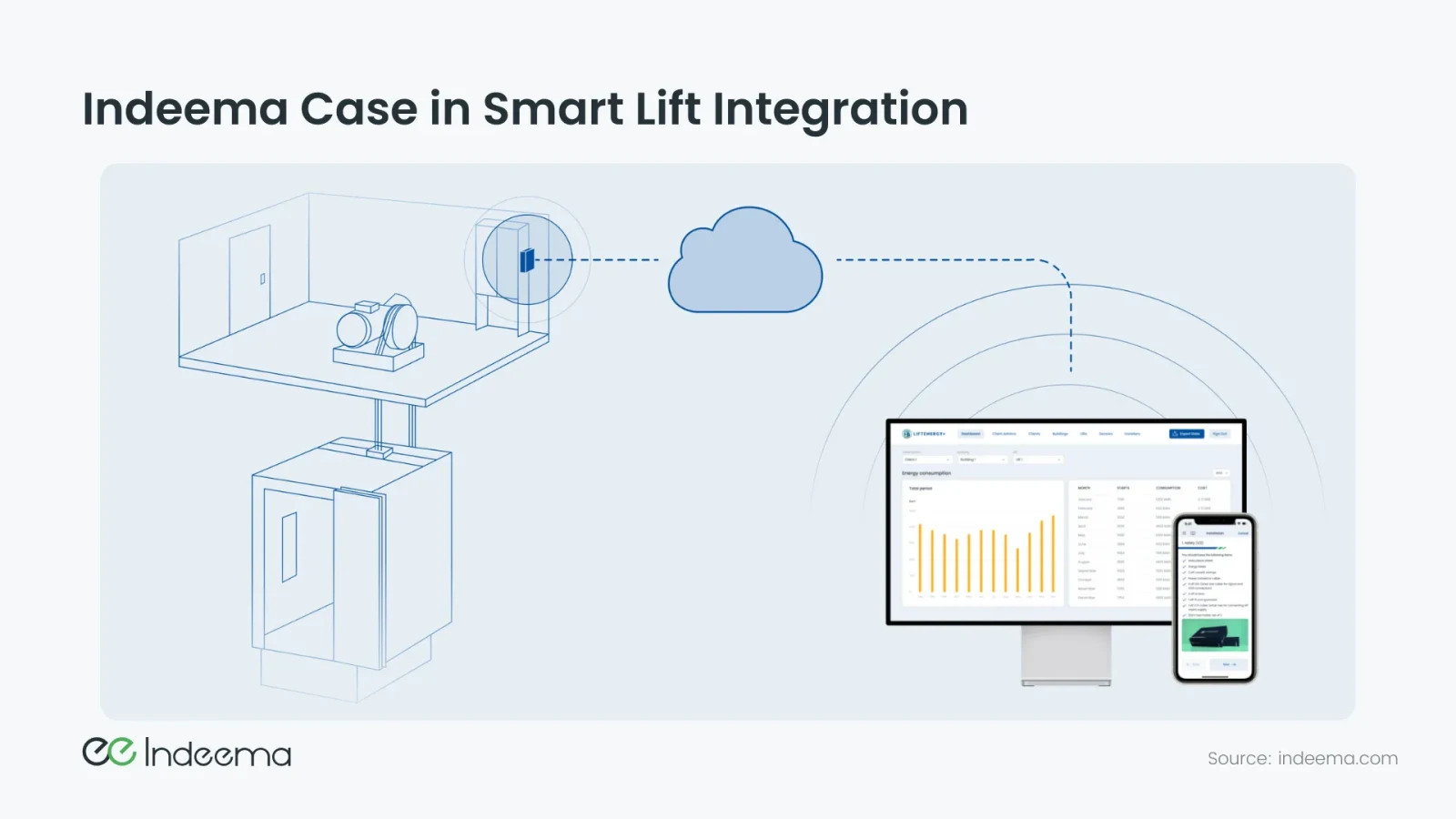
Most of the value above comes from data, and data can usually be added to an existing lift. A monitoring device in the machine room can read the lift's power draw and service signals without changing the controller. From current alone, it can detect when the lift starts and stops, so trips, energy per trip and idle periods become visible.
What a building saves depends on its starting point: how often lifts are serviced without a fault being found, how much traffic they carry, what the drives can recover and what electricity costs. Measure those first. A short monitoring period gives the baseline that any business case for dispatching, regenerative drives or a service-contract change should be built on.
How to start with an existing building
A practical sequence for a smart lift retrofit
- List the lifts, their makes, ages, drives and control panels, and who holds the maintenance contract.
- Decide what you need to know first: energy per lift, trips, out-of-service time, faults, or traffic at peak hours.
- Install monitoring that reads the lift without touching its safety chain, for example energy metering and the out-of-service signal.
- Choose connectivity that works in the machine room; cellular as an alternative to Wi-Fi avoids depending on the building network.
- Plan secure device management and over-the-air updates before the first device is installed.
- Run the monitoring long enough to establish a baseline, then decide on dispatching, drive upgrades or a change to the service schedule.
- Connect the data to the building management, access and fire systems only once each integration has a defined fallback.
Where we've built this
We built this kind of retrofit for a vertical-transport company: a device beside the three-phase power meter in the machine room, Wi-Fi and LTE connectivity, adaptive trip detection, and a web portal showing energy and usage per lift.
Case studyA lift energy and trip monitor, from meter interface to web portalAn elevator monitoring device and web portal that record each lift's energy use, trips and out-of-service periods without replacing the lift's own controller.Questions engineers ask
How do smart elevators work?
A smart elevator records its own operation, such as trips, doors, energy use, faults and service state, through its controller or an added monitoring device, and sends that data to a platform. Dispatching, maintenance alerts, access control and building integration then use the data.
What are smart elevators?
Elevators that measure and share how they operate, so they can be dispatched by live traffic, maintained on their condition, accessed by phone or card, and connected to the building's other systems.
Are there smart elevator systems with touchless operation?
Yes. Lifts can be called and floors selected from a phone, a QR code, NFC or an access card, usually through integration with the building's access-control system. Voice feedback and touchless panels also support accessibility.
Was this useful?
Apply this to your product