


Insights / AI / Edge AI
Edge Computing and IoT: What's the Difference and Where Processing Should Run
Why IoT and edge computing are not alternatives, how cloud, cloudlet, fog and edge models differ, and a function-by-function way to place processing.


The short answer
IoT and edge computing are not alternatives. IoT is the system of connected devices that sense and act; edge computing is a choice about where that system processes data: on or near the devices instead of in a distant cloud. Processing at the edge cuts latency, reduces the data sent over the network, keeps working when the connection drops and keeps sensitive data local. The cloud still does what needs fleet-wide data and large compute. Most products use both, decided function by function.
IoT and edge computing: two different questions
IoT devices generate large volumes of data but usually have limited processing capability, so IoT systems have traditionally been cloud-centric. As data volumes grow faster than network capacity, and as more products need instant responses, part of the processing moves back towards the devices.
- Edge computing
- A distributed computing approach in which data is stored and processed close to where it is produced, within the first mile from the source, rather than sent to a central cloud or data centre for every decision.
Affordable single-board computers and low-power AI accelerators made this practical: they can sit next to sensors and run the matrix maths that machine learning needs.
Cloud, cloudlet, fog and edge computing compared
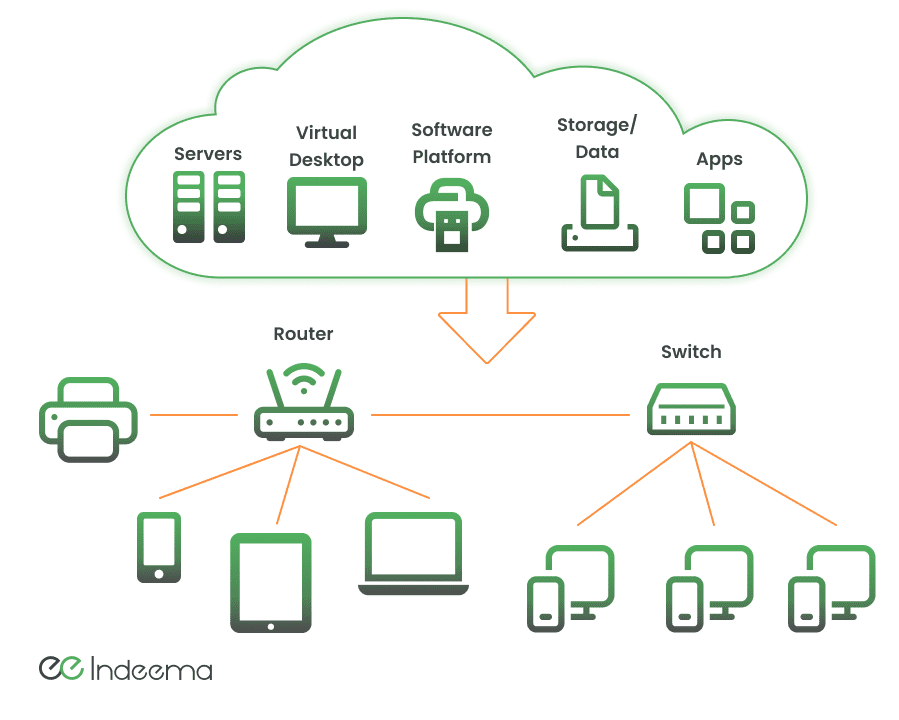
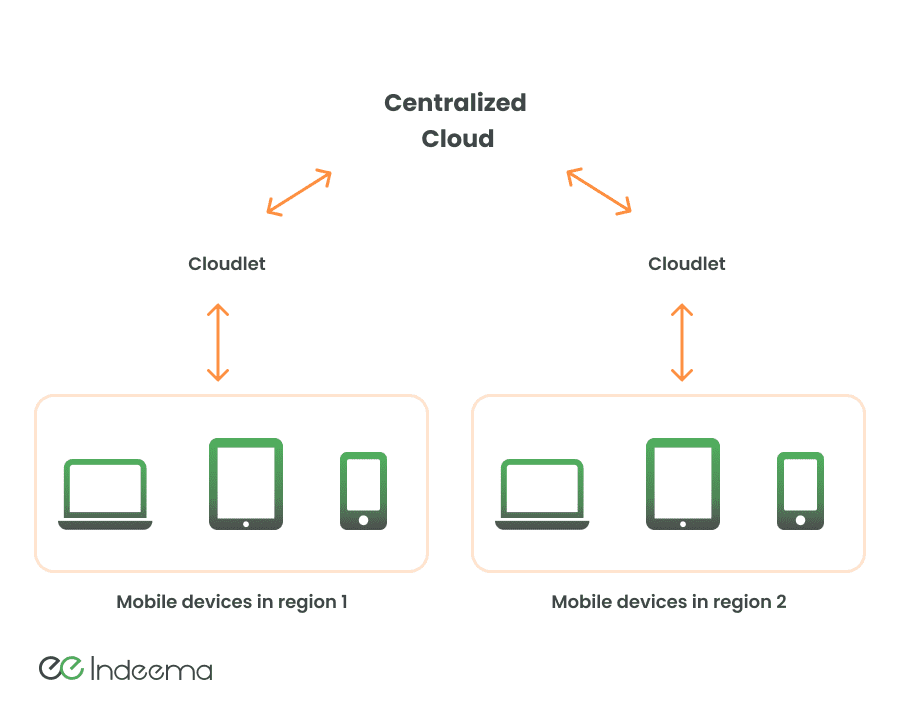
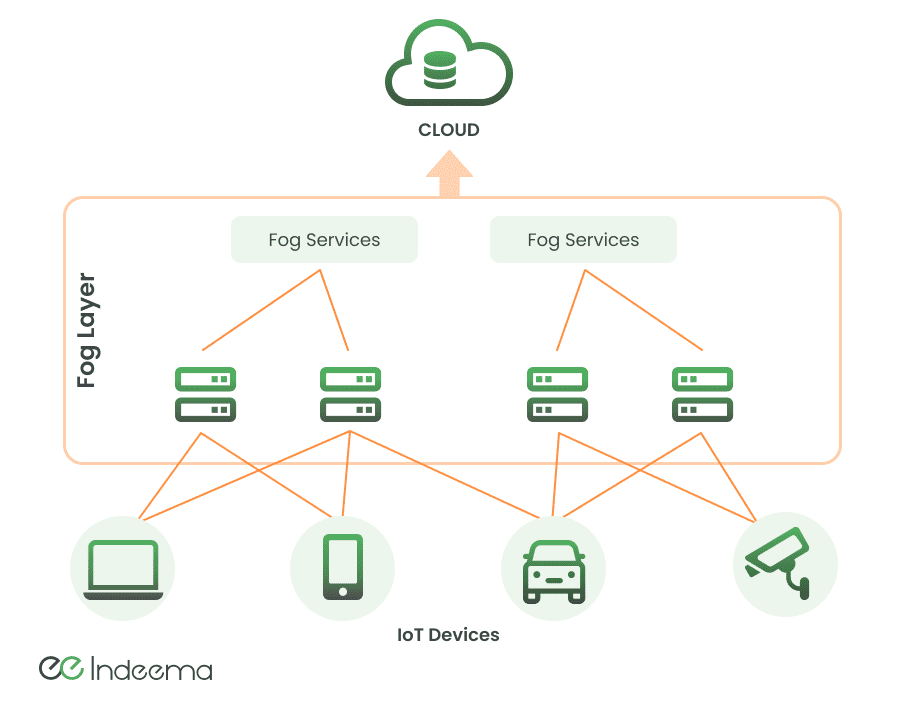
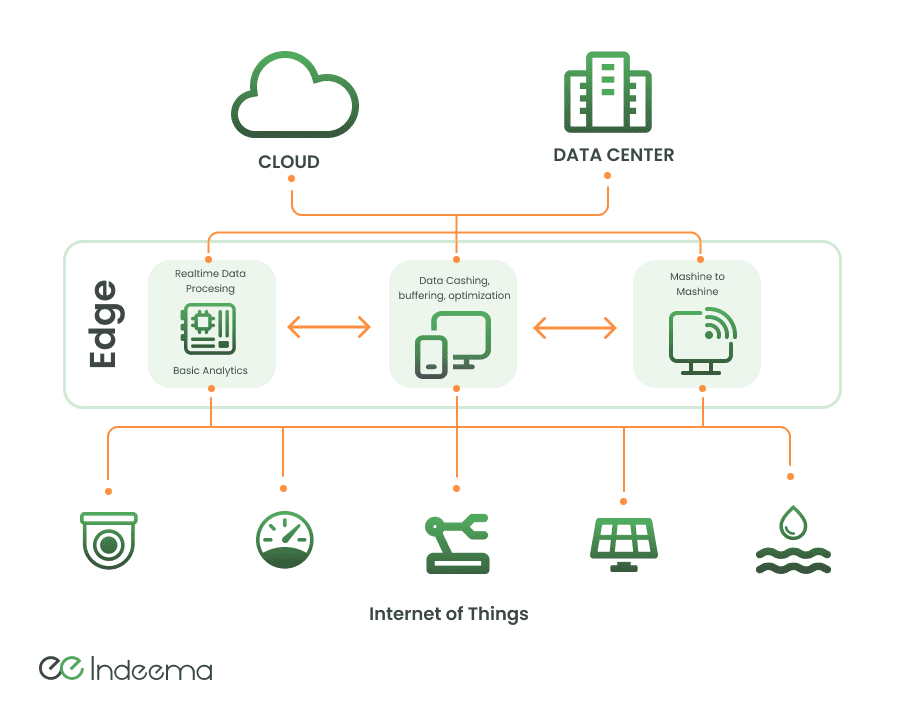
| Model | Where processing runs | Strength | Weakness |
|---|---|---|---|
| Cloud | Central cloud servers reached over the WAN | Virtually unlimited compute allocated per task | Delay over the WAN; sending bulk raw data is inefficient and widens exposure |
| Cloudlet | A local compute centre in the middle of a device, cloudlet, cloud chain | Cuts delay for the most latency-sensitive steps while keeping cloud capacity | Another tier to deploy and keep in sync |
| Fog | Local network devices such as routers, switches and gateways within a limited area | Close to devices; a good fit for many IoT deployments | Limited compute, especially under heavy network load |
| Edge | On or right next to the devices, at the edge of the network | Lowest latency, works offline, keeps data local | Constrained hardware; fleets of edge nodes to update and secure |
A related model is multi-access edge computing (MEC), where computing and storage are provided at the edge of the cellular network, for example at operator base stations.
Why process IoT data at the edge
- Low latency: data travels less far, or not at all, so control loops and alarms respond immediately. For robots and vehicles, a short network delay can make the system unusable.
- Less data to move and store: filtering and summarising locally means less traffic and less cloud processing, which lowers running cost. CCTV video analysis is the typical case: the cameras produce too much data to send everything.
- Edge AI without degraded input: sending data to cloud models often means shrinking images, skipping frames or lowering sample rates, which costs accuracy. Running the model at the edge lets it use the full data, as on-phone face authentication and speech recognition do.
- Data location: processing and storing data locally gives more control over where it lives, which helps with laws on where data may be stored or processed. It does not remove other compliance or security obligations.
Securing IoT at the edge
Many IoT devices lack the compute for strong security, and every compromised device can leak personal data or be used in attacks such as DDoS. Moving processing to the edge spreads the attack surface, so security has to be designed for each node.
- Secure perimeter: encrypted tunnels, firewalls and access control for edge resources.
- Application security: applications on edge devices are secured beyond the network layer.
- Early threat detection: identify devices or nodes that may be untrusted or taken over.
- Fast patch cycles: fix vulnerabilities quickly through a reliable remote update path.
- Vulnerability management: monitor continuously for new weaknesses.
- Least privilege: each device gets only the access and protocols its job needs, so one compromised node does not expose the rest.
- Hardware root of trust: secure elements or hardware security modules provide device identity, encryption of data in transit and at rest, and verified updates.
Where edge computing earns its place in IoT
| Use case | What runs at the edge | Why not only the cloud |
|---|---|---|
| Visual inference | A camera with an edge computer analyses video for intruders, safety breaches or production anomalies | Video volume is too high to stream for every decision |
| Condition-based remote monitoring | An edge server watches temperature, pressure or strain on critical assets such as pipelines | A dangerous condition needs a response in milliseconds |
| Autonomous vehicles | On-board computers process traffic, pedestrians and signals | A vehicle cannot wait for a network round trip to brake or turn |
| Industrial IoT | Edge servers spot equipment faults or misuse and act until people intervene | Production must be protected even when the link is down |
| Smart cities | Local nodes pre-process data from large sensor networks | Raw data from a whole city is costly to move and slow to analyse centrally |
The engineering implication: placement is decided per function
Edge versus cloud is rarely a single decision for a whole product. A fault detector may need to run on the device, a site dashboard on a gateway, and model training and fleet analytics in the cloud. The useful unit of decision is the function, judged by its response time, data volume, offline behaviour and update path.
Placing functions at the edge also creates a fleet to operate: models and software on edge nodes must be deployed, monitored and rolled back remotely. For how intelligence spreads across these layers, see cognitive IoT. Deciding placement before the architecture is fixed is a typical question for IoT consulting services.
How to decide what runs at the edge
For each function the product performs
- Write the response time it needs.
- Estimate the data volume it consumes and produces.
- Define what must happen when the connection is lost.
- Note where its model or rules are updated, and how often.
- Place it on the device, at the edge or in the cloud according to those answers.
- Treat unanswered rows as the questions to settle before choosing hardware.
Questions engineers ask
What is the difference between IoT and edge computing?
IoT is the system of connected devices that sense and act. Edge computing is where that system processes its data: on or near the devices rather than in a central cloud. An IoT product can be cloud-centric, edge-heavy or, most often, a mix.
Was this useful?
Where this shows up in our work
ExpertiseAI for IoT & Edge AIDeciding which models and functions run on devices, gateways or the cloud, and building edge AI that can be updated across a fleet, is the AI for IoT and edge AI work our teams do.On production lines, the edge often has to keep machines safe while the network is down. See Engineering connected products for machines that keep running.
Apply this to your product