


Insights / Smart Home / Consumer IoT
Predictive Is the New Smart: Why the Connected Home Must Anticipate
Why connected homes stall at remote control, and the architecture of a home that anticipates: physical models, presence sensing, local agents, Matter over Thread.


The short answer
Most smart homes are still reactive: a sensor fires, a rule runs, often through the cloud, and a device responds after the event. A predictive home anticipates instead. It models the physics of the building, such as how long a room takes to warm up, senses presence reliably, and runs learning agents locally on a hub or gateway, so decisions are fast, private and survive an internet outage. Matter gives those agents a common language for devices from different brands, Thread gives them a resilient low-power network, and edge AI provides the decisions. Connectivity alone no longer makes a home smart.
The reactive trap: why connected is not the same as smart
For a decade, much of the smart home market has moved a physical switch onto a phone screen. Those systems are reactive: they wait for a tap, a schedule or an "if this, then that" rule. As households add devices, managing all those rules becomes a chore, and connectivity on its own stops adding value.
The bottleneck is rarely the hardware. It is architecture that sends every decision to the cloud. When a motion sensor turns on a light in a cloud-first system, the event goes to a hub, then to a remote server, often through a third-party voice or automation service, then back through the internet provider to the hub and finally to the bulb. Each hop adds delay and a point of failure.
- Predictive home
- A connected home whose system models the building and its occupants and acts ahead of events, with the decision-making running on hardware inside the property rather than depending on a cloud round trip.
Perception: understanding the physics of the home
Autonomy starts with better data. A predictive system needs to understand the physical behaviour of a space, not only on/off states. That calls for hardware and software designed together.
Thermal inertia and predictive heating and cooling
Every building absorbs and releases heat at its own rate, depending on its materials, insulation and even furniture. A reactive thermostat ignores this: it heats until the target is reached, then the heat already in the radiators and vents carries the room past it. A predictive agent running on a local gateway estimates the building's thermal response, for example with recursive least squares or similar estimation methods, and combines it with the weather and solar gain through the windows to decide when to start and stop.
| Aspect | Reactive home | Predictive home |
|---|---|---|
| Trigger | The current temperature crosses a set point | A model of how the room will respond |
| When heating stops | When the target is reached | Before the target, letting stored heat finish the job |
| Inputs | One room sensor | Room sensors, outdoor weather, solar gain, the building's measured response |
| Typical result | Overshoot and wasted energy | The target reached with less overshoot |
Presence that does not depend on movement
Passive infrared sensors miss people who sit still, such as someone reading, and can be triggered by pets or warm air. Radio-based sensing, using mmWave radar or the way a person disturbs Wi-Fi signals, detects the small changes a human body makes in the radio environment, down to the movement of breathing. That lets the home know a room is occupied even when its occupant is asleep.
| Sensing method | Detects | Limitation | Processing |
|---|---|---|---|
| Passive infrared (PIR) | Movement of warm bodies | Misses stationary people; false triggers from pets and air currents | Very light, on the sensor |
| mmWave radar | Presence, small movements, breathing | Needs placement and tuning; more power than PIR | Signal processing on the device or a local gateway |
| Wi-Fi sensing | Changes in radio signals caused by people | Depends on the radios present and on environment calibration | Significant; best done at the edge |
Telling a person from a ceiling fan in raw radio data takes real computation. Doing that sensor fusion locally means no raw signals or images need to leave the house.
From static rules to local agents
"If this, then that" logic is brittle. When a sensor fails or a resident's routine changes, the rule simply does the wrong thing. A rule is static: at 8 pm, dim the lights. An agent is adaptive: it notices from movement patterns and time of day that the household is winding down, and begins a gradual shift to warmer, dimmer light.
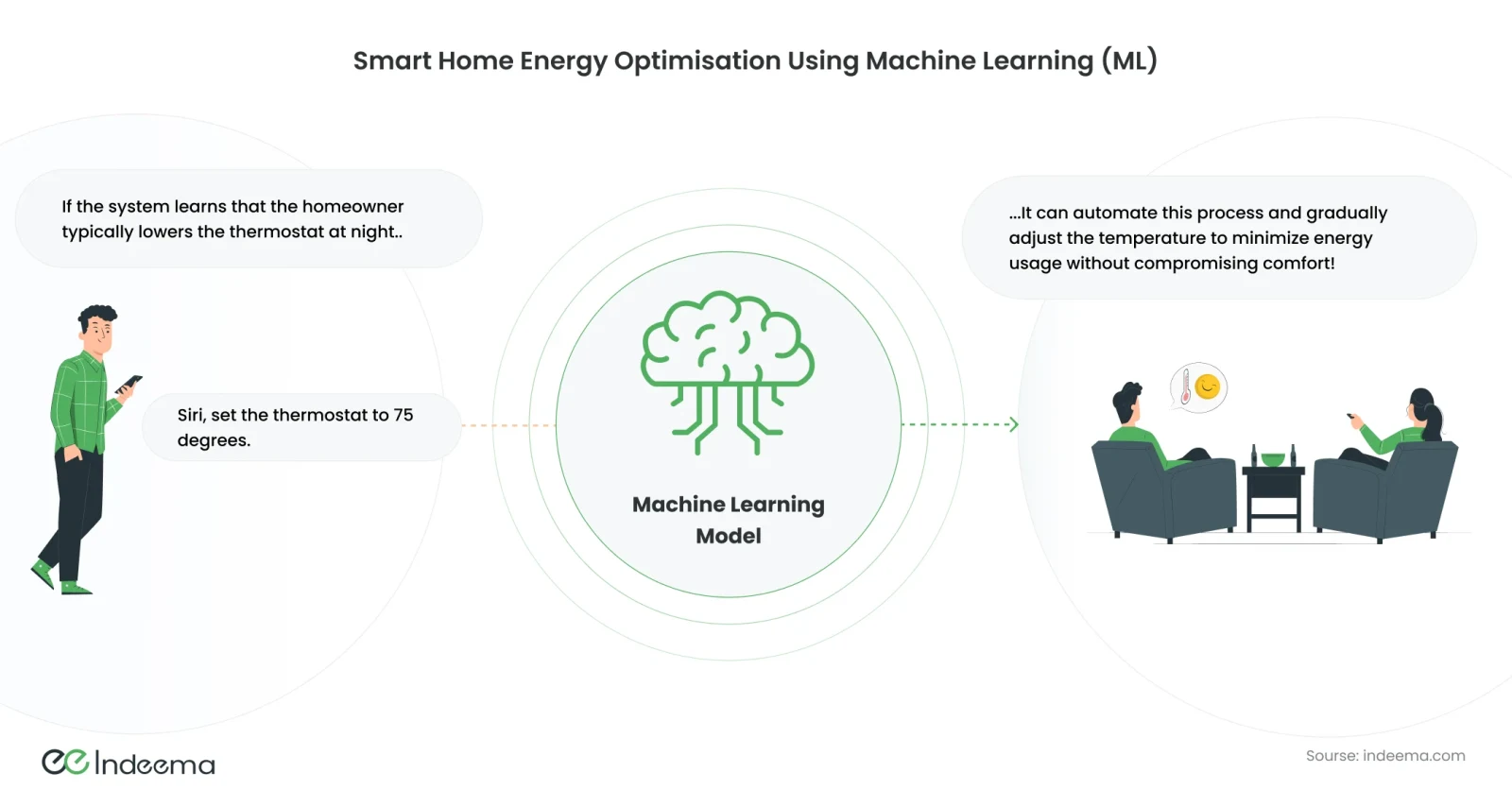
Machine learning makes this possible. As the system collects data, it learns preferences and schedules, so it can anticipate needs instead of waiting for commands. Learning thermostats and adaptive lighting are the most familiar examples.
For an agent to be dependable, it has to live inside the property. Models deployed with runtimes such as TensorFlow Lite or ONNX Runtime on embedded processors, for example NXP i.MX 8, STM32MP1 or NVIDIA Jetson-class modules, make decisions without an internet connection. The choice of sensors, actuators and controllers decides whether that local system is reliable; our guide to smart home device hardware covers those blocks.
- Shifting energy use: run the EV charger or dishwasher when tariffs are low or the home battery is full, without the household changing its routine.
- Acoustic event detection: recognise breaking glass or a call for help on local hardware, without recording or uploading conversations.
- Behavioural comfort models: learn, for example, that a bedroom needs to be cooler on humid nights, and adjust ahead of time.
Voice as the natural interface
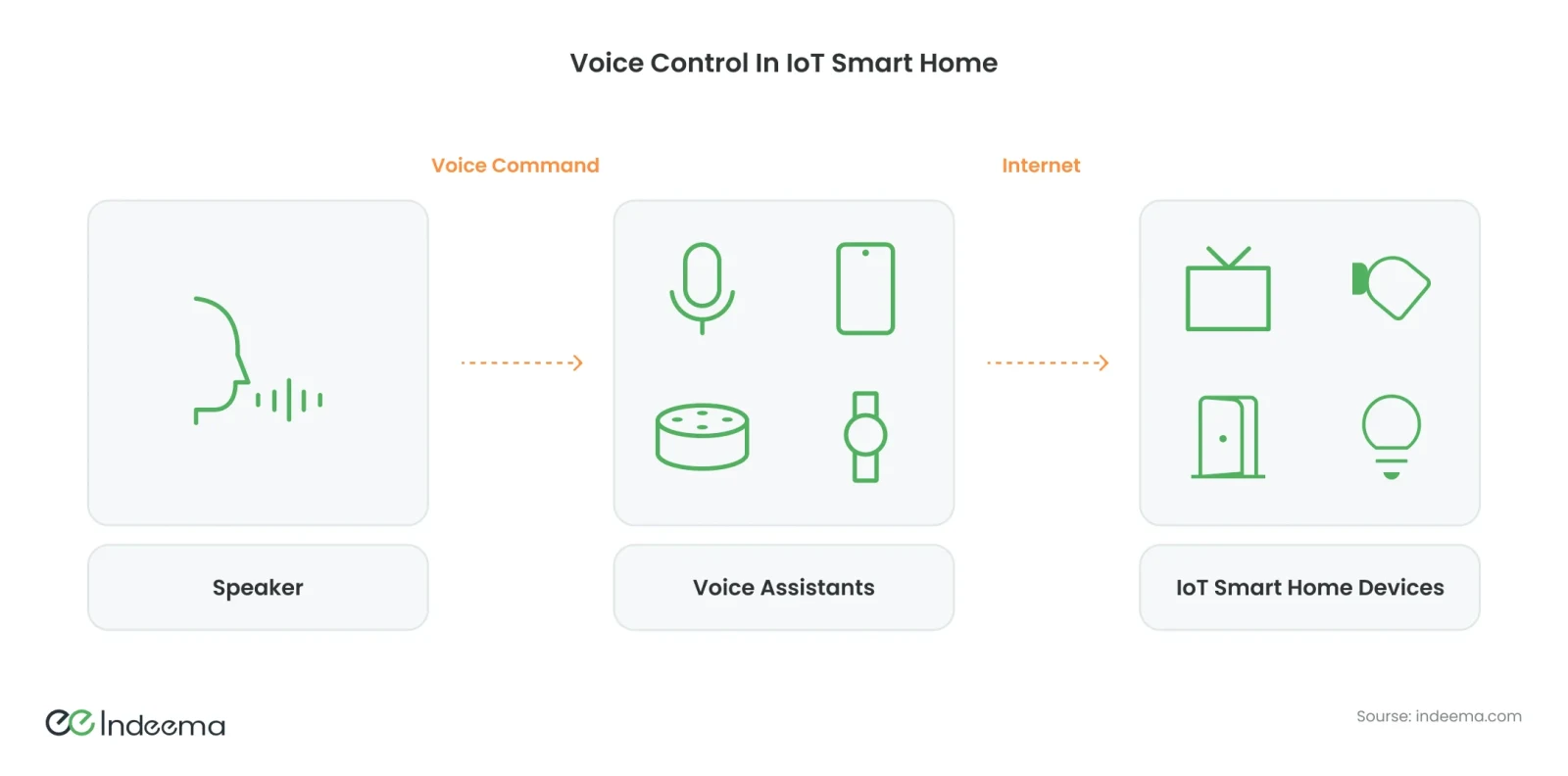
Voice remains the most natural way to talk to a home. Voice assistants now sit in speakers, phones, TVs, earbuds and cameras, but recognition across accents and speech patterns is still imperfect. In a predictive home, voice becomes a way to correct and teach the agent rather than to trigger every action.
Matter, Thread and edge AI: the stack a predictive home needs
Interoperability is often mistaken for intelligence. A home full of Matter-certified devices is a compatible home, not a predictive one. Matter lets devices from different brands understand each other; it does not decide when to pre-cool a house or turn off lights to save money.
- DevicesSensors, thermostats, locks, lights and appliances from different makers.
- MatterThe application-layer standard that gives every device a common vocabulary, so an agent can control new devices without custom drivers.
- ThreadA low-power IPv6 mesh network. It routes around failed nodes and can use more than one border router, so no single box takes the network down.
- Edge AIAgents on a local hub or gateway that model the home, predict and decide.
- CloudOptional: remote access, fleet updates, model improvement and health summaries.
Matter provides the language, Thread the path and edge AI the decisions; without all three the home stays a collection of gadgets.
Because Matter is an open standard, an agent can discover and use devices the household adds later. That protects the investment and avoids the vendor lock-in product teams rightly worry about.
What predictive engineering changes for a product team
For property developers, managers and device makers, the value of a predictive home shows up in operations, not features.
- Maintenance before failure. A local system that watches the electrical signature or vibration of a furnace motor, pool pump or air-conditioning compressor can flag a developing fault before residents notice. Emergency call-outs become scheduled service.
- Energy and grid interaction. Models of thermal inertia reduce overshoot, and with time-of-use or demand-response tariffs the home can pre-cool or pre-heat when energy is cheap and ease off at peak times.
- Fewer support calls. Systems that keep working offline and adapt to routines generate fewer "it stopped working" tickets than cloud-dependent rules.
Security and privacy by design
A home that predicts behaviour collects some of the most sensitive data a product can hold. The more an AI system knows, the better it works, but people are rightly reluctant to share data they do not understand. The answer is to keep it local and be transparent about what leaves the house and why.
- Hardware-rooted identity: each device carries a unique identity anchored in its chip, so it cannot easily be impersonated.
- Secure boot: devices run only signed firmware and refuse to start modified code.
- Local processing: raw schedules, audio and presence data stay on the hub; the cloud receives only summaries such as system health.
- Data minimisation: processing locally reduces exposure and simplifies compliance with privacy laws such as GDPR and CCPA, though it does not remove those obligations.
How to move a product from reactive to predictive
A practical sequence
- Run an internet-isolation test: unplug the router's internet link and list everything that stops working. That is your cloud dependency.
- Move control and safety logic onto the device or a local hub before adding any AI.
- Upgrade sensing where rules fail most often, for example presence sensing that detects stationary people.
- Start with one physical model that has a clear payoff, such as heating and cooling with thermal inertia.
- Choose hub or gateway silicon with headroom for on-device inference and secure boot.
- Support Matter over Thread so the agent can work with devices the household adds later.
- Decide what data ever leaves the home, explain it in the app, and send summaries rather than raw data.
Was this useful?
Where this shows up in our work
ExpertiseAI for IoT & Edge AIRunning models on a hub or gateway, fusing sensor data at the edge and keeping decisions local and private is the AI-for-IoT and edge AI work our engineers own.For how these ideas meet real homes, installers and multi-brand households, see Smart Home & Consumer IoT.
First published
Apply this to your product
Discuss intelligence in your product
Sources
- Connectivity Standards Alliance – Matter accessed 1 October 2026
- Thread Group – What is Thread accessed 1 October 2026