


Insights / Smart Energy
IoT in Renewable Energy: Intelligent Distribution and Consumption
Where IoT fits in a renewable energy system: monitoring generation, scheduling storage, managing distribution and consumption, and deciding what runs at the edge.

The short answer
In renewable energy, IoT connects the assets that produce, store, carry and use electricity to the software that decides what they should do. Sensors on panels, turbines, batteries, meters and lines report their state; edge controllers and cloud platforms combine that data with weather and demand forecasts. The value is control over a supply that depends on the weather: finding faulty assets early, charging and discharging storage at the right time, balancing load, and isolating faults quickly. The key design question is which decisions must run locally and which can wait for the cloud.
Why renewable energy needs IoT
Fossil-fuelled plants produce on demand. Solar and wind produce when the sun shines and the wind blows, and nobody can change that. Using them productively means measuring what is available, predicting what is coming and moving energy through storage and the grid to where it is needed.
That is a data and control problem. Continuous monitoring of remote assets replaces many routine site visits, analytics help localise faults before they become failures, and energy storage absorbs the gap between production and demand. IoT is the layer that makes each of these possible.
- Energy IoT
- Connected sensors, controllers and meters across generation, storage, transmission and consumption, plus the platforms that use their data to monitor, forecast and control an energy system.
Generation: monitoring solar and wind assets
Large solar plants and wind farms spread expensive equipment over wide, often remote areas. Connected monitoring lets operators send people only to the assets that need them.
| Asset | What is measured | What it enables |
|---|---|---|
| Solar panels and strings | Output, temperature and efficiency per panel or string | Finding dirty, faulty or misconfigured panels without inspecting the whole plant |
| Solar trackers | Panel angle against the sun's position | Single- or dual-axis tracking that keeps panels facing the sun |
| Wind turbines | Conversion efficiency, wind speed and direction, generator and bearing condition | Condition-based maintenance and fewer unplanned stops |
| Wind measurement networks | Wind data over time across a region | Wind maps that engineers use to choose turbine locations |
| Site perimeter | Motion, intrusion and tamper sensors | Quick alerts against theft and vandalism of panels and batteries |
Turbines also have an operating window. In very light wind there is not enough power to turn the blades; in very strong gusts the turbine must protect itself. Site data from connected sensors is what tells engineers how often a candidate location falls inside that window.
Storage and home solar systems
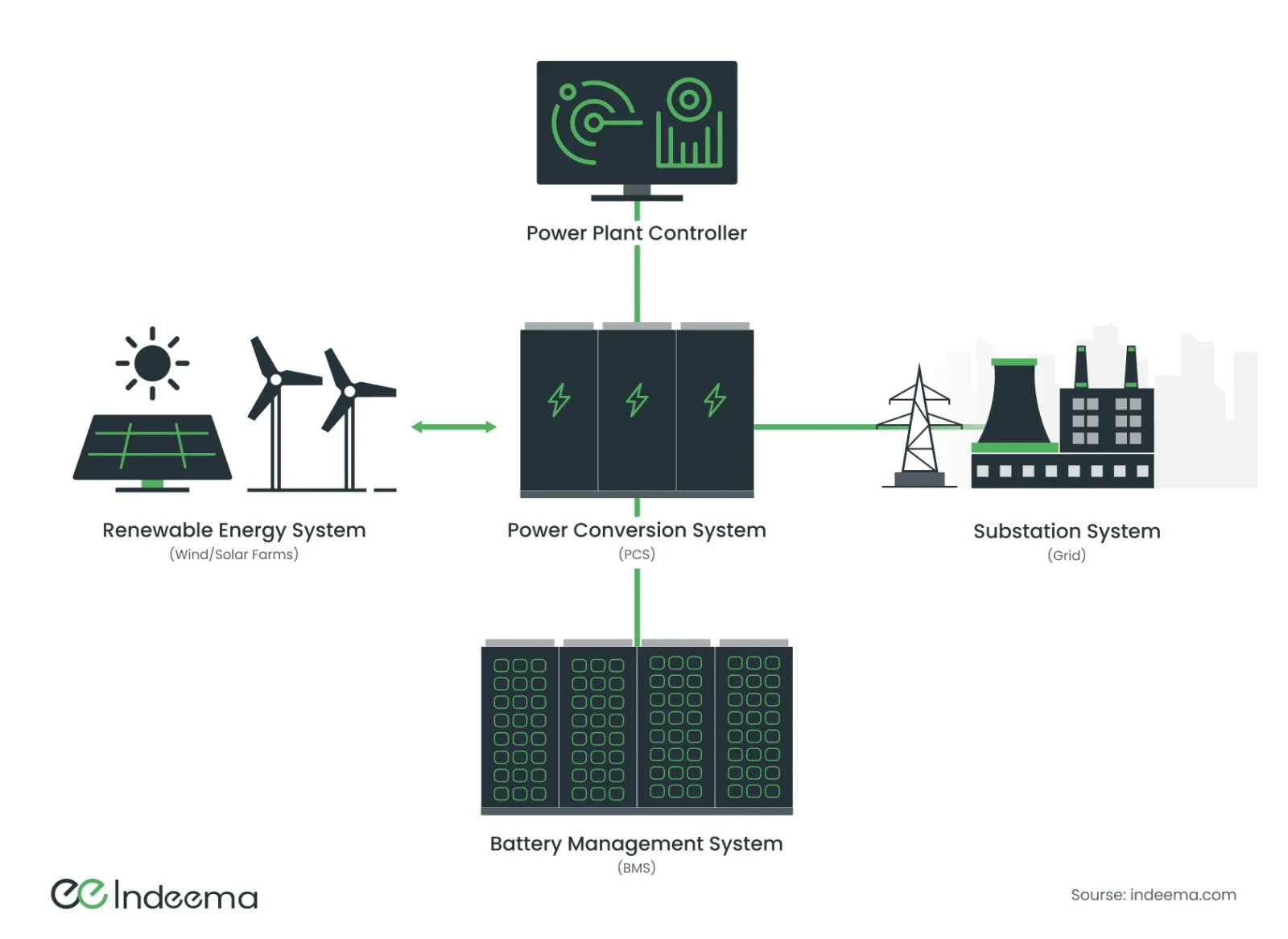
Storage is the partial answer to uneven generation. An IoT system can combine external information, such as weather forecasts and expected near-term consumption, with the battery's state to decide when to charge, when to discharge and when to export. Energy produced at noon is then available in the evening.
The same pattern works at household scale. A home solar system with a controller, battery and inverter can be monitored and managed from a phone, and surplus energy can be exported to the supplier. Some households also rely on solar to keep smart home, security and camera systems running continuously.
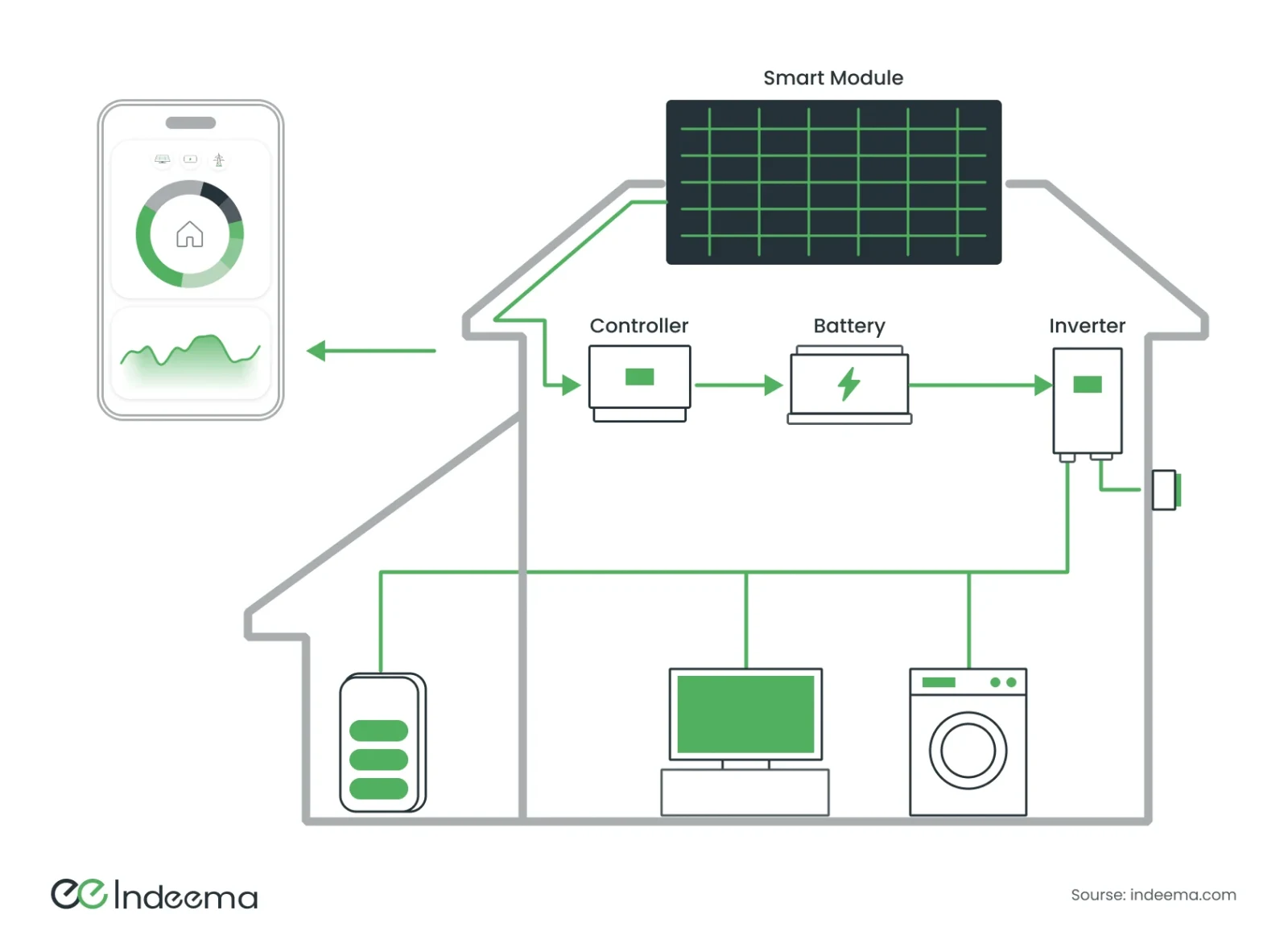
For a worked example of the household case, see how we built an IoT system for managing solar energy usage.
Distribution and consumption: smart meters and smart grids
On the consumption side, smart meters and sensors give households, businesses and energy providers detailed data on when and where energy is used. Combined with cloud analytics, that data supports consumption forecasting, trend detection and tariff design.
- Load management and demand response: real-time consumption data lets providers balance load, manage peaks and ask flexible consumers to shift demand.
- Transmission and distribution: sensors on lines and transformers show how power actually flows, so operators can reduce losses and route energy along existing lines.
- Fault isolation and safety: when a transformer is damaged or a line breaks, real-time data allows that section to be switched off quickly, reducing the risk of fire and electric shock.
Knowing when and where energy is needed is not enough on its own. Delivering it reliably needs the grid to be observable down to the transformer and the meter.
Edge computing in renewable energy systems
Delay matters in energy systems. When conditions change faster than an operator or a cloud service can respond, the decision has to be made close to the equipment. Smart grid architectures are layered, and the edge increasingly sits between the network and the cloud.
- SenseSensors report the state of generation, storage, network performance and consumption.
- TransferA connectivity layer carries the data, over wired, cellular, low-power radio or satellite links depending on the site.
- Decide at the edgeEdge controllers react to fast changes and keep local control running when the upstream link is slow or lost.
- Analyse in the cloudCloud platforms store history and run forecasting, optimisation and fleet-wide analytics.
Fast, safety-relevant responses stay at the edge; optimisation across many sites runs in the cloud and updates edge rules.
Microgrids take this further. A home, apartment block or building can run its own small grid with local generation and storage. The edge system collects the generation and storage data, controls smart inverters and manages consumption. The wider grid becomes a resource it trades with: taking power when local supply is short and accepting surplus when there is too much.
What this changes for an engineering team
An energy IoT system controls physical equipment, so its failures are physical too. That shifts the design priorities away from dashboards and toward three questions.
- Where does each decision run? Protection and fast balancing belong on the device or edge controller; forecasting and optimisation can run in the cloud.
- What happens when the link drops? Every controller needs a defined local behaviour and a way to reconcile its state when it reconnects.
- Who is allowed to change what? Commands that switch equipment or change setpoints need authentication, role-based permissions and an audit trail, because connected energy assets are an attack surface.
How to approach an energy IoT project
Settle these before choosing a platform
- Name the decision the data supports: dispatch a crew, charge a battery, shed a load or isolate a fault.
- Decide which of those decisions must run at the edge and how fast they must be.
- Choose connectivity per site: what is available, what it costs and how it fails.
- Plan local power for remote sensors and edge equipment.
- Define the safe state for every controllable asset when power, network or the controller fails.
- Design identity, signed updates and permissions for every device that can change equipment behaviour.
Where we've built this
Case studyA web service for monitoring and configuring residential solar systemsA solar energy management platform that connects household PV systems to the cloud, visualises energy trends and controls how solar energy is distributed in the home.For how these systems meet the operating constraints of utilities and energy companies, see Engineering connected products for energy environments.
Questions engineers ask
How does the Internet of Things (IoT) impact energy consumption?
IoT gives consumers and providers detailed, real-time data on when and where energy is used. That data supports forecasting, demand response and automatic control, such as running appliances or charging a battery when solar production is high. Connected devices also use energy themselves, so their own power budget is part of the design.
How is IoT transforming the energy industry?
It makes generation, storage and the grid observable and controllable in near real time. Operators can find faulty assets remotely, schedule storage against forecasts, balance load and isolate faults faster than with periodic inspection and manual switching.
How is satellite IoT used in renewable energy projects?
Satellite links connect sensors and edge equipment at remote sites, such as solar farms or wind measurement masts, where cellular or wired networks are not available. Those sites usually also need local power, often a small solar or wind generator with a battery.
Was this useful?
Apply this to your product