


Insights / Cloud & Connected Systems
Narrowband IoT (NB-IoT): How It Works and When to Choose It Over LTE-M or LoRaWAN
What NB-IoT is, how it squeezes into an LTE network, and how to choose between NB-IoT, LTE-M, LoRaWAN and short-range radios for a connected device.

The short answer
Narrowband IoT (NB-IoT) is a low-power cellular standard from 3GPP that runs inside licensed LTE spectrum on a single 180 kHz carrier. It trades speed and mobility for deep indoor coverage, very low power and cheap modules, so a stationary device that sends a few small messages a day can run for years on a battery. Choose it for fixed sensors and meters; choose LTE-M when the device moves, needs lower latency or voice; choose LoRaWAN when you want to run your own network in unlicensed spectrum.
Key takeaways
- NB-IoT suits stationary devices sending small, infrequent messages where coverage indoors or underground matters more than speed.
- LTE-M is the safer cellular choice for anything that moves, needs firmware updates of real size, or needs replies in well under a second.
- LoRaWAN removes the per-device operator contract but makes you responsible for gateways, coverage and duty-cycle limits.
- Battery life comes from how often the device wakes and how good its signal is, not from the radio name on the datasheet.
- Check operator support and roaming for NB-IoT in every target country before you fix the module.
Why the radio choice decides whether a field device is viable
A water meter in a basement, a soil sensor in a field or a tracker on a pallet has to work for years without a battery change, reach a network from wherever it is installed, and cost little enough to deploy by the thousand. Wi-Fi and Bluetooth cannot reach that far, and ordinary LTE drains a battery in days. Low-power wide-area networks (LPWAN) exist to resolve that conflict between range and power.
The radio is also one of the hardest decisions to reverse. It fixes the module, the antenna, the certification path, the connectivity contract and much of the firmware. Picking NB-IoT, LTE-M or LoRaWAN is really picking an operating model for the whole fleet.
Short-range and long-range radios: where NB-IoT sits
Wireless options for connected devices split by coverage radius. Short-range links (NFC, RFID, Bluetooth, Wi-Fi and IEEE 802.15.4-based meshes such as Zigbee and Thread) work within centimetres to roughly a hundred metres and need a phone, hub or gateway to reach the internet. Long-range links reach kilometres and connect the device to a network directly.
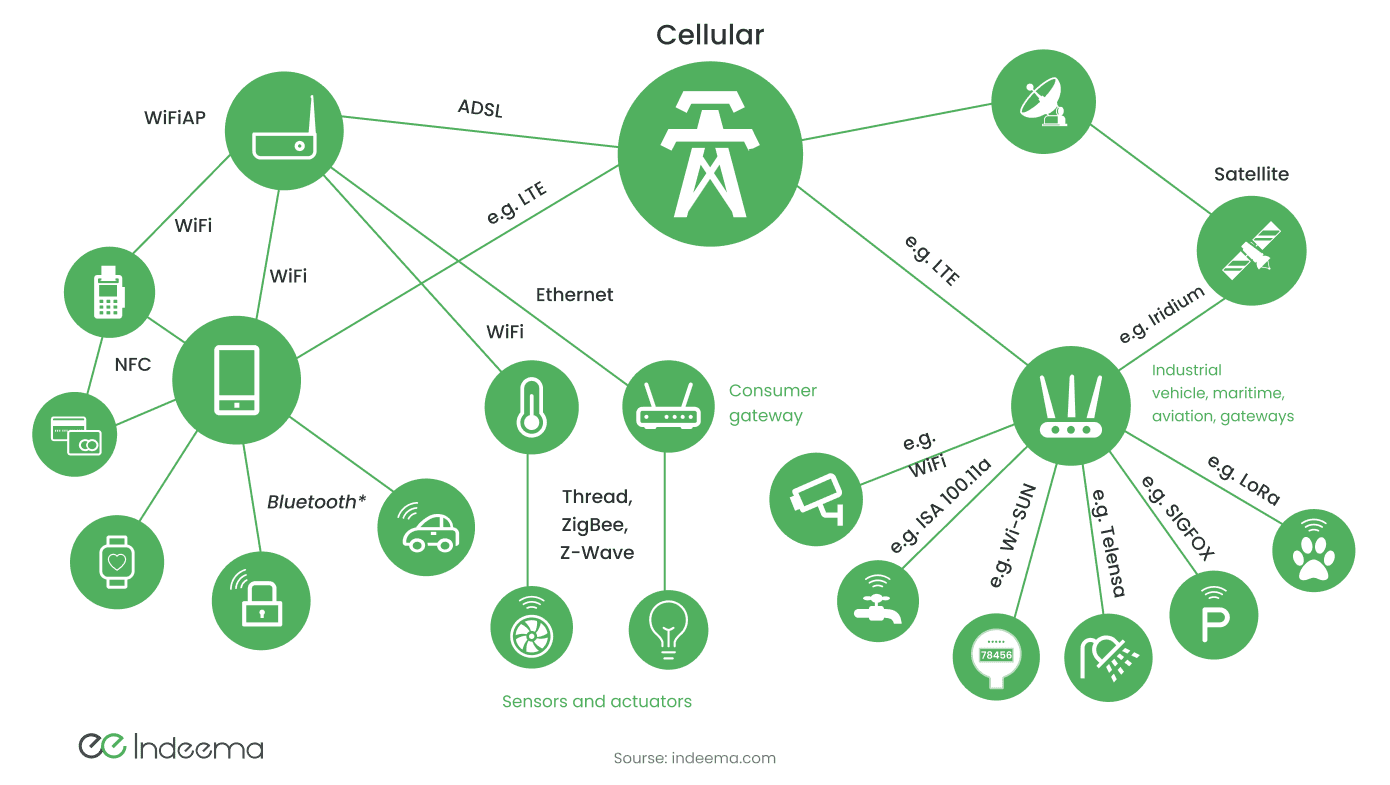
Long-range networks divide again by spectrum. Licensed networks (cellular, including NB-IoT and LTE-M) run in bands an operator has paid for, so interference is controlled and the operator manages coverage. Unlicensed networks (LoRaWAN, Sigfox and others) use free ISM bands below 1 GHz, so anyone can deploy them, but they share the air with other devices and are bound by duty-cycle and power rules. Satellite links cover almost anywhere but cost more in module price and power, so they usually sit on gateways rather than on every sensor.
| Technology | Typical range | Data rate class | Power profile | Reaches the internet via |
|---|---|---|---|---|
| NFC | A few centimetres | Hundreds of kbps | Very low; often powered by the reader | A phone or reader; used for pairing and authentication |
| RFID | Centimetres to metres (passive), further for active tags | Identity and small payloads | Passive tags need no battery | A fixed or handheld reader |
| Bluetooth LE | Tens of metres | Up to around 1–2 Mbps | Low; coin-cell devices are common | A phone or gateway |
| IEEE 802.15.4 (Zigbee, Thread) | Tens of metres per hop; mesh extends it | Up to 250 kbps at 2.4 GHz | Low; battery sensors last years | A hub or border router |
| Wi-Fi | Tens of metres | High, up to gigabit class | High; usually mains-powered | The building's router |
| NB-IoT / LTE-M | Kilometres, with deep indoor coverage | Tens of kbps (NB-IoT) to around 1 Mbps (LTE-M) | Very low with power-saving modes | The mobile operator's network directly |
| LoRaWAN | Kilometres, line-of-sight dependent | Hundreds of bps to tens of kbps | Very low | Your own or a public LoRaWAN gateway |
- LPWAN
- Low-power wide-area network: a class of radio technologies built for devices that send small amounts of data over kilometres while running for years on a battery. NB-IoT, LTE-M, LoRaWAN and Sigfox are the best-known examples.
How NB-IoT works
3GPP completed the first NB-IoT specification in 2016 (Release 13) and has extended it in later releases. It reuses LTE's structure, so an operator can usually add it to existing base stations with a software upgrade rather than new towers. To cut module cost and power, the standard removes much of what a phone needs.
- One narrow carrier: a 180 kHz carrier, the width of a single LTE resource block, with 15 kHz subcarriers on the downlink.
- Half-duplex operation: the device either transmits or receives, never both at once, which simplifies the radio front end.
- Single-tone or multi-tone uplink: single-tone transmission (at 15 kHz or 3.75 kHz spacing) concentrates power for devices at the edge of coverage.
- Repetition for coverage: messages can be repeated many times so a weak signal still gets through, reaching basements and underground meter pits.
- Small transport blocks and a simplified retransmission scheme, which keep the protocol stack and memory small.
Three ways an operator can place the carrier
| Mode | Where the 180 kHz carrier sits | Effect on the network |
|---|---|---|
| Stand-alone | In its own spectrum, for example a re-farmed 200 kHz GSM channel | No impact on LTE capacity; needs spare spectrum |
| Guard band | In the unused guard band at the edge of an LTE carrier | Uses spectrum that would otherwise be idle |
| In-band | Inside an LTE carrier, taking one resource block | Shares capacity with LTE traffic; most flexible for the operator |
Where the battery life comes from
The radio is only efficient if the device spends almost all its time asleep. Two network features make that possible, and both need to be agreed with the operator, not just enabled in firmware.
- Deep sleep (PSM)The modem is effectively off but stays registered, so it does not need to re-attach on every wake-up.
- Wake and measureThe microcontroller wakes on a timer or event, reads the sensor and powers the modem.
- SendThe device sends a small uplink, repeating transmissions as needed for its coverage level.
- Listen brieflyA short active window lets the platform deliver a command or acknowledgement.
- Back to sleepThe device returns to PSM or extended discontinuous reception (eDRX), where it checks for paging only occasionally.
The longer the device can stay in PSM or eDRX, the longer the battery lasts, and the longer the platform must wait to reach it.
NB-IoT vs LTE-M vs LoRaWAN
These three cover most low-power wide-area designs. The differences that matter are not the peak data rates but mobility, latency, who runs the network and how the device gets firmware updates.
| Property | NB-IoT | LTE-M (Cat-M) | LoRaWAN |
|---|---|---|---|
| Spectrum | Licensed LTE bands | Licensed LTE bands | Unlicensed sub-GHz ISM bands |
| Who runs the network | Mobile operator | Mobile operator | You, a community network or a LoRaWAN operator |
| Channel width | 180 kHz | 1.4 MHz | 125 kHz or more per channel |
| Data rate class | Tens of kbps | Up to around 1 Mbps | Hundreds of bps to tens of kbps |
| Latency | Seconds are normal | Tens to hundreds of milliseconds | Seconds; downlink mostly after an uplink |
| Mobility | Limited; best for fixed devices | Full handover between cells | Possible, but no handover concept |
| Voice | No | Supported (VoLTE) where the operator allows | No |
| Indoor and underground reach | Strongest of the three | Good | Good with well-placed gateways |
| Firmware updates over the air | Possible but slow; keep images small | Practical | Very slow; needs special techniques |
| Recurring cost | Operator data plan per device | Operator data plan per device | Gateways and network server, or a provider fee |
Sigfox and other ultra-narrowband networks send very small messages with tight daily limits, and their coverage and ownership have changed over time. Check current availability in each target country before designing around them. EC-GSM-IoT depends on GSM networks, which many operators have switched off or are retiring, so it is rarely a sensible choice for a new product.
Is NB-IoT 4G or 5G?
NB-IoT and LTE-M were born as LTE (4G) technologies, and 3GPP has carried both forward as the massive-IoT path within 5G: they can run alongside 5G NR carriers in the same spectrum. Devices that need more than LTE-M offers, such as wearables or video-capable sensors, are the target of the reduced-capability 5G NR device class (RedCap). 3GPP has also specified NB-IoT and LTE-M over satellite (non-terrestrial networks), which can extend coverage to remote sites with a compatible module and service.
Where NB-IoT fits and where it does not
NB-IoT is strongest when the device is fixed, the data is small and the install location is hard to reach: utility meters, parking and occupancy sensors, environmental and agricultural sensors, alarms and leak detectors. In these cases the long sleep, deep coverage and absence of any gateway outweigh the slow link.
- Moving assets such as vehicles, trackers on trucks or wearables are better served by LTE-M, which hands over between cells.
- Devices that must answer quickly, for example a lock or a remote shut-off valve, may find NB-IoT's wake-up and paging delay too long.
- Large or frequent firmware updates take a long time over NB-IoT. Design the update scheme, image size and delta updates before choosing it.
- Private sites such as a farm, campus or factory where you control the area can be cheaper on LoRaWAN, with no per-device contract.
Many cellular modules support both NB-IoT and LTE-M, and fall back from one to the other. That keeps options open across operators and countries, but the firmware must then handle two sets of timing, power and roaming behaviour.
Choosing the module and network
NB-IoT runs in licensed LTE bands, typically low bands below 1 GHz where coverage is best, but the exact bands differ by operator and region. The module, antenna and certification need to cover every band in every market you plan to sell into.
Before you fix the radio
- Confirm NB-IoT and LTE-M support, bands and roaming with the operators in each target country.
- Write down the message size, frequency and the longest acceptable delay for a command to reach the device.
- Decide how firmware updates will reach the fleet and how large an image the link can realistically carry.
- Agree PSM and eDRX timers with the operator; the network can override what the device requests.
- Measure current consumption on the real module in the worst coverage location you expect.
- Plan antenna placement and enclosure together; a small ground plane or metal housing costs coverage.
Engineering trade-offs
NB-IoT vs LTE-M
- You gain
- NB-IoT reaches deeper indoors, uses the narrowest channel and gives the lowest module power in fixed, low-traffic devices.
- You pay
- It has limited mobility, higher latency and slow firmware updates; operator support and roaming vary more than for LTE-M.
- Choose it when
- NB-IoT for stationary meters and sensors in hard-to-reach places; LTE-M for anything that moves, needs quick replies or regular updates.
Operator cellular vs your own LoRaWAN network
- You gain
- Cellular needs no gateways and gives managed coverage across a country; LoRaWAN avoids per-device contracts and works where you build it.
- You pay
- Cellular adds a data plan per device and dependence on the operator's roadmap; LoRaWAN makes you responsible for gateways, coverage planning and duty-cycle limits.
- Choose it when
- Cellular for devices spread across cities or countries; LoRaWAN for dense deployments on a site you control.
Single-mode vs dual-mode cellular module
- You gain
- A module supporting both NB-IoT and LTE-M can follow whichever network is available in each market.
- You pay
- It adds firmware and test effort for two behaviours, and can cost more than a single-mode part.
- Choose it when
- Dual-mode when the product ships into several countries or operators; single-mode when one operator and one region are fixed.
Decision matrix: which radio for which device
Start from how the device moves, how fast it must respond and who will run the network; the radio follows.
| Device | Moves? | Response time needed | Data per day | Recommended radio |
|---|---|---|---|---|
| Utility meter in a basement | No | Minutes to hours | A few small readings | NB-IoT |
| Asset tracker on vehicles or containers | Yes | Seconds | Frequent position updates | LTE-M, often with NB-IoT fallback |
| Sensors across one farm or campus | No | Minutes | Small, periodic readings | LoRaWAN on your own gateways |
| Remote actuator such as a valve or lock | No | Under a few seconds | Commands and status | LTE-M |
| Sensors in a home or one building | No | Sub-second | Small, frequent events | Thread, Zigbee or Bluetooth LE via a hub |
Decision rule: Decide mobility, response time and network ownership first. If the device is fixed, tolerant of delay and installed where coverage is hard, NB-IoT is usually the best fit; otherwise start from LTE-M or a site network.
Implementation notes for an NB-IoT device
The issues that usually surface between the first prototype and a fleet in the field:
- Use a lightweight application protocol (for example CoAP, LwM2M or MQTT-SN) and binary payloads; every byte costs airtime and battery.
- Batch readings and send them together rather than waking the modem for each one.
- Handle long and variable latency in the platform: commands queue until the device wakes, so design for eventual delivery.
- Log coverage level, retries and wake time from the modem, so battery problems can be traced to sites with poor signal.
- Keep firmware images small and support delta or resumable updates, so an interrupted update does not brick a device.
- Test with the operator's network or a network simulator, not only on a bench with strong signal.
Common mistakes
Quoting the datasheet battery life
Real coverage, retries and wake-ups drain the battery far sooner than planned, and field replacements cost more than the device.
Instead: Model battery life from measured current at the worst expected coverage, with margin.
Assuming NB-IoT works everywhere LTE does
The device ships into a country or operator without NB-IoT support or roaming, and cannot connect.
Instead: Confirm support and roaming per market, or choose a dual-mode module.
Choosing NB-IoT for a moving device
Limited mobility causes dropped sessions and long reconnects as the device changes cells.
Instead: Use LTE-M for mobile assets.
Designing the update scheme after the radio
A full firmware image takes too long to send over a slow, sleepy link, so security fixes cannot reach the fleet in time.
Instead: Size the update mechanism and image before committing to NB-IoT.
Questions engineers ask
What is NB-IoT?
Narrowband IoT is a low-power cellular standard from 3GPP. It runs on a 180 kHz carrier inside licensed LTE spectrum and is designed for devices that send small amounts of data, need deep indoor coverage and must run for years on a battery.
What is a significant advantage of NB-IoT over regular cellular connectivity?
Coverage and power. NB-IoT reaches further indoors and underground than ordinary LTE because it can repeat transmissions, and its power-saving modes let a device sleep for long periods while staying registered on the network.
Is NB-IoT 4G or 5G?
It was introduced as an LTE (4G) technology, and 3GPP has carried it forward as part of 5G's massive-IoT path. NB-IoT carriers can run alongside 5G NR in the same spectrum.
What frequency bands does NB-IoT operate on?
NB-IoT uses licensed LTE bands, most often low bands below 1 GHz for better coverage. The exact bands depend on the operator and region, so the module must support the bands used in each target market.
How does NB-IoT work?
The device spends most of its time in a deep-sleep mode while staying registered, wakes to send a small message over a narrow carrier, briefly listens for commands, then sleeps again. Repetition lets weak signals get through at the edge of coverage.
What is the difference between NB-IoT and LTE-M?
Both are low-power cellular standards. NB-IoT uses a narrower channel, reaches deeper indoors and suits fixed devices. LTE-M (also called eMTC) offers higher data rates, lower latency, full mobility and voice support, so it suits moving or interactive devices.
Was this useful?
Where this shows up in our work
ExpertiseIoT Product Engineering & Development ServicesChoosing between NB-IoT, LTE-M and LoRaWAN, then making the module, firmware, power budget and cloud side work as one system, is connected-product engineering we take on end to end.Metering and remote energy assets are where NB-IoT's deep coverage and long sleep matter most. See Engineering connected products for energy environments.
Apply this to your product
Talk through your device architecture
Sources
- 3GPP – NB-IoT accessed 1 October 2026
- LoRa Alliance – About LoRaWAN accessed 1 October 2026