


Insights / Embedded & Firmware
IoT Security Regulations and Standards: What They Ask of Connected Devices
The three kinds of rule that now shape connected-device security, the standards behind them, and what each asks the firmware and product team to build.

The short answer
IoT security regulation now works at three levels. Product rules set what a connected device must do before it can be sold in a market, such as the EU Cyber Resilience Act and the UK's consumer product security regime. Operator rules such as the EU's NIS 2 Directive require organisations in critical sectors to manage cyber risk, including their suppliers. Technical standards, chiefly ETSI EN 303 645 for consumer devices and ISA/IEC 62443 for industrial systems, supply the concrete requirements. They share a baseline: no default passwords, vulnerability handling, secure updates and protected data.
From guidance to law: how IoT security regulation developed
Rules arrived after connected devices were already everywhere. NIST's 2014 cybersecurity framework was not written for IoT, but its principles applied to it. In 2015 the ITU-T's Internet of Things Global Standards Initiative worked towards common technical standards, which were advisory only.
The first law aimed squarely at IoT device security was the US IoT Cybersecurity Improvement Act of 2020. It made NIST and the Office of Management and Budget responsible for minimum security standards for IoT devices bought by federal agencies, so it works through procurement rather than a ban on sale. In Europe, the EU Cybersecurity Act of 2019 created a certification framework, and ETSI EN 303 645 followed in 2020 as a security baseline for consumer IoT.
Since then the direction has been from voluntary guidance to binding requirements on the product itself. Several jurisdictions now set mandatory security requirements for connected products placed on their markets, and many of those requirements trace back to the same baseline.
Three kinds of rule, and which one reaches your product
| Layer | Examples | Who it binds | What it means for the device |
|---|---|---|---|
| Product security law | EU Cyber Resilience Act; EU radio equipment cybersecurity requirements; UK consumer connectable product security regime | Manufacturers, importers and distributors placing products on that market | Security requirements for design, updates and vulnerability handling, checked before sale |
| Operator and sector law | EU NIS 2 Directive; US federal IoT procurement rules | Organisations in covered sectors, and government buyers | Reaches device makers through customer and supply-chain requirements |
| Technical standards | ETSI EN 303 645; ISA/IEC 62443 | Voluntary on their own; referenced by laws, certification schemes and customers | The concrete engineering checklist teams build and test against |
The EU Cyber Resilience Act applies horizontal cybersecurity requirements to hardware and software products with digital elements sold in the EU, across planning, design, development and maintenance, and requires manufacturers to handle vulnerabilities through the product's lifecycle. Its obligations phase in over several years, and some product categories need third-party assessment before sale. The UK regime for consumer connectable products bans universal default passwords and requires a way to report vulnerabilities and a published minimum period of security updates.
ETSI EN 303 645: the consumer IoT baseline
ETSI EN 303 645, first published in 2020 after collaboration between industry, academia and government, sets a security baseline for consumer IoT: baby monitors and connected toys, smoke detectors, door locks and window sensors, cameras, speakers and TVs, wearable health trackers, home automation and alarm systems, connected appliances, smart assistants, and the gateways and hubs that connect them. Devices intended mainly for manufacturing, other industrial use or healthcare settings are outside its scope.
The standard is not binding on its own, but several national certification and labelling schemes are built on it, and product security laws draw on the same provisions. Its 13 provisions read as an engineering backlog.
| Provision | What the device team has to build |
|---|---|
| No universal default passwords | Unique per-device credentials provisioned in manufacturing, or a password the user must set at first use |
| Implement a means to manage reports of vulnerabilities | A public disclosure policy, a contact point and an internal triage process |
| Keep software updated | Signed, verified over-the-air updates and a stated support period |
| Securely store sensitive security parameters | Keys and credentials in a secure element or protected storage, never hard-coded in firmware |
| Communicate securely | Encrypted, authenticated links between device, app and cloud |
| Minimise exposed attack surfaces | Close debug ports and unused services; least privilege in firmware |
| Ensure software integrity | Secure boot that refuses unsigned or modified firmware |
| Ensure that personal data is secure | Protection of personal data in transit and at rest, and clear information to users |
| Make systems resilient to outages | Defined behaviour and local function when the network or power drops |
| Examine system telemetry data | Collect and monitor security-relevant telemetry for anomalies |
| Make it easy for users to delete user data | A simple reset that removes personal data from the device and associated services |
| Make installation and maintenance of devices easy | Secure set-up that a non-expert completes correctly |
| Validate input data | Input validation on every user interface, API and network message |
NIS 2: operator obligations that flow down to suppliers
The NIS 2 Directive, Directive (EU) 2022/2555, raises cybersecurity requirements for essential and important entities across a wide range of sectors, including digital infrastructure and digital service providers. Member states transpose it into national law, so details vary by country. It requires organisations to take technical, operational and organisational measures, including:
- risk analysis and information system security policies;
- incident handling, backup management and disaster recovery;
- supply chain security;
- security in the acquisition, development and maintenance of network and information systems;
- cybersecurity training;
- multi-factor or continuous authentication where appropriate.
NIS 2 binds the operator, not the device. A device maker meets it indirectly: customers in covered sectors pass supply-chain requirements down to their vendors, so security documentation, update commitments and incident cooperation become part of the sale. Certain providers established outside the EU that offer services in it must also designate a representative in a member state.
ISA/IEC 62443: the industrial counterpart
The ISA/IEC 62443 series has set security requirements for industrial automation and control systems since around 2010. In 2021 the IEC designated it a horizontal standard, applicable across sectors such as manufacturing, metals and mining, power and water utilities, healthcare and transportation. It defines shared terminology, how to determine an appropriate security level, risk-assessment processes, and a security methodology for product developers.
For a device or component supplier, two parts matter most: the secure product development lifecycle requirements (62443-4-1) and the technical security requirements for components (62443-4-2). Unlike the EU instruments, 62443 is an international standard used in many markets, and industrial buyers increasingly ask suppliers to show how a product meets it.
Where connected devices actually expose data
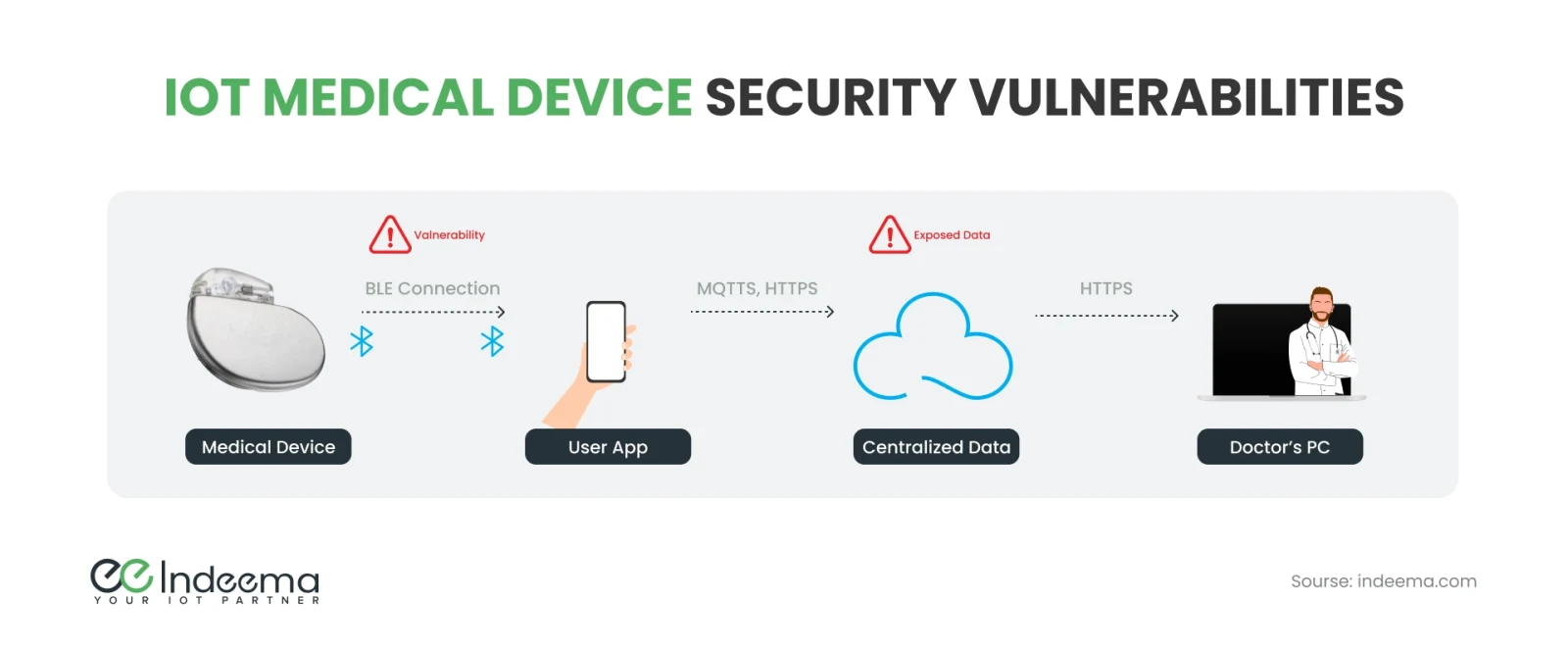
Regulators focus on outcomes, but the weak points are concrete. A connected medical device shows the pattern: data moves over a Bluetooth link to a phone app, then to a central platform and on to a clinician. The pairing link and the central store are where an attacker gains the most.
- Healthcare: a compromised device or a malicious app update can harm patients, and recovering devices already in use is slow and expensive.
- Vehicles and transport: a widely reported 2015 demonstration showed researchers remotely controlling a production SUV, and vulnerabilities in vehicle telematics are still being found.
- Consumer electronics: buyers and retailers increasingly look for security information, and product laws now make a baseline mandatory.
- Anyone holding sensitive data: one connected device on a corporate network, even a thermostat, can become the way in.
The common engineering response is the same in each case: unique identity per device, encryption on every hop, signed updates and a plan for handling the next vulnerability. Our article on the Microchip Connectivity Framework shows one way to keep messages encrypted end to end across mixed links. Encryption alone does not meet any of these frameworks: they also cover process, policy and support commitments.
What a product team should do now
Turning regulation into device requirements
- List the markets and customer sectors the product will be sold into, and get the applicable rules confirmed by a specialist.
- Use ETSI EN 303 645 (consumer) or ISA/IEC 62443-4-2 (industrial) as the engineering baseline even where it is not mandatory.
- Provision unique credentials per device; never ship a shared default password.
- Build secure boot and signed over-the-air updates in the first hardware revision, and decide the support period.
- Publish a vulnerability disclosure policy and set up internal triage before launch.
- Keep a software bill of materials so you can tell quickly whether a new vulnerability affects your fleet.
- Document security design decisions; customers under NIS 2 and 62443 will ask for evidence.
Questions engineers ask
What security measure ensures IoT devices have strong initial credentials?
Unique credentials for every device, provisioned during manufacturing, or a requirement for the user to set a strong password at first use. Shipping one universal default password across a product line is what ETSI EN 303 645 and several product security laws prohibit.
Was this useful?
Where this shows up in our work
ExpertiseEmbedded and firmware engineeringUnique credentials, secure boot, signed updates and fixing vulnerabilities over a product's support period are firmware work. Our embedded team builds them into devices from the first revision.Where a compromised device can harm a patient, security requirements reach further still. See Healthcare.
Apply this to your product
Review your device security approach
Sources
- ETSI – Consumer IoT security (EN 303 645) accessed 1 October 2026
- European Commission – Cyber Resilience Act accessed 1 October 2026
- European Commission – NIS 2 Directive accessed 1 October 2026
- European Commission – EU Cybersecurity Act accessed 1 October 2026
- ISA – ISA/IEC 62443 series of standards accessed 1 October 2026
- US Congress – IoT Cybersecurity Improvement Act of 2020 (H.R. 1668) accessed 1 October 2026