


Insights / AI / Edge AI
What Is Physical AI? An Engineer's Definition, Examples and What It Takes to Build
Physical AI senses the physical world and acts in it. What it takes to build one into a product: sensors, onboard compute, limits on autonomy, failure handling and field updates.

The short answer
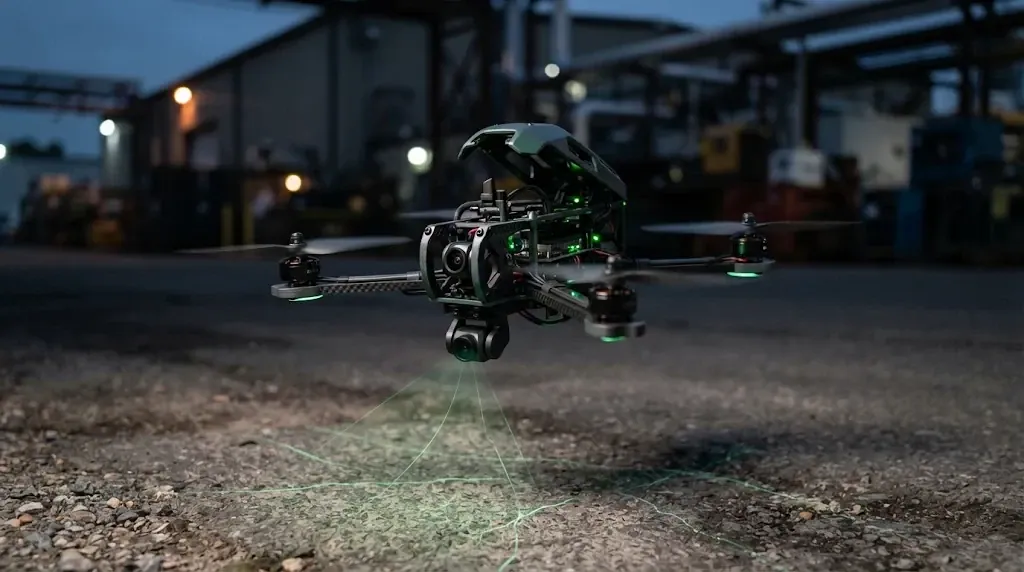
Physical AI is artificial intelligence that perceives the physical world through sensors and acts in it through motors, valves, brakes or other actuators. Think of robots, drones, vehicles and industrial machines that work out what is happening and then move. When generative AI gets something wrong, a person reads the answer and ignores it. When physical AI gets something wrong, something moves that shouldn't. So the model turns out to be the smaller part of the job. The product also needs the right sensors, compute that fits its power and heat budget, a clear limit on what the AI may do by itself, a safe response to every failure, and a way to update the model once devices are in the field.
Key takeaways
- Physical AI is AI whose output is an action in the physical world: a movement, a force, a switched valve.
- The model is one step in a loop of sense, interpret, decide, act and learn. A poor sensor or a slow controller limits the result as much as a poor model.
- Before choosing a model, agree how much the AI may do on its own for each task.
- Work out early what happens on sensor loss, low confidence and a dropped link. Fixing it after devices ship costs far more.
- Run real-time control on its own controller, so a failing model can't destabilise the machine.
Physical AI, defined
- Physical AI
- Physical AI is artificial intelligence that perceives the physical world through sensors and acts in it through actuators, so its output is a movement or a physical change rather than text or an image.
Chip makers, cloud providers and consultancies all use the term now. NVIDIA describes physical AI as what lets machines such as factory robots and robotaxis perceive, understand and act in the real world. IBM keeps it shorter: AI systems that operate in and interact with the physical world, rather than only in software.
The idea is older than the name. Robotics researchers have talked about embodied AI for years, and industrial engineers have built machines that sense and react for decades. What changed is the hardware and the models. Perception models got good enough, and accelerators small and efficient enough, to put learned behaviour into products that ship in volume, like drones, mobile robots, vehicles and production-line machines.
One question settles it: if the AI is wrong, does something move that shouldn't? If it does, you're building physical AI, and failure handling matters as much as accuracy.
Physical AI overlaps with two older terms, robotics and embodied AI. As the International Federation of Robotics summarises the ISO 8373 standard, a robot needs a degree of autonomy: the ability to perform intended tasks based on current state and sensing, without human intervention. Embodied AI comes from research. A 2021 survey in IEEE Transactions on Emerging Topics in Computational Intelligence describes it as AI whose agents learn through interactions with their environments, rather than from images, video and text collected from the internet. Physical AI is the newer industry term and the widest of the three. It covers robots, and also drones, vehicles and industrial machines that nobody would call a robot.
| Term | Where it comes from | Typical example |
|---|---|---|
| Robotics | An engineering field and its standards | An industrial arm welding car bodies |
| Embodied AI | Research on agents that learn through a body | A robot that learns to open doors in simulation |
| Physical AI | The current industry term for AI that senses and acts | A drone, a vehicle or a motor that diagnoses its own faults |
How physical AI differs from generative AI
Both use the same families of models, and robots increasingly use generative models to understand scenes and spoken instructions. What differs is what happens to the output.
| Question | Generative AI | Physical AI |
|---|---|---|
| What does it produce? | Text, images, code | A movement, a force, a switched valve, a flight path |
| What does a wrong output cost? | Someone spots the mistake and moves on | Damage, downtime or a safety incident |
| How fast must it answer? | Seconds are acceptable | Often tens or hundreds of milliseconds, every time |
| Where does it run? | Mostly in a data centre | Often on the device, within a power and heat budget |
| Where does training data come from? | Text and images on the internet | Sensor data from real machines, which has to be collected, labelled or simulated |
| How is it updated? | Redeploy a service | Update thousands of devices in the field, safely |
IBM makes the same point: in software a person can ignore a wrong prediction, while in a physical system the same mistake can be serious. That's why most of the work in physical AI is systems engineering: sensors, control, power, safety and updates. The model is one component among them.
How physical AI works: the loop behind every product
Every physical AI product, from a delivery robot to a vibration monitor that stops a machine, runs the same loop.
- SenseCameras, accelerometers, current sensors, lidar or GNSS measure the world, at a rate that captures what the decision needs.
- InterpretFirmware and models turn signals into meaning: an object, a fault type, a position, a trend.
- DecideRules, a model or a person choose what to do, within the limits set for that task.
- ActA real-time controller turns the decision into motion or a physical change, and keeps the machine stable while it does.
- LearnData from the field returns, models are retrained, and a signed update goes back to the device.
The loop closes through the field: real behaviour improves the next model.
Authority and fallbacks come before the model
Before anyone picks a model, someone has to answer a harder question: how much is the system allowed to do by itself? We set autonomy one decision at a time on four levels: a person decides, the system recommends, the system acts within rules, and the system acts within explicit limits. The same drone can steer itself around an obstacle at the fourth level and still need a person to approve a landing in an unknown place.
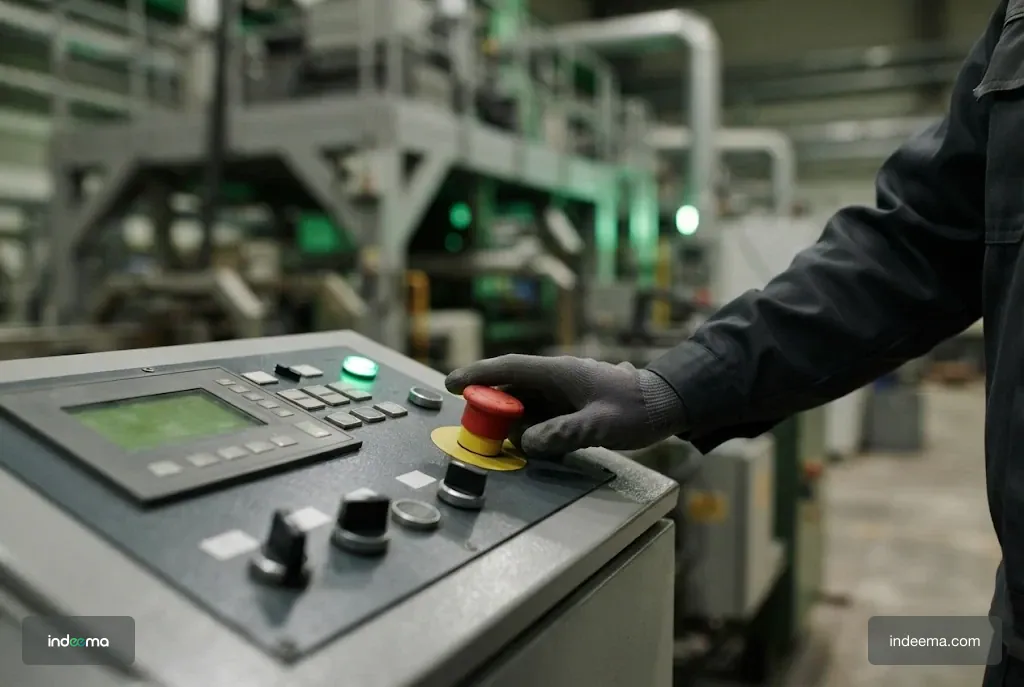
Every level also needs a plan for the moments when the AI can't be trusted. Sensor loss, low confidence, lost connectivity, uncertain model output, subsystem failure and leaving the operating envelope each need a designed answer before the system is given that authority.
Failure cases to design before you hand over authority
- A sensor fails or gives implausible values
- The model is not confident enough to act
- The link to the operator or cloud drops
- A subsystem, such as a motor or a battery cell, fails
- The machine leaves the conditions it was designed and tested for
It's far cheaper to write these down at the start than to discover them after devices ship.
Where physical AI runs: device, edge or cloud
A decision can run on the device, at the edge, in the cloud or in an application, depending on latency, connectivity, privacy, compute, power and data. There's no best place in general. Anything that has to happen in a fraction of a second, or while the link is down, runs on the device. Learning across the fleet, long-term analysis and retraining go to the cloud.
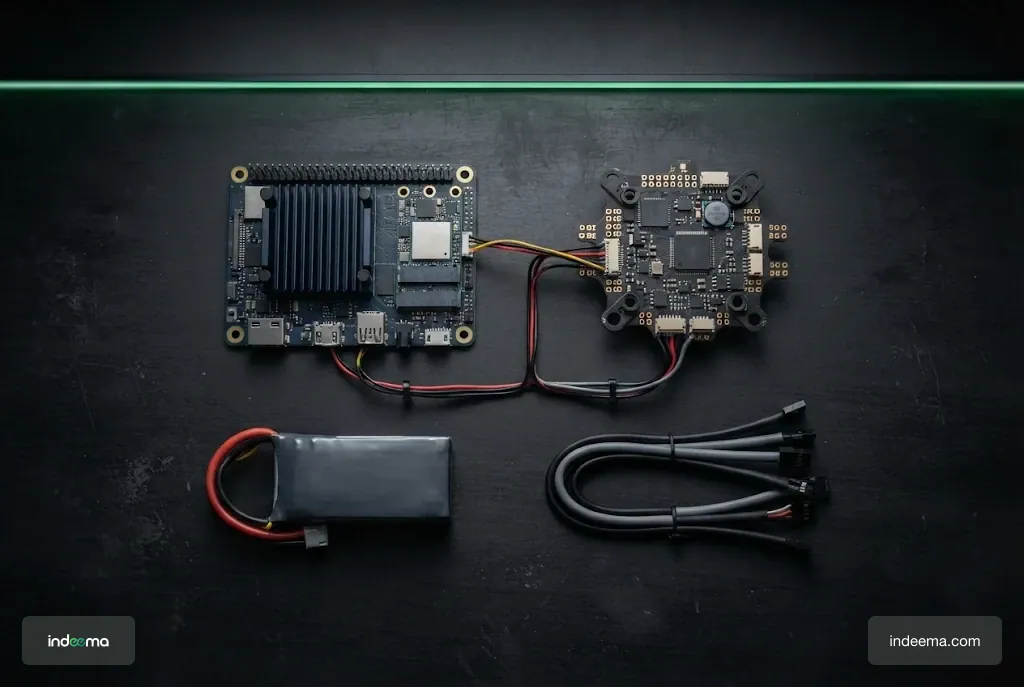
Onboard AI uses less power than most people expect, at least next to the motors. On a quadcopter we presented with the Edge AI Foundation, the single-board computer and Hailo-8 accelerator draw several watts during inference, while the four-motor drive draws hundreds of watts in flight. On that system, end-to-end image processing, from capture to post-processing, takes roughly 100 to 300 milliseconds.
We keep one rule here: separate the two. Real-time control runs on its own controller and stays responsible for stability. The AI computer sits next to it and sends requests. If the model crashes or slows down, you lose a feature and the machine keeps working.
Physical AI examples and applications from our projects
Three projects show the same loop at different scales.
A drone that follows a person. For Hover Hero, a coastal-safety start-up, we built a concept-stage proof of concept for a drone that could hover and follow a person and alert wearable devices, built on open-source flight software; object recognition was simulated at that stage. For the next stage, the requirements kept the flight firmware unmodified and put detection in a separate edge-processing module that sends it commands over MAVLink. That's the separation rule from the section above.
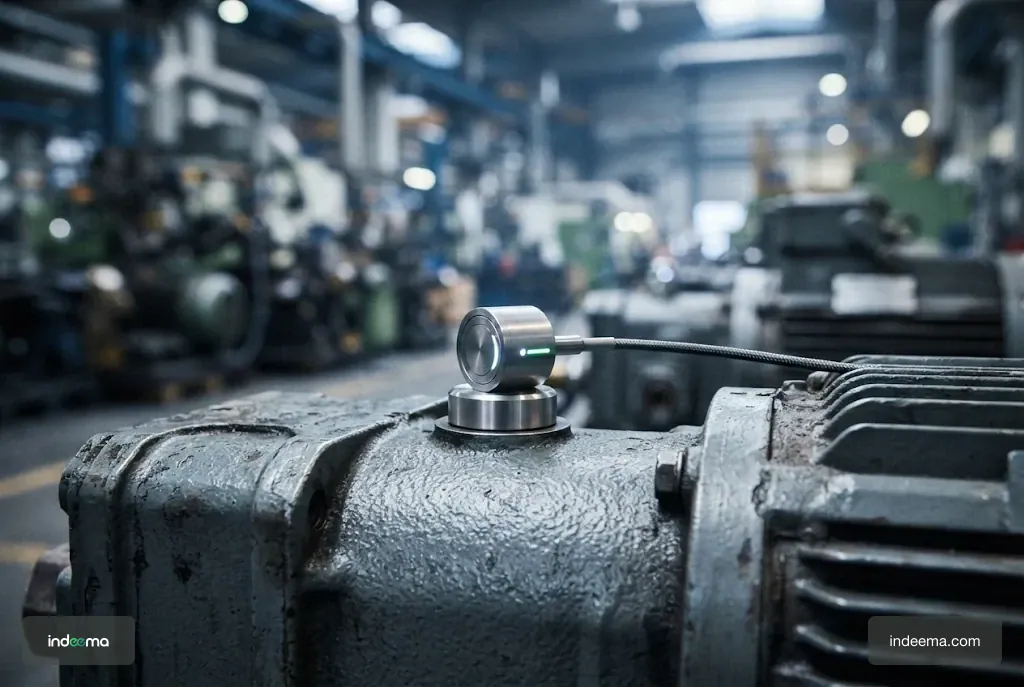
A machine that diagnoses itself. iReDS is a vibration-diagnostics product owned and developed by Indeema. In iReDS, AI analyses vibration signals and identifies the type of fault in bearings and other rotating mechanisms, so maintenance can be planned before a breakdown. The output is a work order instead of a motor command, yet the loop is identical: sense, interpret, decide, act, learn.
A drone that counts what it sees. In the onboard AI drone architecture we described for orchards, the vision model runs on the aircraft and sends detections, not raw video, to the cloud, which retrains the model and sends it back to the fleet.
None of them is a humanoid robot, and that's typical. Most physical AI reaching the market over the next few years will be existing machines that sense more, handle a few more situations on their own and improve with each update.
Physical AI applications in other industries
Outside our own work, the clearest examples are in warehouses, on roads and in fields.
Warehouses. Amazon has deployed its 1 millionth robot. Its DeepFleet foundation model coordinates how those robots move and, by Amazon's account, improves the travel time of its robotic fleet by 10%.
Roads. Waymo reports that it more than tripled its annual volume to 15 million rides in 2025, and counted 127 million miles of fully autonomous operation by February 2026.
Fields. John Deere's See & Spray uses camera vision and machine learning to tell crops from weeds, and sprays only the weeds.
Each of these runs the loop described above. And each depends as much on sensors, onboard compute, safety logic and fleet-wide updates as on the model itself.
Questions to answer before you build
- Which actions must the product take on its own, and which stay with a person?
- What happens, physically, when the model is wrong?
- Which sensors and sampling rates does each decision really need?
- What is the latency budget, and does it rule out the cloud?
- Does onboard compute fit the power, heat and cost budget of the device?
- Is real-time control isolated from AI compute?
- Where will training data come from, and how does a new model reach devices in the field?
It's normal for several of these to be open at the start. It's also where physical AI projects often lose months. Indeema engineers intelligence together with the device that carries it: sensor, firmware, connectivity, data path, model and update path are treated as one design problem. Our page on autonomous and intelligent physical systems shows how we work.
Engineering trade-offs
Decide on the device
- You gain
- Works without a link, answers within milliseconds and keeps raw data local.
- You pay
- Model size is limited by the accelerator and the power budget, and every update needs a safe path to the fleet.
- Choose it when
- The action must happen in real time or while the connection is unreliable.
Decide in the cloud
- You gain
- Larger models, simple updates and fleet-wide context.
- You pay
- Adds network delay and stops working when the link drops.
- Choose it when
- The decision can wait seconds or longer, or needs data from many devices.
Recommend, let a person decide
- You gain
- Lowest risk, and every decision becomes labelled training data.
- You pay
- Slower, and needs an operator available.
- Choose it when
- Errors are expensive and the model has not yet earned trust in the field.
Common mistakes
Choosing the model before the authority level
The team optimises accuracy for a decision the product should never make alone.
Instead: Set the authority for each decision first, then pick the simplest model that serves it.
Letting AI compute control stability
A slow or crashed model takes the whole machine down with it.
Instead: Keep real-time control on its own controller and let the AI computer send requests.
Treating the first model as finished
Accuracy drops as conditions in the field drift, with no way to fix it.
Instead: Plan data return, labelling, retraining and signed updates from the first prototype.
Where we've built this
Case studyTurning machine vibration into condition-monitoring viewsiReDS, Indeema's own vibration-diagnostics product: AI identifies the fault type in rotating machinery so maintenance is planned before a breakdown.Questions engineers ask
What is physical AI in simple terms?
Physical AI is AI that can sense the real world and act in it. Instead of writing an answer on a screen, it moves something: a robot arm, a drone, a vehicle or a valve on a machine.
What are examples of physical AI?
Factory and warehouse robots, self-driving vehicles, drones that follow a person or count fruit, and industrial machines that detect their own faults and trigger maintenance. Most physical AI in products today is an existing machine that senses more and decides a little on its own.
What is the difference between physical AI and generative AI?
Generative AI produces text, images or code that a person can read and ignore. Physical AI produces an action in the physical world, so a wrong output has a physical cost. That makes latency, safety, fallbacks and field updates central to the engineering.
Is physical AI the same as embodied AI or robotics?
They overlap. Embodied AI is the research term for intelligence that learns through a body. Robotics is the wider engineering field. Physical AI is the current industry term for AI that perceives and acts in the physical world, including drones, vehicles and industrial machines that are not robots in the usual sense.
Does physical AI need the cloud?
Not for every decision. Decisions that must happen in real time or without a connection run on the device. The cloud is used for fleet data, long-term analysis, retraining models and sending updates back to devices.
How does physical AI work?
Sensors measure the world, firmware and models interpret the signals, rules or a model choose what to do within set limits, a real-time controller carries out the action, and data from the field comes back to retrain the model. In most products only one or two of these steps use AI.
Was this useful?
Where this shows up in our work
ExpertiseR&D services for hardware and software productsNeed sensing, firmware, onboard AI and the update path designed together, and proven on one prototype before you commit to a product?Apply this to your product
Discuss intelligence in your product
Sources
- NVIDIA Glossary: What Is Physical AI? accessed 9 November 2026
- IBM Think: What is physical AI? (Cole Stryker, 19 January 2026) accessed 9 November 2026
- International Federation of Robotics: Service Robots (definition after ISO 8373) accessed 9 November 2026
- Duan et al., A Survey of Embodied AI: From Simulators to Research Tasks (IEEE TETCI; arXiv 2103.04918) accessed 9 November 2026
- About Amazon: Amazon launches a new AI foundation model to power its robotic fleet and deploys its 1 millionth robot accessed 9 November 2026
- Waymo blog: Accelerating our global growth: Waymo raises $16 billion investment round (2 February 2026) accessed 9 November 2026
- John Deere: See & Spray Gen 2 accessed 9 November 2026