


Insights / Hardware & Electronics
Raspberry Pi for IoT: When a Single-Board Computer Fits, and When It Doesn't
What a Raspberry Pi is, how it differs from a microcontroller, and when a single-board computer suits a prototype or gateway rather than a production device.

The short answer
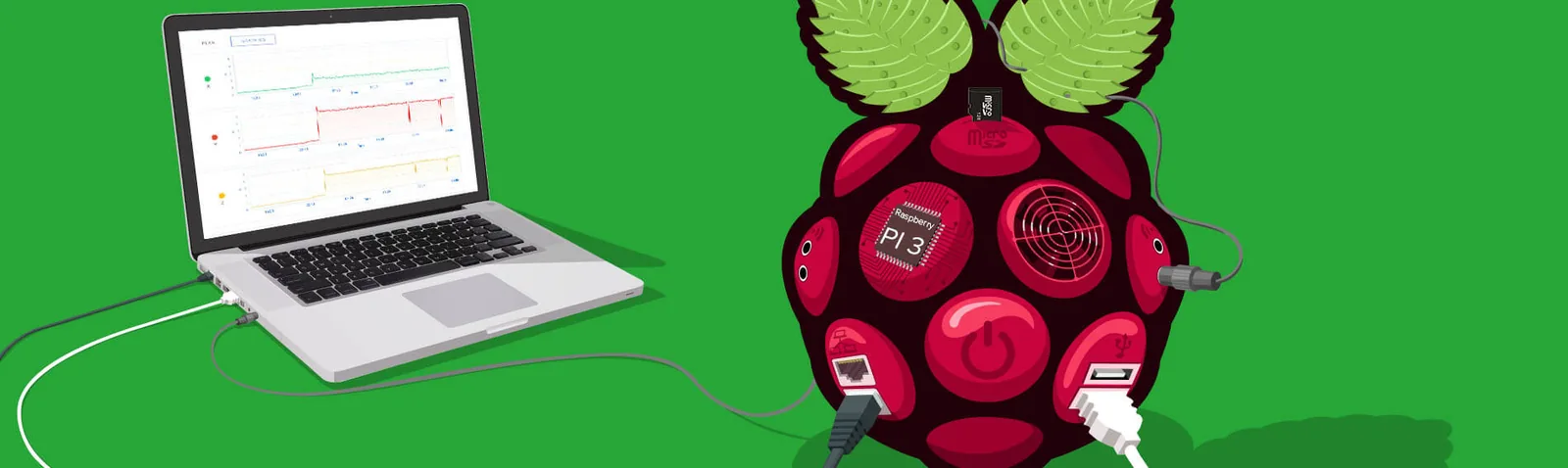
A Raspberry Pi is a single-board computer: an application processor, RAM, storage and ports on one board, running a full operating system such as Linux. In IoT it is an excellent tool for prototypes, gateways and edge devices that need networking, a camera, a display or local processing. It is usually the wrong choice for a battery-powered sensor or a high-volume product, where a microcontroller on a custom board wins on power, cost, boot time and long-term control. Many products use both: a Pi to prove the idea, then a production design built around what the prototype taught.
What a Raspberry Pi is
The Raspberry Pi began as a low-cost computer for learning, and its stated purpose is still computers that people use to learn, solve problems and have fun. That origin explains its strengths: it is cheap, well documented, supported by a very large community, and capable enough to run the same software stack as a server.
What separates it from a desktop computer is the number and kind of connections. Alongside USB, networking and video, it exposes general-purpose input/output (GPIO) pins and camera and display interfaces, so sensors, actuators and modules can be wired straight to it. Successive generations have added processing power, memory and connectivity; check the current lineup rather than relying on any one model's specification.
- Single-board computer (SBC)
- A complete computer, with processor, memory, storage interface and input/output, built on one circuit board and normally running a general-purpose operating system.
Microcomputer or microcontroller: the difference that matters
Strictly, a Raspberry Pi is a microcomputer. A microcontroller (MCU) is a single chip with a processor core, flash and RAM that runs one firmware image directly, often on a real-time operating system (RTOS) or none at all. The two solve different problems.
| Aspect | Single-board computer (e.g. Raspberry Pi) | Microcontroller on a custom board |
|---|---|---|
| Software | Full OS such as Linux; any language, libraries, containers | Bare-metal firmware or an RTOS; C, C++ or Rust |
| Power | Watts while running; no true deep sleep | Milliamps active, microamps or less asleep; can run for years on a battery |
| Start-up | Seconds to boot the OS | Milliseconds from reset to running |
| Timing | Best effort; the OS can delay a task | Deterministic; suits control loops and precise sampling |
| Storage | SD card or eMMC; must be protected against power loss and wear | Internal flash with the firmware image; data in flash or EEPROM |
| Unit cost and size | Fixed board cost and form factor | Only the parts the product needs; small and cheap at volume |
| Maintenance | OS and package updates and security patches for the device's life | A single signed firmware image to update |
Neither is better in general. The question is which properties your device needs: rich software and processing, or low power, fast start-up and tight control.
Where a Raspberry Pi fits in an IoT product
- Proof of concept and prototypes. Wire sensors and actuators to the GPIO, write the logic in a high-level language and show a working system in days. It is the fastest way to test whether the idea and the data make sense.
- Gateways. A gateway collects data from many low-power nodes over Bluetooth LE, Zigbee or other radios and forwards it to the cloud over Ethernet, Wi-Fi or cellular. It is mains-powered and needs a network stack, buffering and remote management, which suits an SBC well.
- Edge processing and vision. Camera input, local inference and protocol translation need more compute and memory than a typical microcontroller offers.
- Displays and operator panels. A screen, a browser-based interface or a kiosk is far easier on Linux than on bare-metal firmware.
- Low-volume and internal equipment. Test rigs, lab tools and small fleets where development speed matters more than unit cost or power.
From board to product: compute modules and custom designs
When an SBC-class processor is the right engine for a production device, the usual step is a compute module: the processor, memory and storage on a small module that plugs into a carrier board you design. The carrier board carries only the connectors, power, sensors and radio your product needs, in your enclosure's shape.
When the prototype shows the device does not need a full OS, the better step is a microcontroller design, often with a radio system-on-chip, on a custom board. The prototype's logic is reimplemented as firmware, and the hardware is sized to the measured power budget and the real sensor set.
The engineering implication: the prototype board is not the product
A development board proves behaviour. Shipping it as the product moves the risk into the field: SD cards corrupted by power cuts, an operating system that needs patching for years, a power draw that rules out batteries, a form factor the enclosure has to work around, and a bill of materials that cannot fall with volume. Each of these has a known fix, but the fixes are design work, not configuration.
The useful output of a Raspberry Pi prototype is therefore not the board but the requirements it reveals: which sensors are needed, what sampling rate, how much processing, what must happen offline and how much power the device really uses. Those numbers decide whether the production device is a compute-module design or a microcontroller design.
How to choose between an SBC and a microcontroller
Decide with these questions
- Does the device run on a battery or harvested energy? If so, start from a microcontroller.
- Does it need a full OS: a camera pipeline, local inference, a display or many network protocols? An SBC or compute module fits.
- Must it start instantly or control something with tight timing? Use a microcontroller, alone or alongside the SBC.
- How many units will ship? At volume, a custom board sized to the product usually wins.
- Who will maintain the software for the product's life? An OS-based device needs patching and secure remote updates.
- Use the prototype to measure power, sampling and processing needs, then design for production from those numbers.
Questions engineers ask
Is a Raspberry Pi a microcomputer?
Yes. A Raspberry Pi is a single-board microcomputer: a processor, memory, storage interface and ports on one board, running a full operating system such as Linux.
Is a Raspberry Pi a microcontroller or a microcomputer?
The main Raspberry Pi boards are microcomputers. A microcontroller is a single chip that runs one firmware image without a general-purpose OS, which gives it far lower power draw and faster start-up. The Raspberry Pi family also includes microcontroller boards such as the Pico, which are a different class of device.
Was this useful?
Where this shows up in our work
ExpertiseHardware and electronics engineering for connected productsTurning a Raspberry Pi prototype into a production device, whether a compute-module carrier board or a microcontroller design, is hardware and electronics work we do with the firmware team.Apply this to your product