


Smart home / Hub, cloud and delivery pipeline
Smart-home hub with sensors, cloud back end and mobile appDevOps, firmware, cloud, UX/UI and mobile connectivity engineering
Extending a leak-detection product into a connected smart-home hub
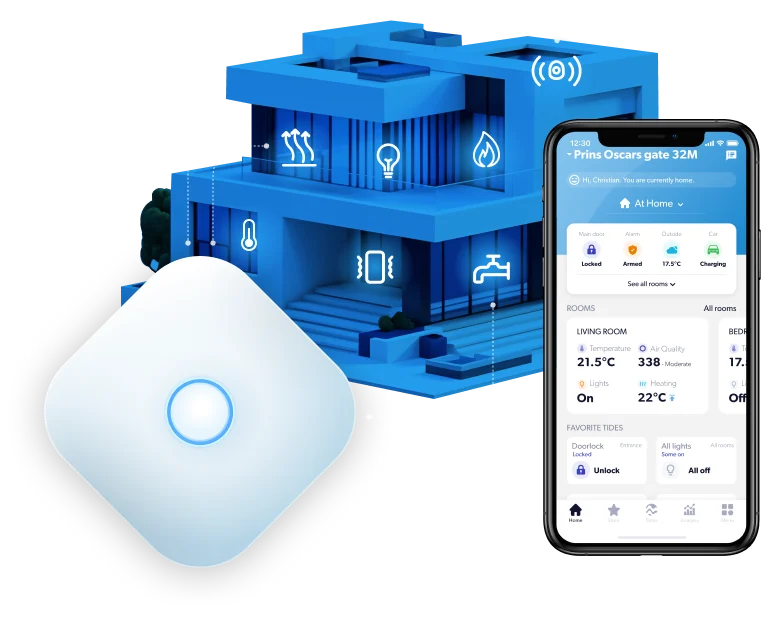
The client already sold a water-leak detection product with a growing user base. Its next step was a smart-home system built around a hub that brings leak detection together with lighting control, door locks, fire alarms, heating control and per-device energy monitoring, so household members can see live data and usage graphs in one app.
The client first needed an organised flow of commits and a CI/CD architecture for its development. As the product grew, it also needed interface design, embedded work, cloud infrastructure and mobile connectivity so the hub could work with the smart-home devices on the client's compatibility list.
- Product
- Smart-home hub with sensors, cloud back end and mobile app
- Buyer
- Device companies extending an existing connected product into a broader platform
- Engagement
- DevOps, firmware, cloud, UX/UI and mobile connectivity engineering
- Indeema scope
- CI/CD for firmware and back end, AWS environments and operations, Firmware proofs of concept, Embedded logging and radio traffic, UX/UI design, BLE connectivity and provisioning
The product need
What had to become possible
The client first needed an organised flow of commits and a CI/CD architecture for its development. As the product grew, it also needed interface design, embedded work, cloud infrastructure and mobile connectivity so the hub could work with the smart-home devices on the client's compatibility list.
Ownership, made clear
Where the work started and what Indeema owned
Starting system
Leak-detection product
A water-leak detection product already on the market, with limited integration with other devices.
Device compatibility list
A list of popular smart-home devices the hub had to work with.
Other engineering teams
The mobile app was built jointly by several teams; Indeema's part was the BLE connectivity API and the device provisioning section.
Indeema owned
CI/CD for firmware and back end
Build CI/CD pipelines for ESP-IDF builds that automate compilation, testing and deployment with SonarQube code-quality checks, automated integration tests and versioning, then extend the same approach to back-end services.
AWS environments and operations
Set up and run the AWS infrastructure with sandbox, development, pre-production and production environments, including IAM, OTA update jobs, S3 storage and resource monitoring.
Firmware proofs of concept
Run proofs of concept to validate technology choices, including Apple HomeKit compatibility and Alexa and Siri integration at firmware level.
Embedded logging and radio traffic
Implement a dedicated logging system across the hub's multiple embedded processors and optimise radio traffic between many sensors and one hub.
UX/UI design
Run use-case and user-flow workshops, design the app in Figma including per-device energy consumption graphs, and write the user-interface and acceptance-criteria document.
BLE connectivity and provisioning
Create the API for BLE connectivity and design the in-app provisioning flow that onboards devices and connects them to the cloud back end.
Worked with
Phone to hub
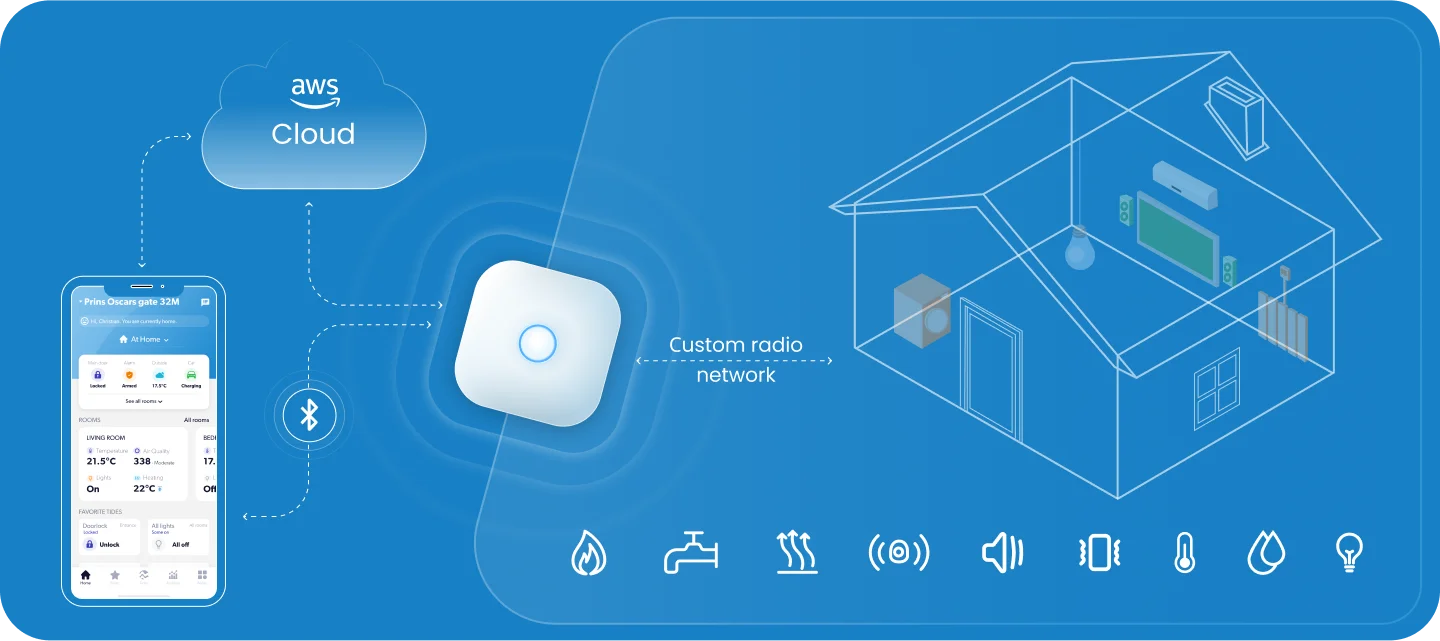
The app onboards the hub over Bluetooth Low Energy.
Hub to home devices
The hub talks to leak, fire, heating, lighting, lock and other home sensors and devices over a custom radio network.
Hub and app to cloud
The hub and the app communicate through the AWS back end, which also distributes OTA updates.
Smart-home ecosystems
Firmware proofs of concept tested Apple HomeKit compatibility and Alexa and Siri integration.
Product constraints
What made the engineering difficult
- 01
Many devices, one hub
The hub had to work with a wide range of third-party smart-home devices, which meant working through each product's technical documentation.
- 02
Debugging across several processors
Multiple embedded processors and a large volume of log data at different levels made standard logging insufficient.
- 03
Radio traffic from many sensors
Many sensors communicating with a single hub required radio traffic to be optimised to keep communication efficient and latency low.
- 04
Distributed teams
Several international teams worked on the product, so time zones and blockers needed a defined process and automated checks.
Engineering judgement
Decisions that shaped the product
Start with the delivery pipeline
The engagement began with a CI/CD prototype, so firmware builds, tests and deployments were automated before the product scope expanded.
One pipeline approach for firmware and back end
The same CI/CD conventions, quality gates and versioning were applied to ESP-IDF firmware and back-end services, which supports traceability and rollbacks.
Separate cloud environments
Sandbox, development, pre-production and production environments in AWS keep testing apart from the live system.
Validate integrations with proofs of concept
HomeKit, Alexa and Siri integration was tested in firmware proofs of concept before being relied on in the product.
Product system
How the product moves from signal to user
- 01
Home devices
Leak, fire, heating, lighting and lock devices report to the hub.
- 02
Hub
Collects device data over a custom radio network, with multi-processor logging.
- 03
AWS back end
IoT Core, Lambda, DynamoDB and S3 handle data and OTA update jobs.
- 04
Mobile app
Onboards devices over BLE and shows control screens and energy graphs.
- 05
CI/CD
Builds, tests and deploys firmware and back-end services with quality gates.
Delivered product capability
What the product can do
- 01
Automated firmware pipeline
Build, test and deploy ESP-IDF firmware automatically, with SonarQube checks and versioned releases.
- 02
Multi-environment AWS setup
Run sandbox, development, pre-production and production environments with IAM management, S3 storage and monitoring.
- 03
OTA updates
Create and manage over-the-air update jobs for devices in the field.
- 04
Hub logging
Collect and analyse logs from multiple embedded processors at different levels.
- 05
BLE onboarding
Onboard devices from the app over BLE and connect them to the cloud back end.
- 06
App design
Device control screens and per-device energy consumption graphs designed for the app.
Product change
What changed for the product team
The client's development moved onto automated, quality-gated pipelines and separate AWS environments, while its product grew from a leak-detection device into a hub-based smart-home system with BLE onboarding, OTA updates, embedded logging and an app designed around device control and energy graphs.
For a company extending an existing connected device into a wider platform, the case shows how delivery infrastructure, cloud operations, firmware integration work and app onboarding can be added around a product that other teams are also building.
- Automated CI/CD for ESP-IDF firmware and back-end services, with SonarQube checks, integration tests and versioning.
- AWS infrastructure with four environments, OTA update jobs and ongoing monitoring and IAM audits during maintenance.
Product evidence
A closer look at the product
Technology, in context
ESP-IDF · Bluetooth Low Energy · AWS IoT Core · AWS Lambda · Amazon EC2 · Amazon DynamoDB · Amazon S3 · AWS IAM · GitLab CI/CD · SonarQube · Flutter · Figma
A comparable product problem?
Smart-home hub extension
Bring the product context, the system that already exists and the engineering decision you need to make.