


Insights / Drones & UAV
Internet of Military Things: How IoT Is Used in Military Systems
Where connected devices are used in defence, from soldier health monitoring to logistics and sensing, and why resilient communications decide whether any of it works.

The short answer
The Internet of Military Things is the use of connected sensors, wearables, vehicles, drones and communication networks in defence, so that data from the field reaches the people who need it. The main uses are soldier health monitoring, logistics and equipment condition, situational awareness from sensors and unmanned systems, and the communications that tie them together. The engineering problem is the same as in any critical IoT system, only harsher: links will be jammed or lost, devices run on limited power, and every node has to be trusted.
What the Internet of Military Things means
Military technology has always shaped how armed forces operate. The current shift is connectivity: many devices in a modern force carry sensors and radios, and value comes from combining their data rather than from any single device.
- Internet of Military Things
- A network of connected devices used in defence (wearable sensors, vehicles, unmanned systems, logistics tags and command systems) that exchange data so commanders, medics and logisticians can act on current information. Internet of Battlefield Things (IoBT) is a closely related term focused on the combat environment.
A note on naming: the abbreviation IoMT is most widely used for the Internet of Medical Things, connected healthcare devices. To avoid confusion, this article spells out Internet of Military Things in full.
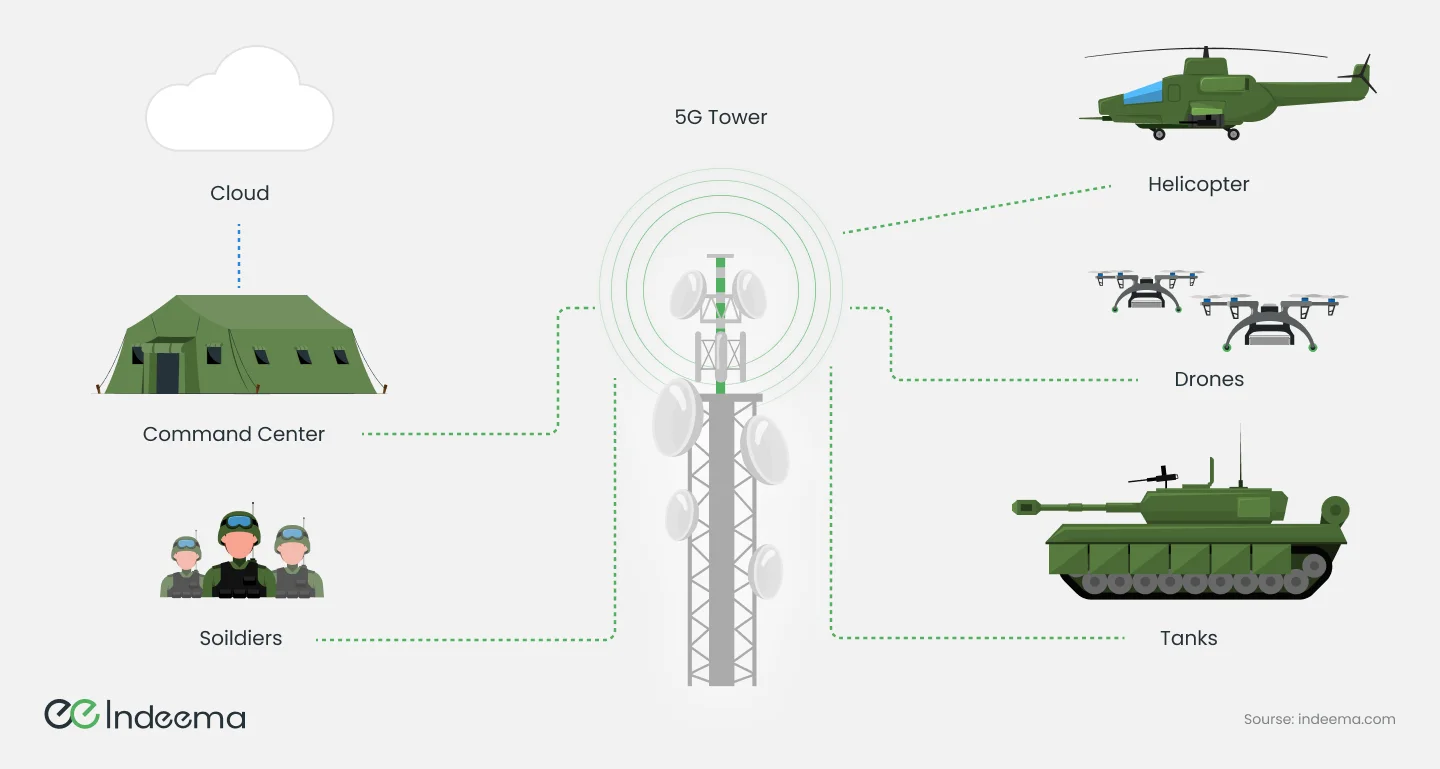
Where connected devices are used in defence
| Area | Typical devices | Data it produces | Main engineering constraint |
|---|---|---|---|
| Soldier health and military medicine | Wearable heart-rate, SpO2 and muscle-activity sensors in clothing or straps | Vital signs and activity, location context | Low power, comfort, and protecting highly personal data |
| Logistics and supply | RFID tags, GPS trackers, vehicle telematics | Location and movement of goods and vehicles, stock levels | Tracking without exposing concentrations of supplies |
| Equipment condition | Engine, fuel and position sensors on vehicles and vessels | Wear, consumption, maintenance needs | Rugged hardware and data that survives long offline periods |
| Situational awareness | Sensor-equipped drones, ground sensors, cameras | Terrain maps, detections, alerts | Bandwidth: process at the edge and send results |
| Training | VR and AR equipment fed by recorded field data | Realistic simulated scenarios | Fidelity of the models built from real data |
Soldier health, medical logistics and supply
Health monitoring is one of the most developed uses. Unlike consumer fitness trackers, military systems integrate several sensors into clothing and report continuously, so medical teams can spot problems early and, after an injury, prepare the right equipment and evacuation before the casualty arrives.
Logistics depends on knowing where people, vehicles, fuel and supplies are. Continuous monitoring of engine condition and fuel use helps decide when to repair or replace equipment, and GPS and RFID tracking of goods and vehicles helps build delivery schedules that adapt as the situation changes. The same tracking supports civilian evacuation and aid delivery, where routes also have to avoid congestion.
Sensing and unmanned systems
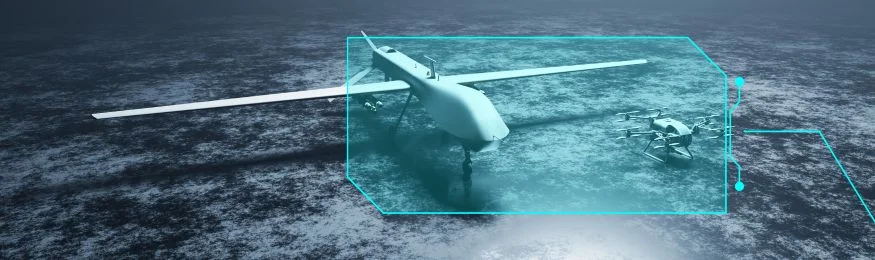
Satellites give a wide view but pass over a given area only for limited periods. Drones with connected cameras and sensors now provide much of the local, current picture: they build 3D terrain maps and report what they detect to a command post, without putting the operator in the same place.
In most systems the drone does not act on what it detects by itself. It sends an alert, and an operator reviews the information and decides what happens next. As onboard processing improves, one operator can supervise several unmanned systems, because routine functions such as holding a course run on the device.
- SenseA sensor on a drone, vehicle or wearable captures a reading or image.
- Process on the deviceAn embedded module filters the data and keeps what matters, so only results travel over the link.
- Transmit securelyThe module sends encrypted messages, for example over MQTT, through radio, cellular or satellite links.
- AggregateA gateway or edge node combines data from many devices and buffers it when the backhaul is down.
- DecideCommand, medical and logistics systems show the combined picture to the people who act on it.
Every link in this chain must keep working, or degrade predictably, when parts of the network are lost.
Communications: the network that holds it together
None of this works without communication between devices, soldiers, vehicles, depots and command. Wired links were once the most dependable option, but they cannot follow mobile forces. Most data now moves over encrypted radio, similar in principle to civil IoT links, and over satellite networks.
Adversaries use jamming stations to suppress radio and satellite links. Systems that can change frequency dynamically and switch between several bearers, such as radio, cellular and satellite, are harder to suppress than single-link designs.
The engineering implication: design for a contested network
Civil IoT can usually assume the network will come back soon. Defence systems cannot. That changes the design: each device has to keep its core function offline, store data until a link returns, and prove its identity before anything it sends is trusted. Bandwidth is scarce, so processing moves to the edge, and power is limited, so every radio transmission has a cost.
These are the same principles behind dependable industrial and drone systems: offline-first state, edge filtering, encrypted transport, signed firmware and clear behaviour when a component fails.
Practical recommendations for connected defence systems
Check these before you commit to an architecture
- Define what each device must do with no network at all, and for how long.
- Plan more than one communication path, and how the device chooses between them.
- Process data on the device or a nearby edge node; send results, not raw streams.
- Give every device a verifiable identity and accept only signed firmware.
- Budget power from real transmission patterns, not standby figures.
- Treat personal and health data with medical-grade access control and retention rules.
Questions engineers ask
What does IoT mean in the army?
IoT stands for the Internet of Things. In a military context it means connected sensors, wearables, vehicles, drones and logistics tags that share data over a network, so commanders, medics and logisticians can act on current information.
Is the Internet of Military Things the same as the Internet of Battlefield Things?
They overlap. Internet of Military Things usually covers connected devices across defence, including logistics and medicine; Internet of Battlefield Things focuses on devices and networks in the combat environment.
Was this useful?
Where this shows up in our work
SolutionAutonomous & Intelligent Physical Systems EngineeringResilient links, edge processing and secure firmware for drones and other unmanned systems are the autonomous physical systems work we do across electronics, firmware and cloud.For how we engineer drone systems, from flight controllers to connected fleets, see UAV and drone systems engineering.
Apply this to your product