


Insights / Product Engineering / Product Discovery
Starting an IoT Project: From Idea to a Validated Product Plan
How to take an IoT idea to a validated plan: users and value, outcome-based requirements, discovery, proof of concept, prototype, MVP, and the limits to find early.

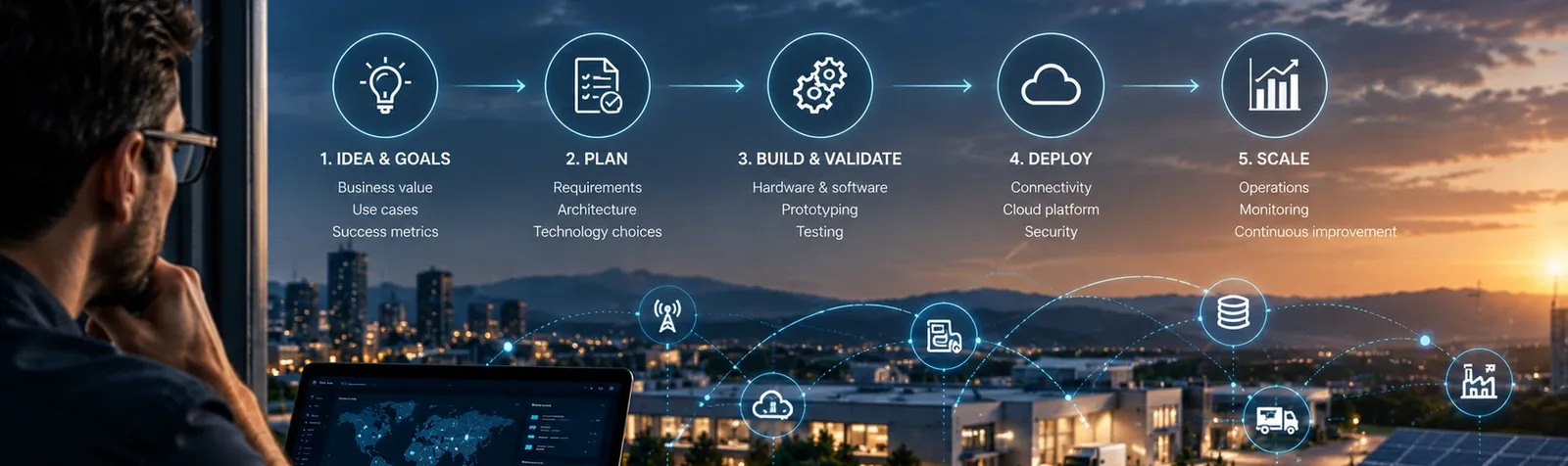
The short answer
Start an IoT project by deciding who will use the product, what outcome it must deliver and how you will prove it, in that order. Write requirements as outcomes, not feature lists. Then run the project in stages that each answer one question: discovery (is it feasible, and at what scope?), proof of concept (does the core technology work?), prototype (do users understand it?) and MVP (will the market use or pay for it?). Hardware and software move in parallel, so find the limits early: component supply, certification, the operating environment and security.
Key takeaways
- Answer who, what and how in that order. Most stalled IoT projects skipped the first question.
- Describe what you want to achieve, not how. An outcome leaves room for a simpler solution.
- Each stage should answer one question; do not pay for production engineering before the proof of concept works.
- Put MVP effort where the product is unique: borrow hardware if the value is in software, and the reverse.
- Write down limits as you find them: parts you cannot buy at volume, country certifications, harsh environments.
Why IoT projects are harder to start than software projects
An IoT product combines hardware, firmware, connectivity, cloud and apps. They are developed in parallel, so a mistake in one layer can stall the others. Changing hardware after tooling costs far more than changing code.
- Two disciplines at once: the project needs deep hardware and software expertise working to one plan.
- Different testing: devices must be validated in the real environment, on real networks, over time.
- Longer life: devices are added and changed for years after launch, so the process must absorb change.
- Security across every layer: device, connection, cloud and app each need protection from the start.
The most expensive problems are rarely technical surprises. They are decisions taken too early: a feature list written before anyone agreed who the user is, or hardware chosen before the environment was understood. One of our own B2B products took considerably longer than planned because we put design effort first and found production limits late.
Start with three questions: who, what and how
- Who will use the product? Name the user, their environment and their technical skill.
- What do you want to achieve? The outcome for that user, stated so it can be measured.
- How can you achieve it? Only now: hardware, connectivity, platform and features.
The buyer changes the answers. In B2C, the end user decides, and attractiveness and simplicity weigh as much as numbers. In B2B, a business decides for its staff, mostly on cost, uptime and process fit, and the people using the product may not be the people who bought it.
| Factor | B2B: machinery vibration monitoring | B2C: indoor air-quality monitor |
|---|---|---|
| Customers | Plants that run rotary machinery and the firms that maintain it; established processes, slow to adopt new tools | Families, IT professionals, people who care about their environment, and therapists |
| Development priority | Easy installation, configuration and operation of hardware and software | Hardware that fits different interiors; apps that appeal to non-specialists |
| Network | Cloud and/or local network; strong built-in security; tweaks for hybrid set-ups | Wi-Fi and Bluetooth, so modules must support both |
| Environment | High loads, indoors and outdoors; hardware must survive any mounting point | Indoors, mains-powered; materials must be safe for homes and schools |
| Interface | Usability over looks; technical vocabulary and advanced options are acceptable | Must be simple, attractive and in plain language |
| Integrations | Kept out of the core product; planned as add-ons with clear protocols | None at first; placed on the not-doing list |
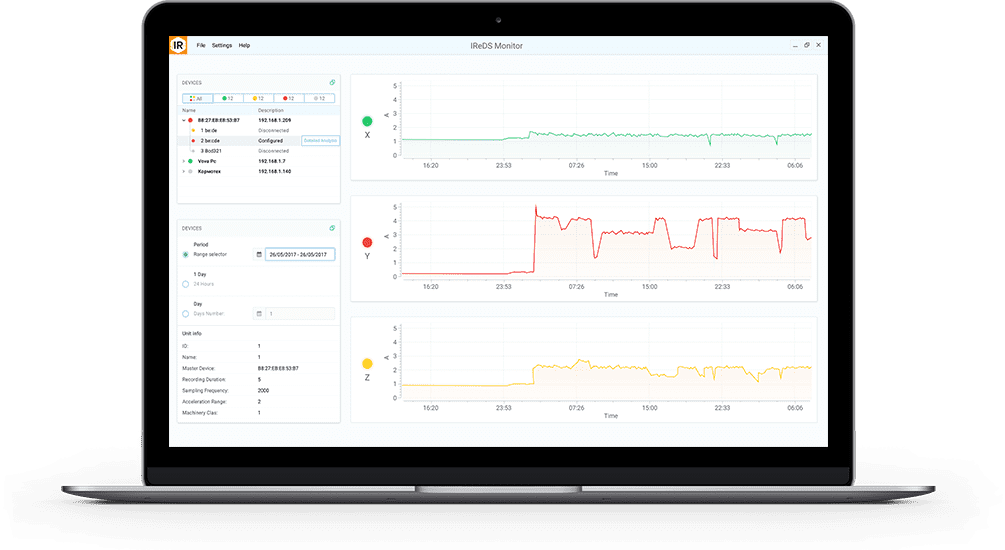
In both cases, simplicity decided adoption. If a new product is harder to use than the tool it replaces, people go back to the old tool.
Write requirements as outcomes, then decide what you are not doing
Compare two ways of briefing the same industrial project:
- Feature brief: connect every machine on the production line, record it on a blockchain for investors, show a dashboard and configure automatic alerts.
- Outcome brief: halve the time our customers spend connecting SCADA devices, and let them see readings and receive alerts from anywhere.
Three months in, the first brief typically meets a change request: the investors did not need most of their features, but owners and managers needed more settings, and the architecture has to change. The second brief can be tested with core customers early. Once the core works, the next step is a natural extension, such as a mobile app for on-the-go configuration. The outcome brief describes what problem to solve and lets the team choose how.
Ideas multiply once work starts. Sort each one by value and implementation effort before it enters the scope:
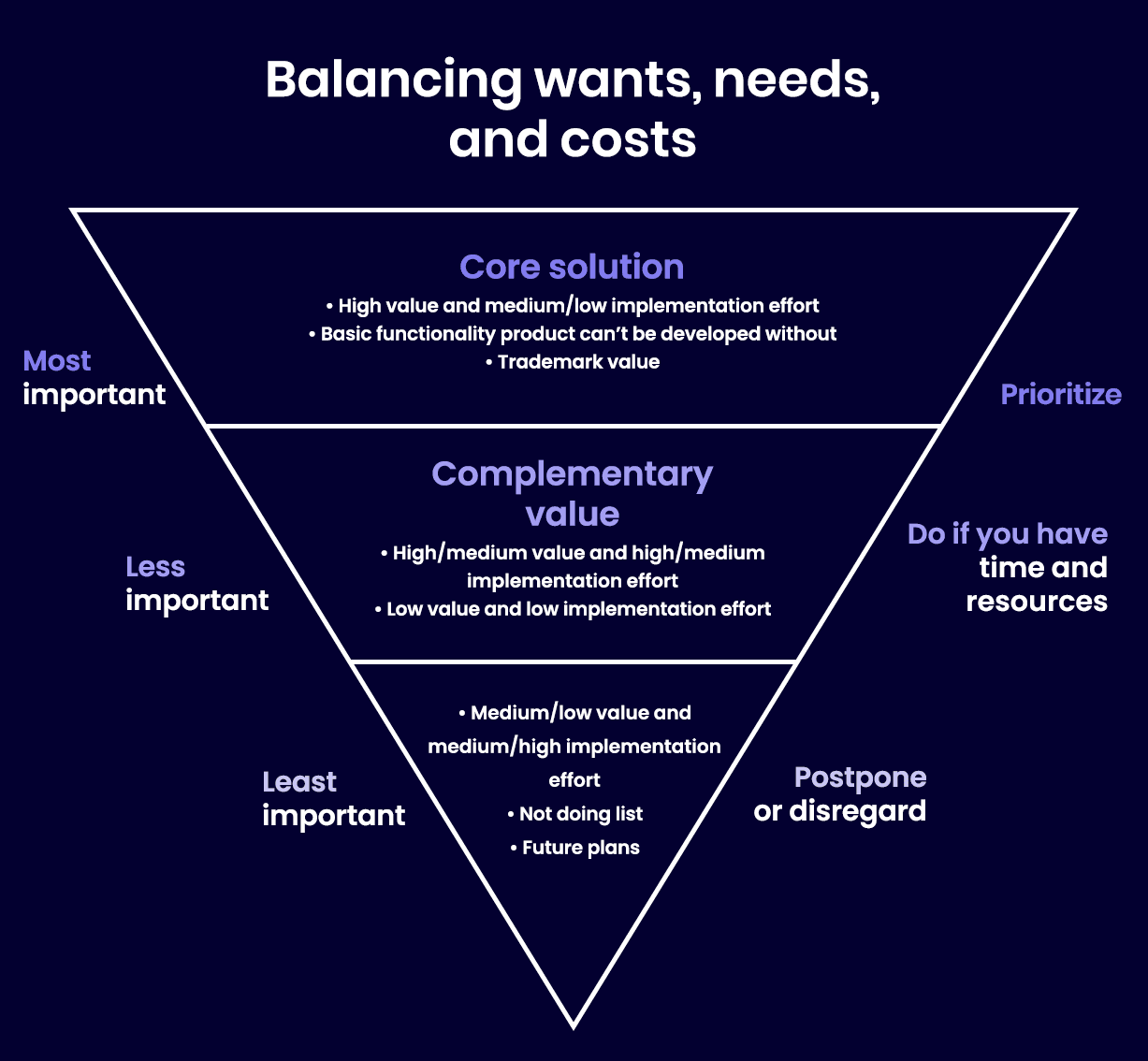
Questions for every new feature idea
- Does it give the product a strategic advantage?
- Does it help win the target audience?
- Does it fit the rest of the plan?
- Does its value exceed the effort to build it?
- Does it fit the current hardware and software architecture?
Ideas that fail these questions go on a written not-doing list, or into a future version. Then set success criteria that are specific, measurable, achievable, relevant and time-bound (SMART), and share them with every stakeholder. Specifications will change. The goal should not.
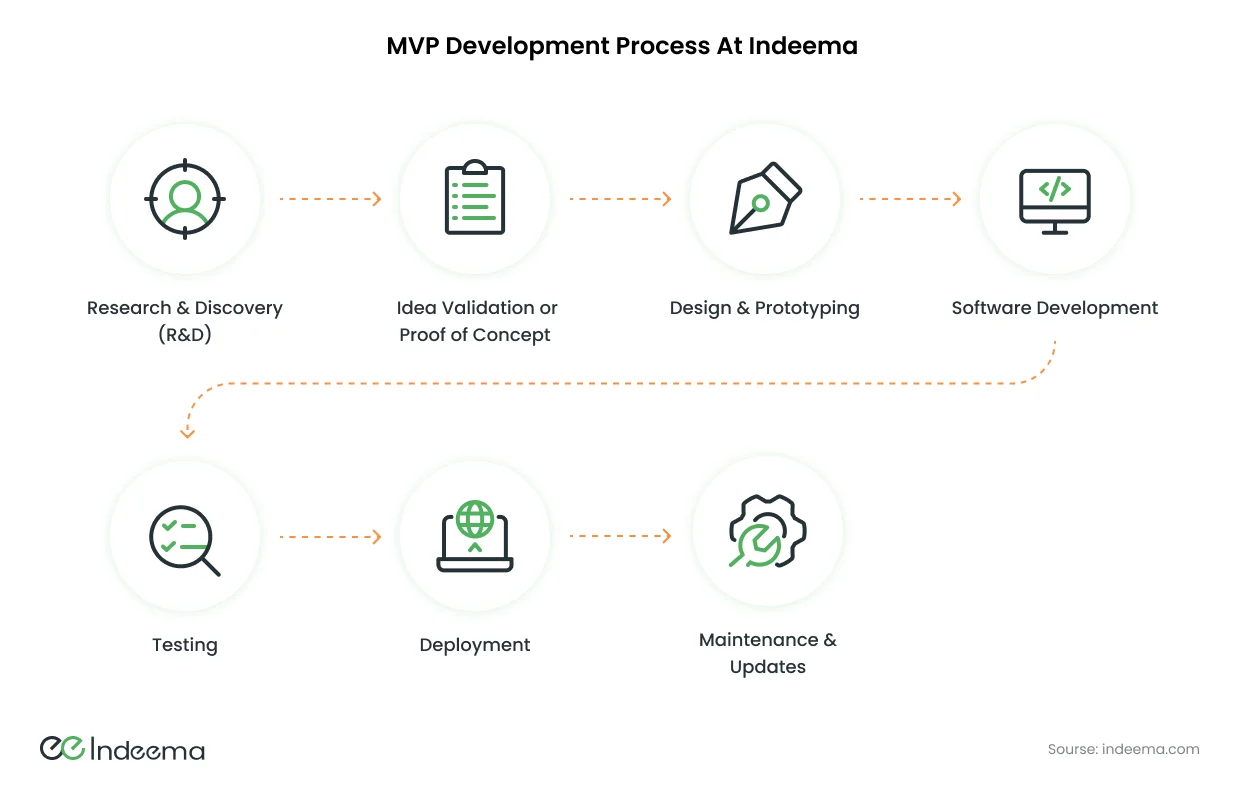
The IoT development process, stage by stage
Each stage exists to answer one question before money is committed to the next.
- DiscoveryIs it feasible, and at what scope? Goals, constraints, platform and tool choices, a work plan and an estimate.
- DocumentationWhat exactly are we building? A requirements specification for function, properties and technical design.
- Proof of conceptDoes the core technology work? A minimal build that proves, or rules out, the riskiest assumption.
- PrototypeDo users understand it? Wireframes, UX and a working device tested with real users.
- MVPWill the market use or pay for it? Core functionality only, released to early users.
- ProductionCan we build, certify, support and update it at volume?
Feedback from each stage updates the specification; it is a living document, not a contract frozen at the start.
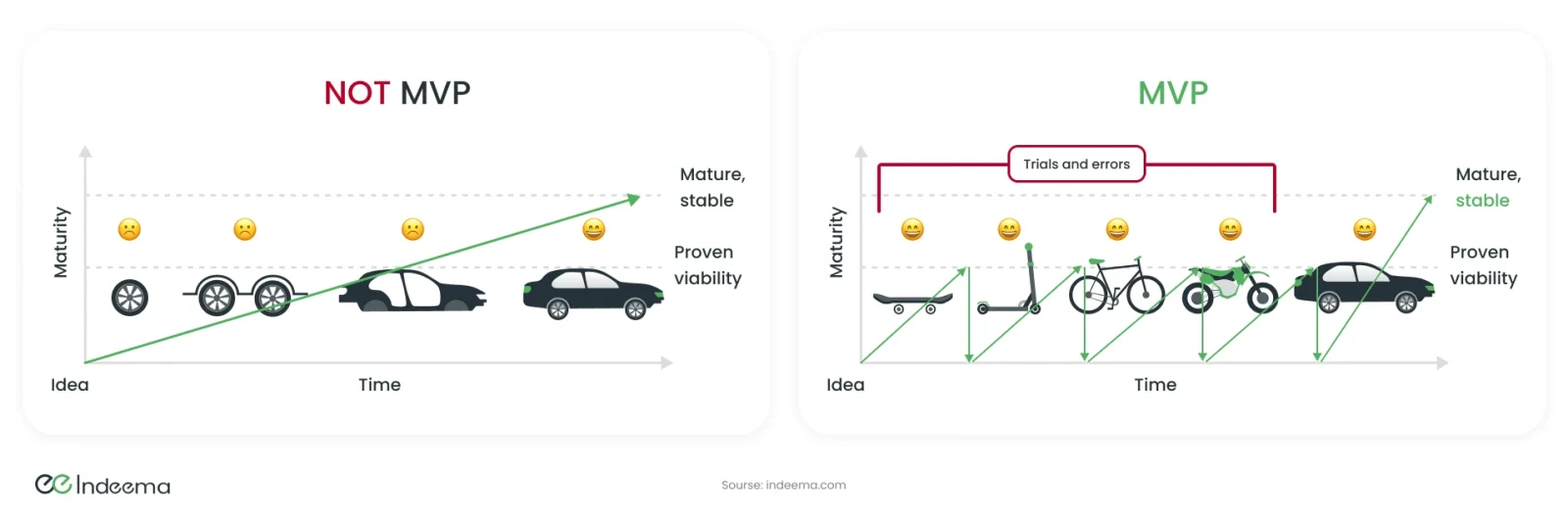
- Minimum viable product (MVP)
- The first version of a product with only the functions needed to test whether it solves the problem for real users. Its feedback decides what to build next, and sometimes which business model to use: a one-off sale, a subscription or a service.
A proof of concept is just as valuable when it fails. It can rule out an idea that is not technically viable before the cost of a full product is spent on it.
What discovery decides: software, connectivity, framework and hardware
- Software and platform: choose something that scales with traffic and supports many device types, with an easy way to add new ones.
- Connectivity: Wi-Fi, Ethernet, cellular, Bluetooth or a low-power network, chosen for where the device lives and whether that will change as the business grows.
- Framework: look at what similar successful projects used; the right choice grows with the product.
- Hardware: decided by the sensors and devices the product must connect, with room to add more later.
For prototyping, the development kit matters. Each class suits a different job:
| Platform | What it is | Suits | Limits |
|---|---|---|---|
| Microcontroller board (e.g. Arduino) | A simple controller that runs one program | Reading sensors and switching outputs; simple repetitive tasks | Needs add-on modules for some connectivity; limited computation |
| ARM single-board computer (e.g. Raspberry Pi) | A small Linux computer with Wi-Fi, Bluetooth and Ethernet | Gateways, heavier computation, several tasks at once | Higher power draw; not a production board for most devices |
| x86 single-board computer (e.g. LattePanda) | A small PC that runs Windows or Linux | Proofs of concept that need desktop software or more compute | Cost and power; rarely the production choice |
An IoT MVP in practice
For an indoor air-quality monitor and app we developed ourselves, the early work ran in parallel tracks:
- Proof of concept: a draft electrical and mechanical design; checking that the device measured readings and sent them to an MQTT broker, and that the cross-platform app communicated with the broker; a first working prototype of hardware and app.
- Prototype: app design adjusted from feedback; experiments with the hardware design.
- MVP: a cloud server deployed and connectivity configured; core functionality, including alerts when air quality crosses a limit; an improved 3D model of the device.
- Next in the plan: beta testing with users, presales, production and version 2.0.
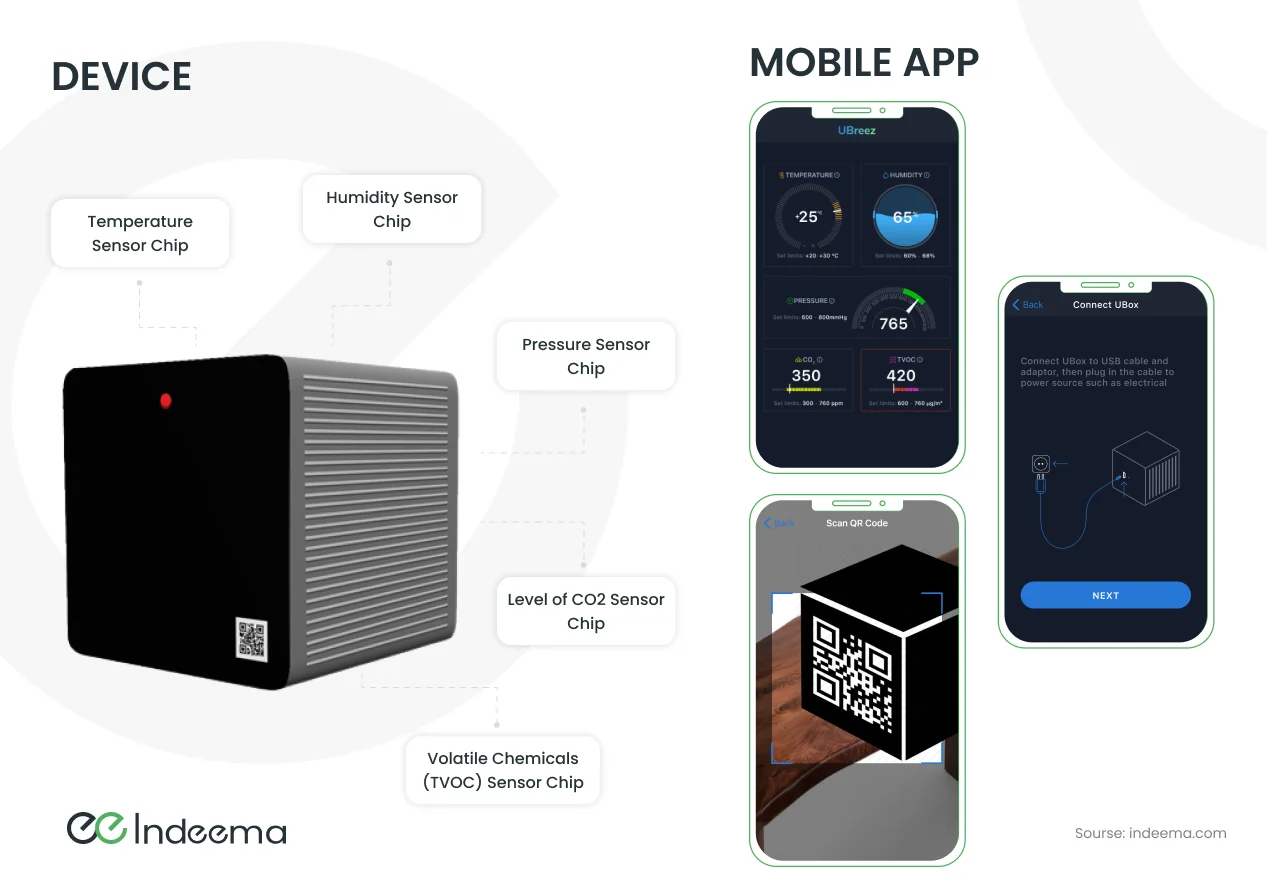
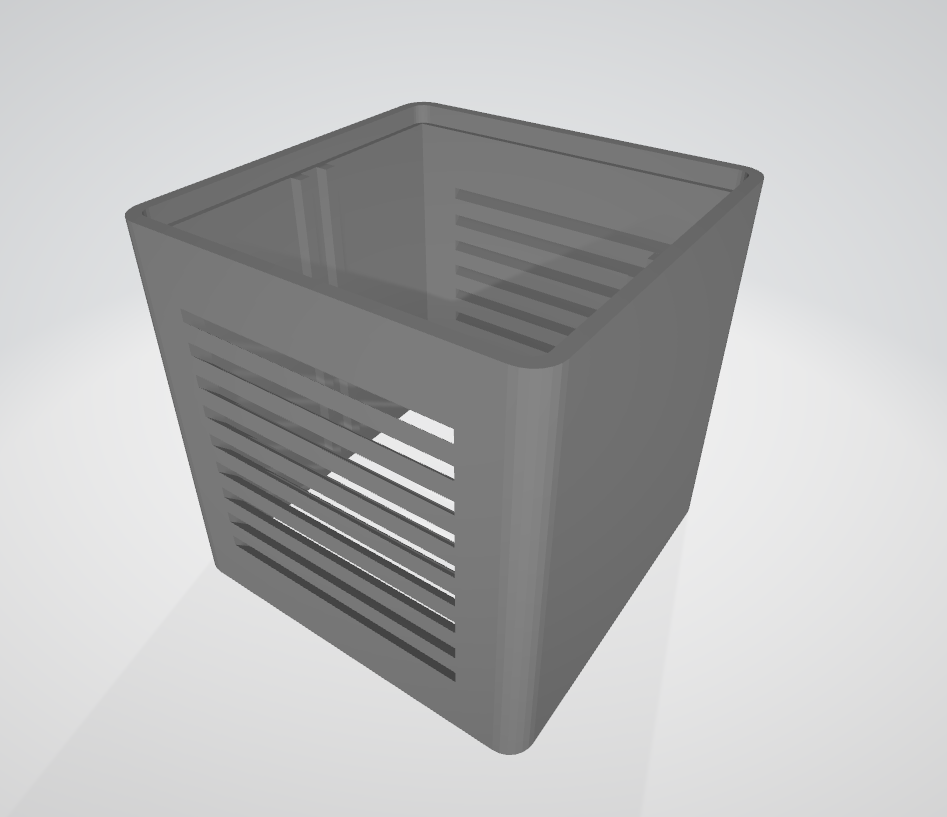
The enclosure went through many iterations to look right in a home, place the sensors for accurate readings and route air through the vents. 3D printing made each round quick and cheap. On the B2B product, testing in real conditions showed the live analytics charts loaded too slowly, so response time had to be improved before release.
Find the limits before they find you
On our B2B monitoring product, three limits slowed development. We had planned for only one of them:
- Component supply: the high-precision accelerometer we chose turned out to be hard to buy at production scale.
- Certification by country: each market had its own rules and procedures, which delayed installations abroad.
- Performance testing: proving reliability meant recreating the working environment and its extremes.
Add every limit you find, or can imagine, to the project documentation and review it with stakeholders. Include regulation: products that handle personal data must meet privacy law such as the GDPR in Europe, and health or medical products face sector rules such as HIPAA in the US and medical-device requirements. These shape the database, encryption, permissions and consent flows.
Also check the competition. Competitors confirm that a need exists, and their customers' complaints show where quality assurance was missed. Make every build pass quality control before it moves on.
Engineering trade-offs
Off-the-shelf hardware vs custom hardware for the MVP
- You gain
- Ready, debugged hardware with known connectivity lets the team spend the budget on the software that makes the product unique.
- You pay
- It may not match the final product's size, power or cost, so a hardware redesign follows if the MVP succeeds.
- Choose it when
- Off the shelf when the value is in software, data or business logic; custom when the device itself is the innovation.
Detailed specification up front vs iterating from an outcome
- You gain
- A detailed specification gives a firmer estimate and fewer early surprises.
- You pay
- Written too early, it fixes features before users have tested anything.
- Choose it when
- Specify in detail what discovery and the proof of concept have confirmed; keep the rest as outcomes and revise them at each stage.
Proof of concept first vs straight to prototype
- You gain
- A proof of concept retires the biggest technical risk cheaply.
- You pay
- It adds a stage and produces little that users can see.
- Choose it when
- Run one whenever the product relies on a new sensor, method or technology; skip it only when every core component is proven.
Where to put MVP effort
Concentrate engineering on the part of the system that makes the product unique, and borrow the rest.
| Device | Hardware for the MVP | Software for the MVP | Validate first |
|---|---|---|---|
| Value is in software, data or business logic | Market or ready-made devices with known behaviour | Built properly; this is the product | Whether users act on the data |
| Value is in the device (a new sensor, unusual control or connection) | Custom; this is the product | App templates, IoT platform services or open-source components | Whether the device measures or acts reliably in the field |
| Value is in both, with no part that can be borrowed | Custom, kept minimal | Custom, kept minimal | The single riskiest assumption, with a proof of concept |
Decision rule: Decide where the product is unique before the MVP plan is written. Borrow everything else, and redesign the borrowed parts only after the market has confirmed the idea.
What to bring to a first technical conversation
You do not need a finished specification, but these make the first discussion productive:
- One sentence naming the user and the decision or task the product supports.
- The outcome you want, stated so it can be measured.
- Where the device will operate: environment, power and connectivity constraints.
- Existing systems the product must work with.
- A draft requirements document or feature list, with what you already know you are not doing.
- The open questions and the assumptions you are least sure of.
Common mistakes
Choosing a team on price or speed alone
Limited experience in hardware or UX shows up as a weak design or implementation that has to be redone.
Instead: Check the team's experience across hardware, firmware, cloud and apps, and whether they ask about users and context.
No clear project structure
Dependencies between hardware, firmware and software get lost and the project becomes hard to manage.
Instead: Map components, interfaces and dependencies early, and plan the hardware and software tracks together.
Leaving decisions unwritten
Developers fill gaps with best practice, and the result differs from what the customer pictured.
Instead: Agree user interactions with stakeholders and document them. What is not written does not exist.
Postponing security
Connected devices are attacked; retrofitting identity and encryption after launch is limited and costly.
Instead: Treat device identity, encrypted communication and secure updates as requirements from discovery onward.
Where we've built this
The MVP path above comes from our air-quality monitor: requirements built from its users and the problem it solves, a prototype from readily available parts, and a 3D-printed MVP device with a companion app for real-time readings and alerts.
Case studyIndoor environment monitor with device, cloud and mobile appAn air-quality device, cloud platform and mobile app taken through proof of concept, prototype and MVP, with hardware and software developed in parallel.Questions engineers ask
How do you start IoT development?
Define the user, the outcome and how you will measure it. Then run discovery to check feasibility and scope, build a proof of concept for the riskiest technical assumption, test a prototype with users, and release an MVP before investing in production hardware.
How do I build an IoT strategy for my business from scratch?
Start from one business problem that connected data could solve, and the decision that data would change. Validate it with a small proof of concept and an MVP, measure the result against criteria agreed in advance, and only then plan a wider roll-out.
How do you develop an IoT device?
Prove the behaviour on a development kit, then design production hardware, firmware, connectivity and enclosure together, test in the real operating environment and plan certification for each target market. Keep the app and cloud work in step with the device from the start.
Was this useful?
Where this shows up in our work
ExpertiseProduct Discovery & Technical Strategy (IoT Consulting)When the questions are still who the product is for, what to validate first and what the first release should contain, our product discovery and technical strategy work answers them before scope is fixed.Apply this to your product
Scope your product before you build
Sources
- GDPR – General Data Protection Regulation (consolidated text) accessed 1 October 2026
- U.S. HHS – HIPAA for professionals accessed 1 October 2026