


Insights / Drones & UAV
Drone Product Development After DroneX 2026: What the Show Floor Showed
What changed on the DroneX 2026 show floor, and five questions to ask before you lock a drone design.

The short answer
The drone market is professionalising. Most of the DroneX 2026 show floor was companies selling components, platforms and services rather than hobby builds. For a team planning drone product development, the hard question is no longer whether it can be built. It is which parts to build, which to buy, and how they fit together, because the parts are easier to find and the integration is where programs now succeed or fail.
Key takeaways
- Suppliers are professional now, so more of the stack can be bought. Integration carries the risk.
- Flight controllers on general-purpose microcontrollers lower the cost of a first airframe, not the cost of integration.
- Radio links, GNSS, secure networking and firmware audits are separate decisions with knock-on effects.
- Five boundary questions show where a drone program is likely to stall.
Drone product development suppliers now look like professionals, not hobbyists
I'm Mike Powell, Director of Sales at Indeema. I went to DroneX at ExCeL London on 29–30 September, part of Uncrewed Tech Expo. I was at the show last year too, and at a drone event in Munich soon after I joined Indeema, so I had two points of comparison.
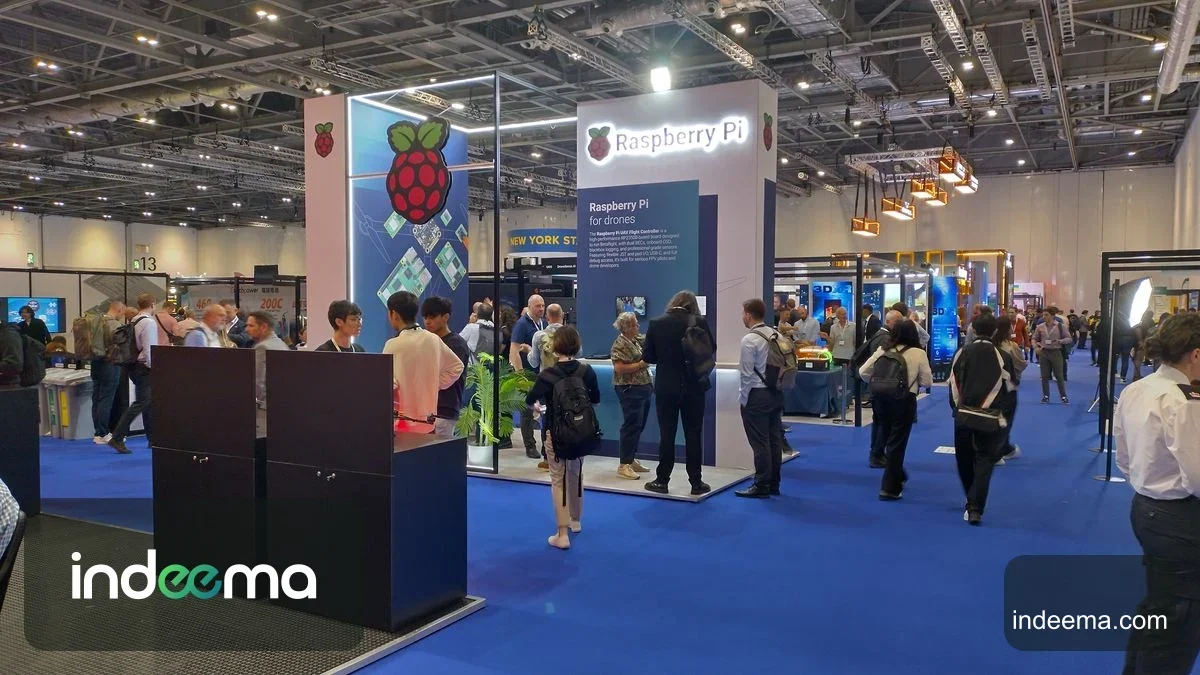
Compared with last year, far more stands belonged to established, professional companies, and far fewer to small hobby-level operations. The mix was international. Ukraine’s drone industry was well represented, including companies working on optical communication systems. A handful of Chinese exhibitors showed battery systems and complete drones. Raspberry Pi had a stand much bigger than I remember from last year.
A market with professional suppliers is a market where you can buy more of your stack. That is good for speed. It also moves the risk: the parts are easier to find, so the integration is where programs now succeed or fail. Our drones and UAV practice works across this stack, from the flight controller to the ground system.
“The primary bottleneck in building intelligent drones today isn’t a lack of AI models. It’s the friction of integrating the engineering stack.” – Mike Powell, Indeema
Drone flight controllers are becoming a commodity board
Raspberry Pi showed its UAV Flight Controller. According to the stand, it is an RP2350B-based board designed to run Betaflight, with dual BECs (onboard voltage regulators), an on-screen display, blackbox logging, professional-grade sensors, USB-C and full debug access.
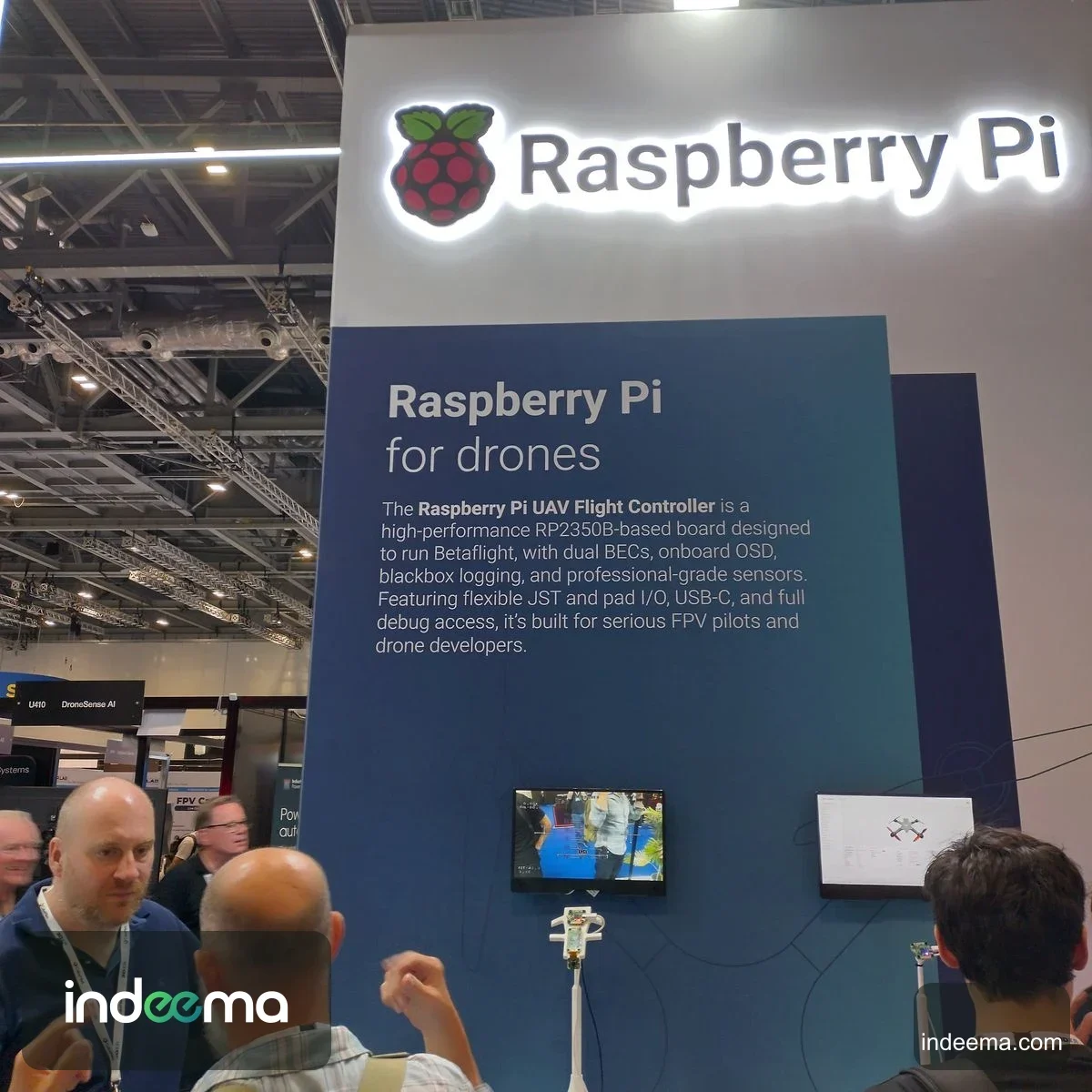
A flight controller built on a general-purpose microcontroller, with open firmware and debug access, lowers the cost of getting a first airframe flying. It does not remove the engineering. Someone still has to decide how that board talks to the payload, the radio, the companion computer and the ground station, and what happens when one of them misbehaves.
Drone connectivity, positioning and security are separate product decisions
Several exhibitors sold only one layer of the stack:
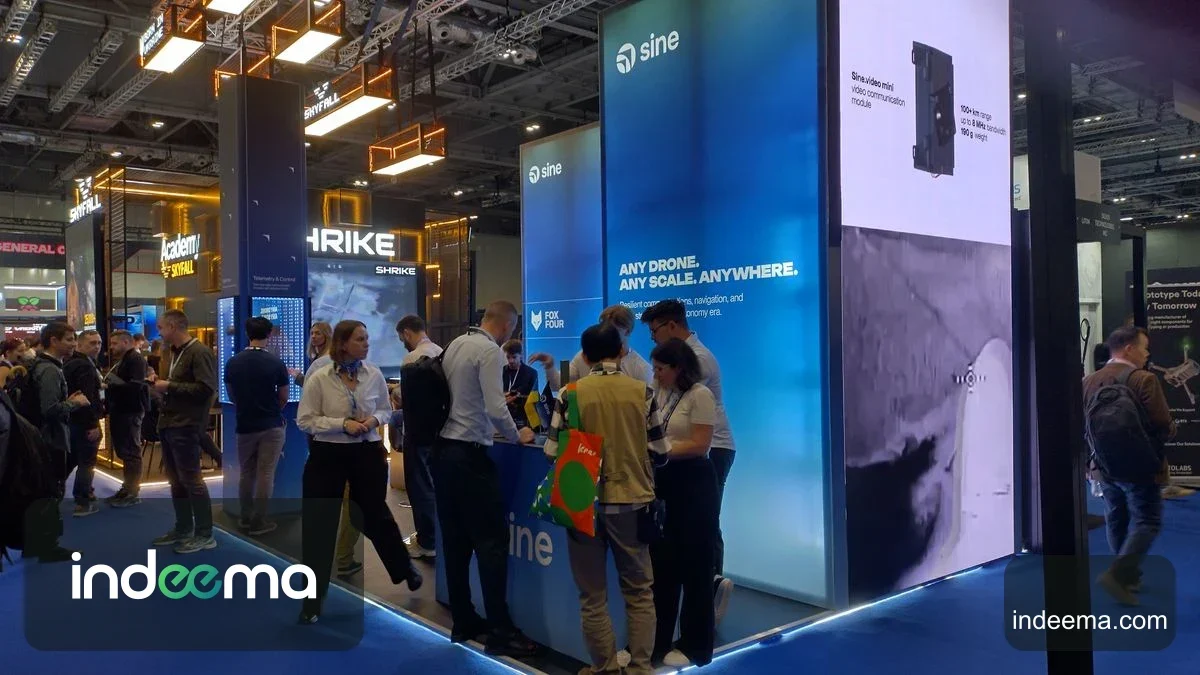
- Video and data links. One stand showed a compact video communication module with a stated range of 100+ km, up to 8 MHz bandwidth and a weight of 190 g. Those are the manufacturer's figures. What matters for your design is what a link like that costs you in power, heat and mass.
- Secure networking. ZeroTier was among the exhibitors, which reflects growing interest in managed, encrypted connectivity for connected devices.
- Positioning. u-blox, a long-established supplier of GNSS modules across many industries, was also exhibiting, with a growing presence in UAVs.
- Firmware and data assurance. InTech Forensics was there too, offering audits of device firmware and data. It is a service that rarely appears on a drone bill of materials, and increasingly belongs on the plan.
Each of these is a decision with consequences elsewhere. A longer-range radio changes the power budget. A different GNSS module changes the antenna layout and the firmware. A security layer changes how you ship updates. None of them is a drop-in part.
Five questions to ask before you lock a drone product design
Walking the floor, one pattern stood out: it is easy to find a good component and hard to know whether the system around it will hold together. Our whitepaper, “Gap or System? What’s Really Stalling Your Drone Program”, frames the problem as five boundary decisions. Here they are as questions to put to your own team this week.
- Interface. Where does one subsystem end and the next begin? If two teams define the boundary between the flight controller and the payload differently, the integration problem is already built in.
- Evidence. What has your prototype actually proven? A demo that flies shows the airframe works. It does not show that the data link, the thermal limits or the update process work.
- Replaceability. Which parts must you be able to swap later? Batteries, radios, compute modules and GNSS all change faster than airframes.
- Where to stop building. What should you buy, and what is truly yours? With a professional supplier market, the answer is different from two years ago.
- Where the knowledge lives. If one engineer holds the tuning, the test setup or the radio configuration in their head, the program carries a risk that does not show on a schedule.
A single decision, such as a new payload, a different compute module or a longer-range radio, moves through mass, power, heat and range at once. The whitepaper shows how to trace that chain. For a real program, see how we built a drone operations reference architecture on AWS and our drone R&D work. It also gives you a test for telling a narrow gap from a systemic problem before you restart, re-staff or re-architect, and a self-check that maps each missing capability to the boundary to examine first.
Was this useful?
Take the next step
WhitepaperGap or System? What's Really Stalling Your Drone ProgramA test for telling a narrow gap from a systemic problem in a stalled drone program, and the five boundary decisions that decide whether it reaches production.Get the whitepaperFor the wider drone stack these decisions sit in, from flight controllers to fleet software, see UAV and drone systems engineering.