


Drone engineering whitepaper
Gap or System? What's Really Stalling Your Drone Program
A stalled drone program is stuck either on one specific gap or on the system itself. The two look alike from the outside, and they call for opposite responses.
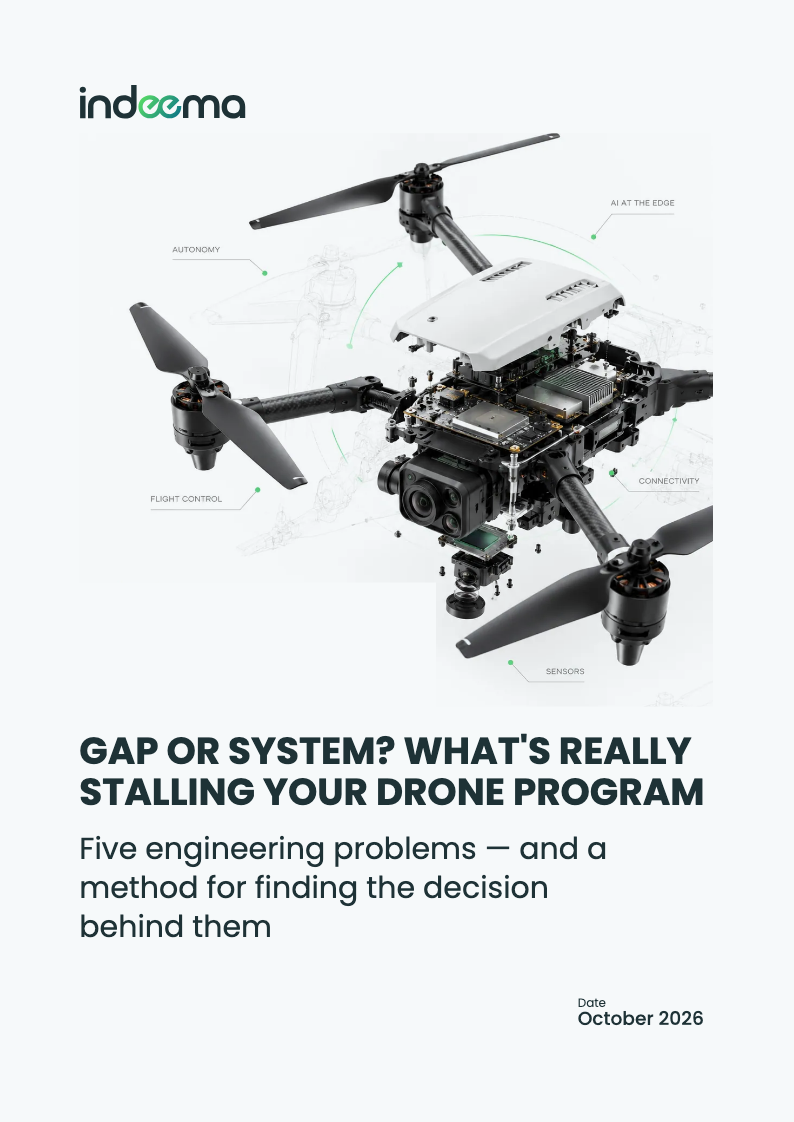
This whitepaper gives you a test for telling them apart, then reads the five problems that stall drone programs between concept and shipping product as five boundary decisions: the interface, the evidence, what stays replaceable, where to stop building, and where the knowledge lives.
It shows how one decision about a payload, a compute module or a radio moves through mass, power, heat and range, and it draws on three drone projects, each within what its record shows.
Free PDF · Practical engineering material
Why this matters
The problem this paper addresses
By the time a company looks for engineering help with a drone or another connected product, the decision to build it has been made. What is missing is the engineering between a validated idea and a product that ships.
In our experience, the expensive decisions sit at the boundaries between parts of the product, and they are often made by default, before anyone has bought the evidence to make them well.
Inside the whitepaper
What you'll learn
- 01
A test for telling one specific gap from a systemic problem before you restart, re-staff or re-architect
- 02
The five boundaries (interface, evidence, replaceability, reuse, knowledge) and the question each one asks
- 03
How one decision about a payload, a compute module or a radio moves through power, heat, mass and range
- 04
What a prototype can and cannot prove at each stage, and why it should say what it does not attempt to prove
- 05
A self-check that maps each missing capability to the boundary to examine first
From the paper
Executive Summary
A drone manufacturer's program was waiting on a ground-station data link that had to keep up with a sensor payload. On paper that is a networking problem: choose a module, write the bridge, meet the data rate. The design record shows why it was not only that. On the chosen module, pin limits constrained the routing and set a ceiling on the interface. In this project the networking layer was a second decision, between the stack the client had used before and the native one . And what the radio would sustain at range was a separate question that a bench test could not answer. Each answer constrained the next. So the question was not only which capability was missing. It was whether the visible problem was one gap, or the place where a systems problem first became visible, and which evidence would settle it before the next commitment. The business consequence is not only that a decision can be wrong: a team may discover too late which other decisions it has already constrained.
So the first question for a stalled program is not which part to fix. It is whether the stall is one gap or the system: the two look alike from the outside, as the data-link case did, and call for opposite responses. The first section after this summary is a short test for telling them apart. The problems start where a validated concept has to become a production-ready product, which takes an engineering system, not a collection of individual technologies. The paper is written for CTOs, VPs of engineering, technical founders and product leaders with a stalled prototype, a concept waiting for funding, or a fielded product heading for its next version.
The gap between a successful prototype and a product that can be manufactured, deployed, maintained, secured, and continuously improved is where organizations lose time, budget, and momentum.
Contents
- Executive Summary
- Start Here: One Gap or the Whole System?
- How Ready Is Your Product, Really? A Quick Self-Check
- The Connected Product Perspective: Decisions at the Boundaries
- How One Decision Moves Through a Drone
- Three Situations Behind a Stalled Program
- Why This Matters Now
- Five Problems, Five Solutions
- The 10% That Stalls the Other 90%
- From Vision to Something You Can Fund
- Built to Survive Its Own Success: Avoiding the Upgrade Trap
- The Two-Year Tax Nobody Budgets For
- Who Supports It Once It's Actually Shipping?
- Where Reuse Pays Off
- What a Reusable Foundation Should, and Should Not, Solve
- What This Paper Does and Does Not Show
- Choosing Where to Start
- Conclusion — From Experimental to Essential
- Which Boundary Is Holding Your Product Back?
- About Indeema
Who this is for
Executives and engineering leaders who fund, run or rescue connected-product programs, with drone programs as the primary case
The problems in this paper do not start with a weak idea. They start where a validated concept has to become a production-ready product, which takes an engineering system, not a collection of individual technologies. This paper names five recurring barriers: a narrow technical gap, a promising idea without a production-ready architecture, a prototype that cannot survive manufacturing, infrastructure rebuilt from scratch, and a product that depends on the people who built it. It shows each through one of three drone engineering projects, within what that project showed, reads the five problems as five boundary decisions, shows how one decision propagates through a drone, and gives decision-makers the questions and self-checks to tell a local problem from a systemic one.
- CTOs and heads of engineering
- Founders and executives funding a drone program
- Product leaders unblocking a stalled program
- Owners of connected products already in the field
Get the whitepaper
Where should we send it?
We email a secure, single-use link to your work email so you can open the whitepaper.
Authors and context
Written by the engineers behind the work
Indeema is a Connected Product Engineering company, founded in 2010. We help organizations turn ambitious product ideas into production-grade connected systems, and help products already in the field evolve after their first release. Our engineers in Lviv and Wrocław work across electronics, embedded software, connectivity, edge and cloud software and applications as one system, so a client does not have to coordinate those disciplines on its own.
Which boundary is holding your product back? Discuss your drone architecture