


Connected wearable / MVP
Bluetooth proximity wearable with iOS, Android and web applicationsMVP development from scratch: firmware, mobile and web apps (pandemic-era project)
A Bluetooth proximity wearable MVP with mobile apps and a dashboard
During the COVID-19 pandemic, the Maggy start-up wanted a small wearable, worn on a lanyard or clip, that signals when its wearer comes too close to another person. The founders had a product idea and a rough hardware architecture, and needed a working MVP quickly.
Turn the concept into a working system: firmware that detects nearby devices and triggers a signal, apps that let users customize their device and see their proximity history, a dashboard of close-contact events, and an API for integration with similar devices.
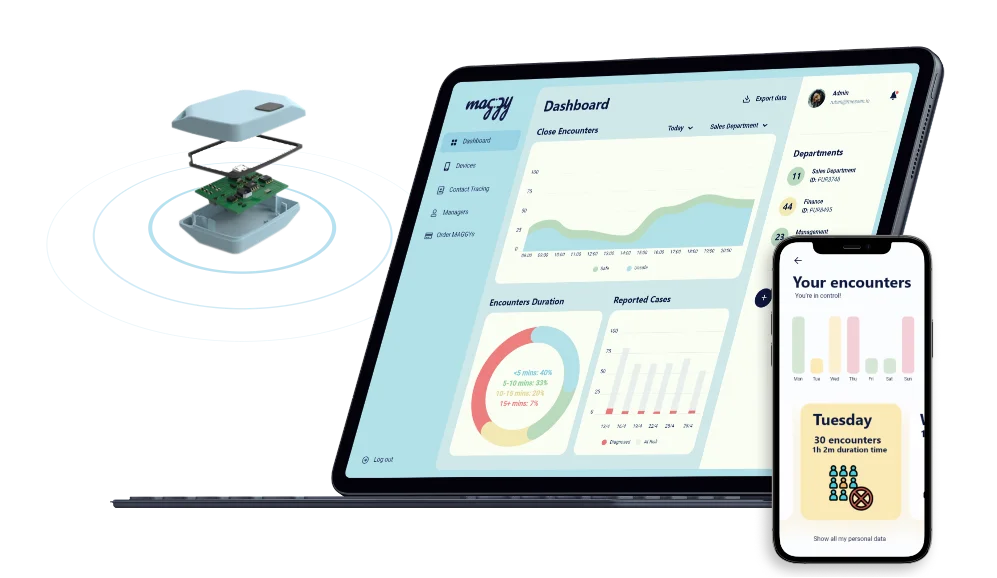
- Product
- Bluetooth proximity wearable with iOS, Android and web applications
- Buyer
- Start-ups that need a working connected-device MVP, from rough hardware architecture to firmware and apps, on a short schedule
- Engagement
- MVP development from scratch: firmware, mobile and web apps (pandemic-era project)
- Indeema scope
- R&D and specification, Wearable firmware, iOS and Android apps, Web application and dashboard, Integration API
The product need
What had to become possible
Turn the concept into a working system: firmware that detects nearby devices and triggers a signal, apps that let users customize their device and see their proximity history, a dashboard of close-contact events, and an API for integration with similar devices.
Ownership, made clear
Where the work started and what Indeema owned
Starting system
Rough hardware architecture
The customer had only an initial hardware architecture for the wearable; there was no firmware or software.
Start-up concept
The proximity-alert product idea and its requirements came from the customer.
Indeema owned
R&D and specification
Clarify the product details and risks through R&D and a written specification before development.
Wearable firmware
Program the firmware that detects other devices nearby and triggers a signal, with adjustable sensitivity.
iOS and Android apps
Build mobile apps that pair with the wearable and let users customize it.
Web application and dashboard
Build the web app and the dashboard of close-contact events, with a back end and data store.
Integration API
Provide an API for integration with other similar devices.
Worked with
Bluetooth LE
The wearable uses Bluetooth to detect other wearables, phones and smartwatches nearby and to pair with the mobile apps.
Device API
An API allows integration with other similar devices.
Product constraints
What made the engineering difficult
- 01
Reliable proximity triggering
Firmware had to trigger a signal when two or more devices come close to each other, from Bluetooth detection on a small wearable.
- 02
Adjustable sensitivity
The detection sensitivity of the device had to be changeable, because the right threshold depends on the setting.
- 03
Secure data transmission
Proximity data travelling from the device through the apps to the back end had to be transmitted securely.
- 04
From rough architecture to MVP fast
Firmware, mobile apps and web had to be built from scratch, starting from only an outline of the hardware, on a short schedule.
Engineering judgement
Decisions that shaped the product
Specify before building
R&D and a specification were used to resolve product details and remove risks early, so the short MVP schedule went into building.
Bluetooth for detection and pairing
Bluetooth serves both device-to-device proximity detection and the connection to the user's phone.
Make sensitivity a setting
Sensitivity is programmable rather than fixed in firmware, so it can be tuned for different environments.
Expose an API early
An integration API was part of the MVP scope, allowing the device to work alongside other similar devices.
Product system
How the product moves from signal to user
- 01
Maggy wearable
Detects nearby wearables, phones and smartwatches over Bluetooth and signals when someone is too close.
- 02
Mobile apps
iOS and Android apps pair with the wearable, adjust its settings and show notifications.
- 03
Back end
Node.js and MongoDB store proximity events and serve the apps and integration API.
- 04
Dashboard and web app
Shows recorded close-contact events ('social crossings') to users.
Delivered product capability
What the product can do
- 01
Proximity signal
The wearable signals when another device comes too close.
- 02
Device customization
Users customize their Maggy from the iOS and Android apps.
- 03
Close-contact dashboard
A dashboard records and shows proximity events ('social crossings').
- 04
Real-time notification
Users are notified when they are too close to another person.
- 05
Web application
A web app alongside the mobile apps, built on Node.js, Angular and MongoDB.
- 06
Integration API
An API for integration with other similar devices.
Product change
What changed for the product team
The Maggy start-up moved from a rough hardware architecture to a working MVP: a wearable with proximity firmware, iOS and Android apps, a web app and a dashboard of close-contact events.
For a start-up that needs a connected-device MVP on a short schedule, the case shows how specification, firmware, mobile apps and a web dashboard can be delivered from scratch as one system. This was a dated MVP built for a specific pandemic need.
- Delivered a working MVP: wearable proximity firmware, iOS and Android apps, a web app and a close-contact dashboard.
Technology, in context
Bluetooth LE · Swift · Java · Node.js · Angular 9 · MongoDB · Firebase Analytics
A comparable product problem?
Maggy proximity wearable MVP
Bring the product context, the system that already exists and the engineering decision you need to make.